Quick Answer
To calculate your target heart rate by age, first estimate your maximum heart rate by subtracting your age from 220. Then multiply that number by your workout intensity.
For example, if you are 30 years old, your estimated maximum heart rate is 190 beats per minute. A moderate workout zone would be about 95 to 133 bpm, while a vigorous workout zone would be about 133 to 162 bpm.
These numbers are helpful, but they are still estimates. Your real exercise heart rate can change based on fitness level, sleep, stress, medications, caffeine, temperature, hydration, and health conditions.
Quick Navigation
- What target heart rate means
- How to calculate your target heart rate
- What target heart rate looks like during a real workout
- Target heart rate chart by age
- What your heart rate zone means in real life
- Why your heart rate can feel different from day to day
- How to use your heart rate during workouts
- The fat-burning zone misunderstanding
- Resting heart rate vs target heart rate
- When to be careful with heart rate zones
- Fitness watches and heart rate trackers
- Common mistakes
- FAQs
- Related tools
- Related guides
- References
What Is Target Heart Rate?
Target heart rate is the heart rate range you aim for during exercise. It is usually shown in beats per minute, or bpm.
The easiest way to think about it is this: your target heart rate helps you understand how hard your body is working. It is not meant to make exercise more complicated. It is meant to give you a simple check-in point, especially when your workout feels harder or easier than expected.
For example, a 30-minute walk may feel gentle on one day and surprisingly tiring on another. Your sleep, stress, hydration, caffeine, temperature, and fitness level can all affect how your heart responds. That is why heart rate can be helpful when you want a little more context than “I feel tired today.”
Target heart rate is especially useful if you are doing cardio, walking, cycling, running, HIIT, or any workout where intensity changes. If your goal is weight loss, you may also want to understand how heart rate connects with calorie burn. This guide on how workout calories are estimated explains why workout intensity matters, but also why heart rate is only one part of the picture.
Simple idea: target heart rate is a guide, not a rule. It can help you train with more awareness, but it should still be balanced with how your body actually feels.
How to Calculate Your Target Heart Rate by Age
The most common beginner-friendly method starts with your estimated maximum heart rate. It is not perfect, but it gives most people a useful starting point.
Estimate your maximum heart rate
Start with 220 and subtract your age. This gives you an estimated maximum heart rate.
Choose your workout intensity
Use 50% to 70% for moderate exercise or 70% to 85% for vigorous exercise.
Multiply your numbers
Multiply your maximum heart rate by your chosen intensity range to get your target zone.
Example for a 40-year-old
A 40-year-old would estimate maximum heart rate like this:
220 − 40 = 180 bpm
For moderate exercise, multiply 180 by 50% and 70%:
180 × 0.50 = 90 bpm
180 × 0.70 = 126 bpm
So, the estimated moderate target heart rate for a 40-year-old is about 90 to 126 bpm.
For vigorous exercise, multiply 180 by 70% and 85%:
180 × 0.70 = 126 bpm
180 × 0.85 = 153 bpm
So, the estimated vigorous target heart rate is about 126 to 153 bpm.
If you do not want to calculate this manually every time, you can use the heart rate and target heart rate calculator instead.
What Target Heart Rate Looks Like During a Real Workout
Heart rate zones make more sense when you picture them during a normal workout instead of just looking at numbers.
Imagine a 35-year-old doing a simple cardio session:
| Workout Stage | How It Feels | Estimated Heart Rate |
|---|---|---|
| Warm-up walk | Easy breathing, relaxed pace | 90–105 bpm |
| Brisk walking | Breathing faster, still comfortable | 110–130 bpm |
| Light jogging | Talking becomes harder | 135–150 bpm |
| Short sprint interval | Heavy breathing, difficult to talk | 155–170 bpm |
This is why heart rate tracking can be useful. It gives context to how exercise actually feels instead of relying only on speed, distance, or calories burned.
Target Heart Rate Chart by Age
This chart gives simple estimated ranges. Use it as a guide, not a strict rule.
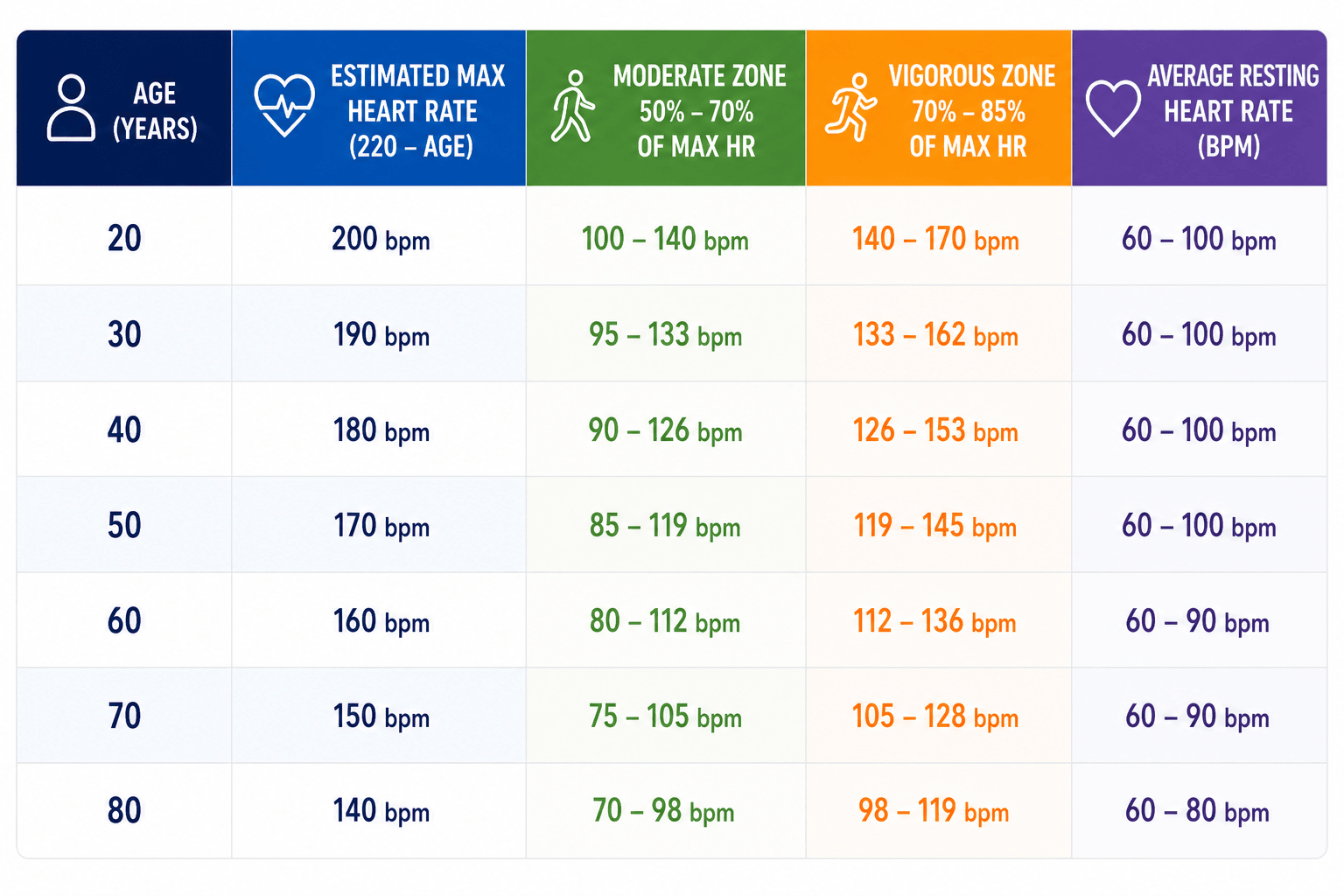
Estimated target heart rate ranges by age for moderate and vigorous exercise.
If your age is between two rows, you can calculate your own number using the formula above or use a target heart rate calculator.
What Your Heart Rate Zone Means in Real Life
Heart rate zones are easier to understand when you connect them to how exercise actually feels.
| Zone | How It Usually Feels | Common Examples |
|---|---|---|
| Below moderate | Very easy, comfortable, relaxed breathing | Slow walking, warm-up, recovery movement |
| Moderate zone | Breathing faster, but you can still speak in short sentences | Brisk walking, steady cycling, light jogging |
| Vigorous zone | Harder breathing, talking becomes difficult | Running, intense cycling, HIIT intervals |
If your goal is fat loss, it can be tempting to chase the highest heart rate possible. But higher is not always better. A sustainable cardio routine usually matters more than forcing every workout to feel intense. These guides on cardio for weight loss and aerobic exercise for weight loss explain how consistency, intensity, and total movement work together.
Why Your Heart Rate Can Feel Different From Day to Day
One of the most confusing things about exercise is that the exact same workout can feel completely different depending on the day.
Some days, a short walk or light jog feels easy and comfortable. Other days, the same pace suddenly feels exhausting, even when nothing about the workout changed.
This is one reason why target heart rate zones should be treated as guides rather than perfect rules.
Your heart rate can change because of:
Poor Sleep
Your body may work harder during exercise when you are under-rested, even during workouts that normally feel easy.
Stress or Anxiety
Emotional stress can increase heart rate before a workout even starts, especially during intense exercise.
Heat and Humidity
Hot weather can make your body work harder to cool itself, which often raises heart rate faster than expected.
Caffeine or Dehydration
Coffee, energy drinks, and dehydration can all affect how your heart responds during physical activity.
This is why experienced exercisers often combine heart rate tracking with body awareness. Instead of asking only “What does my watch say?”, they also ask:
- Can I still speak comfortably?
- Does this intensity feel sustainable?
- Am I breathing normally?
- Does my body feel strong or unusually fatigued?
Heart rate data is useful, but how your body actually feels still matters.
How to Use Your Target Heart Rate During Workouts
The goal is not to stare at your watch every few seconds. For most people, heart rate works best as a check-in tool.
For walking
A brisk walk may bring you into the moderate zone, especially if you are walking uphill, walking faster, or just starting your fitness routine.
For steady cardio
Try staying in a range where your breathing is clearly elevated, but you still feel in control.
For HIIT
Your heart rate may climb during work intervals and drop during rest. A HIIT interval training calculator can help you structure the timing.
For beginners
Start lower and build slowly. You do not need to push into high intensity every workout to improve your fitness.
If you are tracking calories burned, heart rate can be useful, but it should not be the only number you trust. Your body size, workout type, duration, and fitness level also matter. A workout calorie burn calculator can give you a broader estimate, especially when paired with your workout duration and activity type.
Hydration also matters more than many people realize. A workout that feels unusually hard may not always mean you are out of shape. Sometimes you are dehydrated, overheated, or under-recovered. If hydration is something you forget often, the water intake calculator can help you estimate a daily target.
The “Fat-Burning Zone” Is Often Misunderstood
Many people believe that exercising at the highest possible intensity automatically leads to the best fat loss results.
Others hear about the “fat-burning zone” and assume there is one perfect heart rate range that burns fat better than everything else.
Real fitness is usually more complicated than that.
Lower and moderate intensity workouts can use a higher percentage of fat for fuel during exercise, but harder workouts may burn more total calories overall because they require more energy.
This is why sustainable routines usually matter more than chasing the highest heart rate possible every session.
Important: the best workout is usually the one you can recover from, repeat consistently, and realistically maintain long term.
For many people, a combination of walking, moderate cardio, strength training, recovery, hydration, sleep, and nutrition works better than trying to stay in an aggressive heart rate zone every workout.
If your main goal is fat loss, these guides on cardio for weight loss and daily calorie intake for weight loss explain why consistency and sustainability matter more than extreme intensity.
Resting Heart Rate vs Target Heart Rate
Resting heart rate and target heart rate are not the same thing.
Resting heart rate
This is your heart rate when your body is at rest. Many people check it in the morning before getting out of bed.
Target heart rate
This is the heart rate range you aim for during exercise based on your estimated maximum heart rate and workout intensity.
Maximum heart rate
This is an estimate of the highest number of beats per minute your heart may reach during intense activity.
If you are building a health or fitness routine, it can be helpful to understand all three. Resting heart rate gives you a picture of your baseline. Target heart rate helps guide workouts. Maximum heart rate helps estimate your training zones.
When to Be Careful With Heart Rate Zones
Heart rate zones are helpful, but they are not perfect for every person or every situation.
You should be more careful if you have a heart condition, take medication that affects heart rate, have blood pressure concerns, are pregnant, are recovering from illness, or are returning to exercise after a long break.
Your heart rate feels unusually high
If your heart rate climbs much faster than usual during an easy workout, it may be a sign that your body is stressed, dehydrated, overheated, or not fully recovered.
You feel symptoms, not just effort
Chest pain, dizziness, faintness, unusual shortness of breath, or pressure in the chest should not be ignored. Stop exercising and seek medical guidance.
Your tracker does not match how you feel
Fitness trackers can be helpful, but they are not always perfect. If your watch says one thing and your body clearly says another, listen to your body first.
If you are also monitoring blood pressure or other health markers, tools like the blood pressure calculator and cholesterol and lipid profile calculator can support general tracking, but they should not replace professional medical advice.
Fitness Watches and Heart Rate Trackers Are Helpful, But Not Perfect
Smartwatches, fitness bands, and heart rate monitors can be extremely useful for spotting trends and understanding workout intensity.
But it is also important to remember that wearable devices are estimates, not medical equipment.
Heart rate readings may become less accurate during:
- Fast arm movement
- HIIT or interval training
- Sweaty workouts
- Poor watch placement
- Cold temperatures
This is another reason why combining heart rate tracking with body awareness usually works better than relying on numbers alone.
Common Mistakes When Using Target Heart Rate
Treating the formula like a perfect number
The 220 minus age formula is only an estimate. Two people the same age can have different fitness levels and different real heart rate responses.
Ignoring how your body feels
Heart rate is helpful, but it should not replace common sense. Dizziness, chest pain, faintness, or unusual shortness of breath should not be ignored.
Thinking every workout has to be intense
Not every workout needs to be in the vigorous zone. Moderate exercise, walking, and consistency can still support better fitness over time.
Forgetting that devices can be imperfect
Smartwatches and fitness trackers can be useful, but they may not always be perfectly accurate, especially during fast movement or interval training.
Important Health Note
This guide is for general education only and should not replace medical advice. If you have a heart condition, take heart or blood pressure medication, are pregnant, feel chest pain during exercise, or are returning to activity after illness or injury, ask a qualified healthcare professional before using heart rate zones for training.
Frequently Asked Questions
How do you calculate target heart rate by age?
Subtract your age from 220 to estimate your maximum heart rate. Then multiply that number by your desired intensity range, such as 50% to 70% for moderate activity or 70% to 85% for vigorous activity.
What is a good target heart rate while exercising?
A good target heart rate depends on your age, fitness level, health status, and workout intensity. A general moderate workout zone is often around 50% to 70% of estimated maximum heart rate.
Is a higher heart rate always better for fat loss?
Not always. A harder workout can burn more calories in less time, but consistency, total movement, recovery, nutrition, and your overall routine matter more than chasing the highest heart rate every workout.
Why is my heart rate higher than expected during exercise?
Your heart rate can rise because of heat, dehydration, caffeine, poor sleep, stress, illness, medications, or low fitness level. If it feels unusual or comes with symptoms, it is best to stop and seek medical guidance.
Helpful Tools for Heart Rate Tracking and Cardio Training
Disclosure: This section may contain affiliate links. If you buy through these links, LifeToolSuit may earn a small commission at no extra cost to you. These tools are optional and are meant to help you monitor workouts, heart rate, recovery, and overall fitness more easily.
Fitness Tracker Watch
Tracks heart rate, steps, workouts, calories burned, sleep, and activity levels throughout the day.
View on AmazonChest Strap Heart Rate Monitor
Often more accurate during intense workouts, running, cycling, and interval training sessions.
View on AmazonComfortable Running Shoes
Supportive shoes can make walking, jogging, cardio, and heart rate training more comfortable and sustainable.
View on AmazonInsulated Water Bottle
Staying hydrated can help support workout performance and prevent unusually elevated heart rates during exercise.
View on AmazonReferences
- American Heart Association: Target Heart Rates
- American Heart Association: Physical Activity Recommendations
- CDC: Measuring Physical Activity Intensity