This is one of the most useful things to understand when it comes to calories. Even when you are not moving much, your body is still using energy in the background.
Your body does not only burn calories during workouts. In fact, a large part of your daily calorie use comes from simply keeping you alive. That background energy use is why understanding resting calorie burn can make weight loss, maintenance, and nutrition planning much easier to understand.
Quick Navigation
- What calories burned at rest actually means
- What resting calorie burn looks like in real life
- How it relates to BMR and metabolism
- What your body is doing while you rest
- What affects resting calorie burn
- Why two people can burn very different calories
- Resting calories vs activity calories
- How to estimate calories burned at rest
- How resting calories affect maintenance calories
- Warning signs and common misconceptions
- Can you increase calories burned at rest?
- Common mistakes people make
- Practical takeaways
- Editorial and research policy
- References and sources
- FAQ
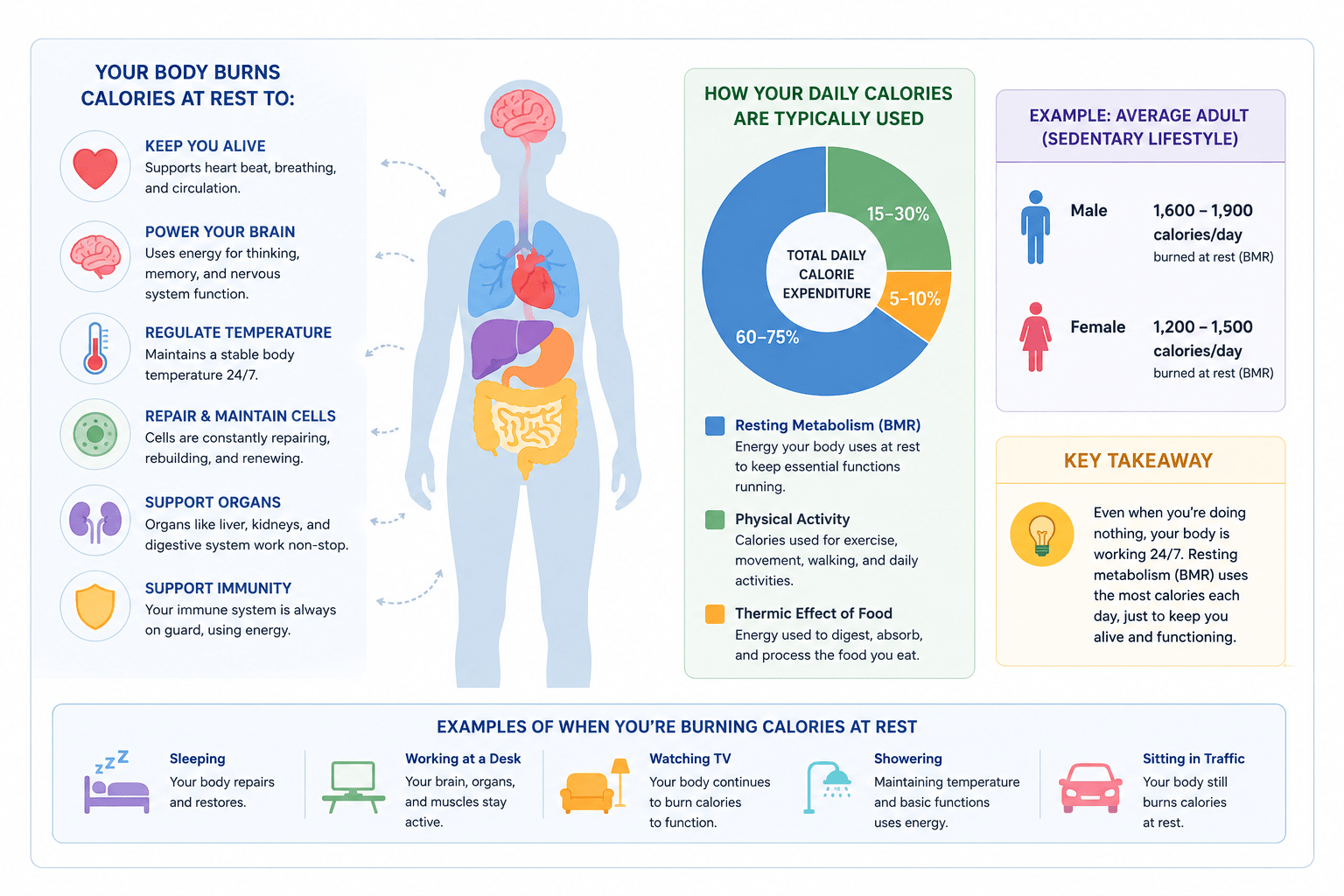
Your body burns calories even when you are resting because essential systems like the brain, heart, lungs, organs, and cells are still working in the background.
What Does Calories Burned at Rest Mean?
Calories burned at rest refers to the energy your body uses when you are not intentionally exercising or moving around. It is the energy needed for essential functions that continue all day and night.
Even if you sat quietly or slept, your body would still need calories. Your heart still beats. Your lungs still move air. Your brain still works. Your body still repairs cells, regulates temperature, and keeps organs functioning.
Breathing
Your body uses energy to keep your respiratory system working, even when you are asleep.
Circulation
Your heart and blood vessels need energy to move blood, oxygen, and nutrients through your body.
Brain Activity
Your brain uses energy for thinking, regulation, memory, and basic nervous system function.
Organ Function
Your liver, kidneys, digestive system, and other organs continue working in the background.
This is why the idea of “doing nothing” can be misleading. You may not be exercising, but your body is never truly doing nothing.
What Resting Calorie Burn Looks Like in Real Life
One reason metabolism feels confusing is because people usually imagine calorie burn only happening during exercise. But in reality, most people spend far more time burning calories quietly in the background than they do in workouts.
For example, someone may go to the gym for 45 minutes and burn a few hundred calories during that session. Meanwhile, their body may already be burning well over 1,500 calories across the entire day just staying alive and functioning normally.
During Sleep
Your body still burns calories while sleeping because your heart, lungs, brain, and organs continue working all night.
During Desk Work
Even while sitting at a desk, your body continues regulating temperature, circulation, posture, digestion, and brain activity.
During Recovery
After workouts, illness, stress, or poor sleep, your body may use additional energy for recovery and repair processes.
A Common Misunderstanding
Many people dramatically overestimate workout calorie burn while underestimating how important baseline metabolism is. Your resting metabolism usually accounts for the largest portion of your daily calorie use.
This is also why two people can follow the exact same workout routine and still have very different calorie needs. Exercise matters, but resting metabolism still forms the foundation underneath everything else.
How Calories Burned at Rest Relate to BMR
Calories burned at rest are closely connected to BMR, which stands for basal metabolic rate. BMR estimates the calories your body needs at complete rest for essential life functions.
In everyday language, people often use resting calorie burn, resting metabolism, and BMR in similar ways. Technically, BMR is usually measured under very controlled conditions, while resting metabolic rate may be measured under slightly less strict conditions. For most everyday calorie planning, both are used to understand your baseline energy needs.
BMR
An estimate of the calories your body burns at rest for basic survival functions.
Resting Metabolism
A practical way to describe how much energy your body uses while not actively moving.
TDEE
Your full daily calorie burn, including resting calories, movement, exercise, and digestion.
Simple Way to Think About It
Resting calories are your baseline. TDEE is your full day. If you want to plan calories, you usually start with resting metabolism and then add activity.
If you want a deeper explanation, read What Is BMR and How Does It Work? or BMR vs TDEE.
What Your Body Is Doing While You Rest
Rest may look quiet from the outside, but your body is still busy. A lot of your energy use happens automatically, without you needing to think about it.
Keeping Your Heart Beating
Your cardiovascular system uses energy every minute to circulate blood and oxygen.
Supporting Breathing
Your body uses energy to move air in and out and support oxygen exchange.
Running the Brain and Nervous System
Your brain continues to use energy for regulation, focus, memory, and basic function.
Regulating Body Temperature
Your body works to keep internal temperature within a safe range.
Repairing and Maintaining Cells
Cell repair, immune function, and tissue maintenance all require energy.
Processing Nutrients
Your body uses energy to digest, absorb, transport, and store nutrients from food.
What Affects Calories Burned at Rest?
Resting calorie burn is different for every person. It depends on your body size, body composition, age, sex, and other factors that influence metabolism.
Body Size
Larger bodies usually need more calories at rest because there is more tissue to support.
Muscle Mass
More lean mass can raise resting calorie needs because muscle uses energy even when you are not exercising.
Age
Resting metabolism can change with age, often because of changes in muscle, activity, and body composition.
Sex
Men and women may have different average resting calorie needs because of body size and lean mass differences.
Hormones and Health
Hormones, medical conditions, medications, and overall health can affect energy use.
Genetics
Natural differences in metabolism can influence resting calorie burn from person to person.
This is why two people with the same weight may not burn the exact same number of calories at rest. Body composition and lifestyle still matter.
Why Two People Can Burn Very Different Calories at Rest
One of the most frustrating parts of calorie planning is realizing that calorie burn is not perfectly equal between people. Two people can weigh the same, eat similar foods, and exercise the same number of days per week, but still have different maintenance calorie needs.
Simple Example
A taller person with more muscle and an active job may burn noticeably more calories at rest and throughout the day than someone at the same weight who has less muscle and sits most of the day.
| Factor | How It Can Affect Resting Calories |
|---|---|
| Muscle Mass | More lean mass usually means the body needs more energy, even at rest. |
| Height and Body Size | Larger or taller bodies often require more calories to support basic functions. |
| Body Composition | Two people can weigh the same but have different amounts of muscle, fat, and lean tissue. |
| Daily Movement | Some people naturally move more throughout the day without counting it as exercise. |
| Dieting History | Repeated crash dieting may affect energy levels, hunger, and activity habits over time. |
| Sleep and Stress | Poor recovery can affect appetite, motivation, energy, and consistency. |
This is why online calorie calculators should be treated as starting points, not exact truths. The most useful calorie target is usually adjusted over time based on real-world results, energy levels, hunger, recovery, and weight trends.
Resting Calories vs Activity Calories
Calories burned at rest are only one part of your total daily calorie burn. Your full daily burn also includes movement, exercise, digestion, and daily activities.
Resting Calories
The energy your body uses for essential functions while you are not actively moving.
Activity Calories
The energy used for walking, workouts, chores, sports, errands, and daily movement.
Total Daily Burn
Your resting calories plus activity, movement, exercise, and digestion.
This full daily number is often called TDEE, or total daily energy expenditure. For weight planning, TDEE is usually more useful than resting calories alone.
How to Estimate Calories Burned at Rest
The easiest way to estimate calories burned at rest is to use a BMR calculator. If your goal is weight loss or maintenance planning, you can also combine it with a daily calorie needs calculator to estimate maintenance calories more realistically. Most BMR formulas use age, height, weight, and sex to estimate your resting energy needs.
Estimate BMR
Use a calculator to estimate how many calories your body burns at rest.
Add Activity
Use activity level to estimate total daily calorie needs, also called TDEE.
Adjust for Goals
Eat below, near, or above total daily needs depending on weight loss, maintenance, or muscle gain.
You can start with a BMR Calculator, then use a Calorie Needs Calculator to estimate total daily needs.
How Resting Calories Affect Maintenance Calories
Resting calorie burn becomes much more useful when you connect it to maintenance calories.
Maintenance calories are the approximate number of calories needed to maintain your current weight without gaining or losing.
Your resting metabolism forms the baseline for that calculation. Then activity, exercise, movement, digestion, and lifestyle habits get added on top.
Start With Resting Burn
Estimate your BMR or resting calorie burn first.
Add Real Activity
Include walking, work activity, workouts, chores, and lifestyle movement.
Track Real Results
Adjust based on actual weight trends, hunger, energy, and recovery.
Practical Insight
Many people focus entirely on workouts when trying to lose weight, but maintenance calories are usually influenced more by overall consistency, eating habits, movement patterns, and long-term behavior than by occasional intense exercise sessions.
If your goal is weight management, it usually makes more sense to understand your full maintenance calorie range rather than obsessing over small fluctuations in individual workouts.
Why Resting Calories Matter for Weight Goals
Resting calorie burn matters because it forms the foundation of your daily calorie needs. Before workouts, steps, and exercise are counted, your body already uses energy just to function.
For Weight Loss
Knowing your resting needs helps you avoid choosing a calorie target that is too aggressive.
For Maintenance
Resting calories help estimate the baseline behind your maintenance calorie range.
For Muscle Gain
Understanding baseline energy needs helps you eat enough to support training and recovery.
For Better Planning
It explains why calorie needs differ from person to person, even at the same body weight.
For goal-specific planning, read Daily Calorie Intake for Weight Loss or Calories to Maintain Weight.
Warning Signs and Misleading Metabolism Claims
Metabolism is one of the most misunderstood topics in the fitness and weight loss industry. Because people naturally want faster results, metabolism myths often spread quickly online.
"Boost Your Metabolism Instantly"
Most dramatic metabolism claims are exaggerated. Real metabolic changes are usually gradual.
Extreme Low-Calorie Diets
Aggressive calorie restriction may make dieting harder to sustain long term and can increase fatigue and hunger.
Smartwatch Calorie Numbers
Fitness trackers can be useful estimates, but they are not perfectly accurate for calorie burn.
Comparing Yourself to Others
Different people naturally have different calorie needs, hunger patterns, recovery rates, and activity habits.
In most cases, consistency matters more than trying to “hack” metabolism. Long-term habits usually outperform quick fixes.
Can You Increase Calories Burned at Rest?
You can support resting metabolism, but it is important to keep expectations realistic. There is no quick trick that dramatically changes resting calorie burn overnight.
Build Muscle
Strength training can help support lean mass, which may raise resting energy needs over time.
Stay Active
Activity raises total daily burn and can support healthier body composition.
Eat Enough Protein
Protein supports muscle maintenance, fullness, and overall nutrition quality.
The bigger opportunity for most people is not only raising resting burn. It is combining healthy muscle, consistent movement, and realistic calorie intake.
Helpful Tools for Tracking Calories, Metabolism, and Daily Activity
While calorie calculators are useful starting points, many people find it easier to stay consistent when they can actually track movement, body trends, sleep, hydration, and daily habits more clearly.
Disclosure: This section may contain affiliate links. If you buy through these links, LifeToolSuit may earn a small commission at no extra cost to you. These tools are optional and are meant to support healthier habits and calorie tracking awareness.
Fitness Tracker Watch
Helpful for tracking steps, workouts, heart rate, sleep, and estimated calorie burn throughout the day.
View on AmazonSmart Body Weight Scale
Tracks weight trends and body composition metrics that can help you better understand long-term progress.
View on AmazonLarge Water Bottle
Staying hydrated can support energy, workouts, recovery, and healthier daily habits overall.
View on AmazonAdjustable Dumbbells
Strength training can help support lean muscle mass, which plays a role in resting calorie needs.
View on AmazonCommon Misunderstandings About Resting Calories
Resting metabolism is helpful, but it is easy to misunderstand. These are common mistakes people make when they first learn about calories burned at rest.
Thinking Rest Means Zero Calories
Your body still uses energy for breathing, circulation, brain function, and organ function.
Using BMR as Your Full Daily Need
BMR does not include walking, workouts, work, chores, or daily movement.
Expecting Exact Numbers
BMR calculators estimate. Real calorie needs may be higher or lower.
Ignoring Activity Level
Your total daily burn depends on what you do beyond resting metabolism.
Best Way to Use Resting Calories
Use resting calorie burn as your baseline, then add activity to understand your total daily needs. For calorie planning, total daily energy use is usually more helpful than resting calories alone.
Practical Takeaways
- Your body burns calories 24/7, even while sleeping, resting, or sitting quietly.
- Resting metabolism usually accounts for the largest portion of total daily calorie burn.
- Online calculators are estimates, not exact measurements.
- Maintenance calories are more useful for real-world planning than focusing only on workouts.
- Muscle mass, body composition, activity level, recovery, and lifestyle habits all influence calorie needs.
- Sustainable nutrition habits usually matter more than trying to dramatically “boost metabolism.”
- The best calorie target is one that works consistently in real life while still supporting energy, recovery, and long-term health.
Editorial and Research Policy
This guide was created to make metabolism and calorie concepts easier to understand for everyday readers without using overly technical language or unrealistic fitness claims.
LifeToolSuit health guides are written with a practical, educational approach focused on clarity, usability, and long-term lifestyle understanding. Topics are reviewed against established nutrition and metabolism concepts commonly used in evidence-based fitness and health education.
Because calorie needs vary significantly between individuals, readers should use calculators and estimates as starting points rather than exact prescriptions.
References and Sources
- Harvard T.H. Chan School of Public Health — Energy Balance and Weight Management
- Cleveland Clinic — Basal Metabolic Rate (BMR)
- Mayo Clinic — Weight Loss and Calorie Basics
- National Institutes of Health (NIH) — Metabolism and Energy Expenditure Research
- Academy of Nutrition and Dietetics — Adult Nutrition and Calorie Guidance
Frequently Asked Questions
What are calories burned at rest?
Calories burned at rest are the calories your body uses for basic functions when you are not actively moving. This includes breathing, circulation, brain activity, organ function, temperature regulation, and cell repair.
Is calories burned at rest the same as BMR?
They are closely related. BMR estimates the calories your body burns at complete rest for essential life functions. In everyday language, people often use resting calorie burn and BMR in similar ways.
Do you burn calories while sleeping?
Yes. Your body burns calories while sleeping because it still needs energy for breathing, circulation, temperature control, brain activity, and recovery.
What affects resting calorie burn?
Resting calorie burn is affected by body size, muscle mass, age, sex, body composition, hormones, genetics, health, and overall metabolism.
How can I estimate calories burned at rest?
You can estimate resting calorie burn with a BMR calculator. Most calculators use age, height, weight, and sex to estimate your baseline energy needs.
Can I increase how many calories I burn at rest?
Building and maintaining muscle, staying active, eating enough protein, and supporting overall health may help support resting metabolism. Changes are usually gradual rather than dramatic.
Is resting calorie burn enough for calorie planning?
Resting calorie burn is a useful baseline, but total daily calorie needs also include activity, movement, exercise, and digestion. For calorie planning, TDEE is usually more useful.
Related Tools
Use these calculators to estimate resting calories, maintenance calories, calorie intake, and overall daily energy needs more accurately.
Related Guides
Continue learning about metabolism, calorie planning, maintenance calories, and realistic weight management strategies.
Important Note
This guide is for educational purposes only and is not medical advice. Resting metabolism, BMR, and calorie needs can vary based on body composition, health conditions, medications, hormones, pregnancy, breastfeeding, eating disorder recovery, intense training, and other personal factors. For personal medical or nutrition concerns, a qualified professional can provide guidance that fits your situation.