Workout calorie numbers are estimates, not exact measurements. They are based on how much energy your body likely uses during a specific activity, but the exact amount can vary from person to person.
A workout calorie calculator can still be helpful for comparing activities, planning routines, and understanding how movement fits into your daily energy use. The key is to treat the number as a guide rather than something perfectly exact.
Quick Navigation
- How workout calorie estimates work
- What METs mean in calorie burn
- The basic calorie burn formula
- What affects calories burned during exercise
- Why activities burn different calories
- Calories burned examples
- Steps, walking, and calorie burn
- Calories burned and weight loss
- How accurate workout calorie estimates are
- How to use calorie burn results
- Common calorie burn questions
- Simple takeaway
- FAQ
- Related tools
- Related guides
How Workout Calorie Estimates Work
Workout calories are estimated by looking at how much energy your body may use during a specific activity. The most common inputs are your body weight, the type of exercise, the intensity of that exercise, and how long you do it.
Body Weight
Moving a heavier body generally requires more energy for the same activity and duration.
Workout Duration
A longer workout usually burns more total calories than a shorter workout at the same intensity.
Activity Intensity
Higher intensity movement increases energy demand and calories burned per minute.
Activity Type
Running, walking, cycling, swimming, lifting, and HIIT all have different energy demands.
This is why two people can do the same workout and see different calorie burn estimates. The workout may be the same, but the energy cost can be different.
What Are METs in Workout Calorie Estimates?
MET stands for Metabolic Equivalent of Task. It is a value used to estimate how intense an activity is compared with resting. A higher MET value means the activity generally requires more energy.
Low MET Activities
Gentle walking, light stretching, and very easy movement usually have lower calorie burn per minute.
Moderate MET Activities
Brisk walking, steady cycling, and moderate exercise usually raise calorie burn more noticeably.
High MET Activities
Running, vigorous cycling, intense sports, and hard intervals usually burn more calories per minute.
Simple Way to Think About METs
METs help calculators turn an activity like walking, running, cycling, or swimming into an intensity value that can be used to estimate calories burned.
The Basic Workout Calorie Burn Formula
Many exercise calorie calculators use a version of this idea: calories burned are based on MET value, body weight, and workout time. The formula may vary slightly by calculator, but the logic is usually similar.
Choose the Activity
The calculator identifies an estimated MET value for the exercise you performed.
Add Body Weight
Your weight helps estimate how much energy your body uses to perform the movement.
Multiply by Time
The longer the workout lasts, the higher the estimated total calorie burn becomes.
To make this more useful, you can try a Workout Calorie Burn Calculator to estimate your activity, then compare it with your daily needs.
It also helps to understand how your body uses energy overall. You can explore how many calories you should eat per day, learn how your metabolism works in what BMR is and how it works, and see how your body burns energy at rest in calories burned at rest.
What Affects Calories Burned During Exercise?
Workout calorie burn can change based on more than just the name of the activity. A 30-minute walk, run, or cycling session can burn different amounts depending on effort and body factors.
Body Weight
Higher body weight usually increases the estimated calories burned for weight-bearing activities.
Workout Intensity
Faster pace, heavier effort, steeper incline, or higher resistance can increase calorie burn.
Duration
Total calories usually increase as workout time increases, even if the pace stays the same.
Body Composition
Muscle mass, fitness level, and movement efficiency can affect real-world calorie burn.
Terrain and Conditions
Hills, wind, heat, uneven ground, or added load can change the energy cost of an activity.
Movement Quality
Form, stride, technique, and efficiency can make two people burn different calories doing the same workout.
Why Different Workouts Burn Different Calories
Not all workouts use energy the same way. Some activities involve more muscle groups, more speed, more resistance, or more impact. That is why calorie burn can vary widely between walking, running, cycling, swimming, strength training, and HIIT.
Cardio Workouts
Running, cycling, rowing, and swimming often have higher continuous energy demand.
Strength Training
Lifting may burn fewer calories during the session than cardio, but it supports muscle and long-term body composition.
HIIT and Intervals
Short bursts of high effort can raise calorie burn quickly, but results depend on true intensity and recovery time.
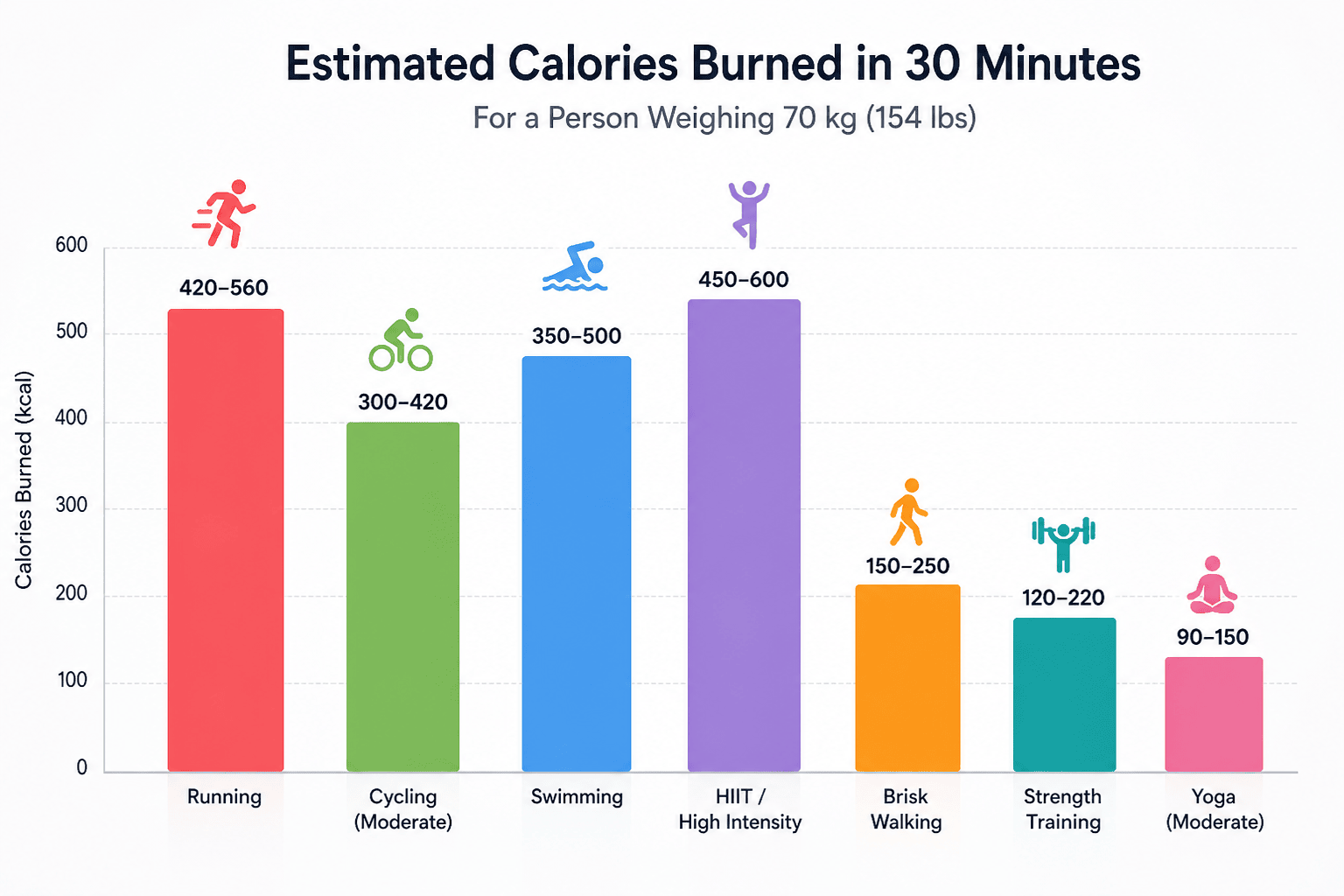
How Many Calories Do Common Workouts Burn?
The number of calories burned during a workout depends on body weight, exercise intensity, and time. Still, rough examples can help you understand what a calorie burn estimate means in real life.
30 Minutes of Exercise
A moderate 30-minute workout may burn about 150 to 300 calories. Harder cardio, running, or intervals can burn more.
Walking
A 30-minute walk may burn around 100 to 200 calories, depending on pace, body size, incline, and distance.
Running
A 30-minute run may burn around 250 to 500+ calories, especially at a faster pace or higher body weight.
Strength Training
Lifting weights burns calories too, but the estimate depends heavily on rest time, volume, load, and workout style.
These numbers are not exact. They are best used as a planning range. For a more personal estimate, use your body weight, workout duration, and activity type in the Workout Calorie Burn Calculator.
How Steps, Walking Speed, and Pace Affect Calories Burned
Walking is one of the easiest ways to increase daily calorie burn because it is simple, low-impact, and easy to repeat. Using a fitness tracker can help you track steps and better estimate how many calories you burn each day.
How many calories do 10,000 steps burn?
For many people, 10,000 steps may burn around 300 to 500 calories. A smaller person walking slowly may burn less, while a heavier person walking faster may burn more.
How many steps is a 30-minute walk?
A 30-minute walk is often around 3,000 to 4,000 steps, depending on walking speed and stride length.
Is it better to walk fast or slow?
Walking faster usually burns more calories per minute, but slower walking for a longer time can still be useful if it helps you stay consistent.
If you want a walking-specific estimate, try the Step Counter and Walking Calories Calculator.
How Workout Calories Fit Into Weight Loss
Burning calories through exercise can support weight loss, but tracking progress over time matters more. A smart body scale can help you monitor weight and body changes more accurately.
How to Burn 500 Calories Per Day
A 500-calorie burn may come from a longer brisk walk, a run, cycling, swimming, or a mix of exercise and extra daily movement. It does not have to come from one intense workout.
What Is a Realistic Weight Loss Goal?
A realistic goal is usually gradual and sustainable. Instead of trying to burn huge amounts every day, focus on a manageable calorie deficit, enough protein, movement, and sleep.
Does Drinking Water Help Burn Fat?
Water does not directly melt body fat, but it can support hydration, workout performance, appetite control, and overall healthy habits.
Signs You May Not Be Eating Enough
Constant fatigue, dizziness, poor recovery, intense cravings, sleep problems, and low workout performance may be signs your calorie intake is too low.
To connect exercise with your daily intake, you may also want to read how many calories you should eat per day and use the Calorie Needs Calculator.
Recommended Tools to Improve Workout & Calorie Tracking
This section may contain affiliate links. If you buy through these links, LifeToolSuit may earn a small commission at no extra cost to you.
Fitness Tracker Watch
Tracks steps, heart rate, and workouts to give more accurate calorie burn estimates.
View on AmazonSmart Body Scale
Helps track weight, body fat, and trends so you can better manage calorie balance.
Check PriceAdjustable Dumbbells
Great for increasing workout intensity and boosting calorie burn at home.
See OptionsResistance Bands Set
Lightweight and effective for adding resistance and increasing calorie burn anywhere.
View DetailsHow Accurate Are Workout Calorie Estimates?
Workout calorie estimates are useful, but they are not perfect. Fitness watches, machines, apps, and online calculators all rely on assumptions. Some estimates can be close, while others may overestimate or underestimate real calorie burn.
Important Reminder
Use workout calories as a helpful estimate, not as an exact measurement. For weight goals, trends over time are more reliable than one workout number.
Accuracy can be affected by your true effort level, fitness level, heart rate response, body composition, and whether the calculator uses general MET values or more personal data.
How to Use Workout Calorie Results
Exercise calorie estimates are most useful for planning and comparison. They can help you understand which activities are more demanding and how movement fits into your overall daily energy use.
If your goal involves weight loss or maintenance, it helps to look at this together with your daily intake. You might also want to explore daily calorie intake for weight loss, calories to maintain weight, and how many calories you need per day.
- Use calorie burn numbers as estimates, not exact results.
- Compare activities to understand intensity and energy demand.
- Track workout trends over time instead of obsessing over one session.
- Be careful about eating back every estimated workout calorie.
- Pair exercise data with calorie intake, recovery, and body progress trends.
How to Burn Calories for Weight Loss (Realistically)
Many people search for the fastest way to burn calories, but sustainable fat loss comes from consistent movement, not extreme workouts.
How to Burn 500 Calories Per Day
This can be done through a mix of walking, cardio, and daily activity. For example, a brisk 60–90 minute walk or a shorter intense workout.
Is It Better to Walk Fast or Slow?
Walking faster usually burns more calories per minute, but longer duration at a comfortable pace can still be effective.
What Activities Burn the Most Calories?
Running, HIIT, cycling, and swimming tend to burn the most calories per minute due to higher intensity.
Does Drinking Water Help Burn Fat?
Water does not directly burn fat, but it supports metabolism, hydration, and workout performance.
Common Questions About Calories Burned During Exercise
What activities burn the most calories?
Running, cycling, swimming, rowing, HIIT, and intense sports usually burn the most calories per minute because they use large muscle groups and require higher effort.
Is burning 3000 calories a day active?
A total daily burn of 3000 calories can be active for many people, but it depends on body size, job activity, workouts, and metabolism. It does not mean someone burned 3000 calories from exercise alone.
Which body part loses fat first?
Fat loss order is mostly influenced by genetics, hormones, and overall body composition. You cannot choose exactly where fat comes off first.
What is the hardest place to lose fat?
Many people find belly, hip, thigh, or lower back fat slower to lose. This varies by person and usually improves with consistent nutrition, movement, and time.
What is the laziest way to burn calories?
The easiest way is usually to add more low-effort movement into your day, such as walking after meals, taking the stairs, standing more, doing light chores, or increasing daily steps.
Simple Takeaway
- Workout calories are estimated using activity type, intensity, body weight, and time.
- MET values are commonly used to estimate exercise energy demand.
- Calorie burn varies from person to person, even for the same workout.
- Fitness apps and calculators are helpful, but not perfectly accurate.
- Use workout calorie estimates as a guide for consistency and planning.
Frequently Asked Questions
How are workout calories estimated?
Workout calories are usually estimated using body weight, activity duration, and exercise intensity. Many calculators use MET values to estimate the energy cost of the activity.
What does MET mean in exercise?
MET stands for Metabolic Equivalent of Task. It compares the energy cost of an activity to resting. Higher MET values usually mean higher calorie burn.
Why do different calculators give different calorie burn results?
Different calculators may use different MET values, formulas, assumptions, or inputs. Some use only weight and time, while others include age, sex, heart rate, or pace.
Are fitness watch calorie estimates accurate?
Fitness watches can be helpful for trends, but they are still estimates. Their accuracy can vary based on sensor quality, heart rate tracking, workout type, and personal data settings.
Do heavier people burn more calories during exercise?
Often, yes. Moving a heavier body usually requires more energy, especially during weight-bearing activities like walking, running, stair climbing, or hiking.
Should I eat back calories burned during exercise?
Be careful with this because workout calorie estimates can be high or low. It may be better to use exercise calories as a general guide and monitor your progress, hunger, recovery, and overall calorie intake.
Does strength training burn calories?
Yes. Strength training burns calories during the workout and supports muscle, strength, and body composition. However, calorie burn depends on volume, rest time, exercise selection, and intensity.
How many calories does a 30-minute workout burn?
A 30-minute workout may burn around 150 to 300 calories for moderate exercise. Higher-intensity workouts such as running, cycling, or intervals may burn more.
How many calories do 10,000 steps burn?
For many people, 10,000 steps burn around 300 to 500 calories. The exact number depends on body weight, walking speed, stride length, and terrain.
How can I burn 500 calories per day?
You can burn 500 calories through longer walking, running, cycling, swimming, sports, gym workouts, or a combination of structured exercise and daily movement.
What activities burn the most calories?
Running, HIIT, cycling, swimming, rowing, and intense sports often burn the most calories per minute because they require higher effort and involve large muscle groups.
Does walking fast burn more calories?
Yes. Walking faster usually burns more calories per minute than walking slowly, although a longer slow walk can still burn a meaningful number of calories.
Does drinking water help you burn fat?
Drinking water does not directly burn fat, but it can support hydration, appetite control, workout performance, and healthier eating habits.
Important Note
This guide is for educational purposes only and is not medical advice. Workout calorie estimates are approximations and can vary based on individual factors, fitness level, health status, environment, and measurement method. For personal exercise or nutrition concerns, consider guidance from a qualified professional.