Most people come across BMR and TDEE when trying to figure out how many calories they actually need. These two numbers are closely related, but they represent different parts of your daily energy use.
BMR and TDEE are both used in calorie estimates, but they answer different questions. BMR tells you about your baseline calorie burn at rest. TDEE tells you about your total daily calorie burn once real life is included.
Quick Navigation
- What BMR means
- What TDEE means
- What BMR and TDEE look like in real life
- BMR vs TDEE key differences
- Why TDEE matters for calories
- The biggest TDEE mistake people make
- How to use BMR and TDEE by goal
- A realistic calorie deficit example
- What affects BMR and TDEE
- Signs your calorie target may be too aggressive
- How BMR becomes TDEE
- Common mistakes
- How long to track before adjusting calories
- References and sources
- FAQ
What Is BMR?
BMR stands for basal metabolic rate. It is the amount of energy your body uses at rest to keep you alive. Even if you stayed in bed all day and did nothing, your body would still need calories for basic functions.
BMR includes the energy used for breathing, circulation, brain function, body temperature, cell repair, organ function, and other automatic processes that happen without you thinking about them.
Breathing
Your body uses energy to keep your lungs and respiratory system working.
Circulation
Your heart and blood vessels use energy to move blood through your body.
Organ Function
Your brain, liver, kidneys, and other organs need energy all day.
Cell Repair
Your body uses energy for repair, maintenance, and basic internal processes.
BMR is helpful because it gives you a baseline. But it does not include walking, working, exercising, cooking, cleaning, or any normal movement. That is why BMR alone is not usually the best number for deciding how many calories to eat.
What Is TDEE?
TDEE stands for total daily energy expenditure. It estimates how many calories your body burns in a full day, including your BMR and everything else you do.
TDEE is often called your maintenance calorie estimate because it gives a rough idea of how many calories you may need to keep your weight stable.
BMR
Your resting calorie burn and the biggest part of daily energy use for many people.
Daily Movement
Walking, chores, errands, standing, fidgeting, and general movement.
Exercise
Workouts, lifting, running, cycling, sports, and structured training.
Digestion
Your body uses energy to digest and process the food you eat.
In most cases, people are looking for something closer to their TDEE than their BMR when estimating daily calories.
What BMR and TDEE Actually Look Like in Real Life
One reason people get confused about BMR and TDEE is because the numbers can look surprisingly different from each other. Someone might see a BMR of 1,500 calories and assume they should only eat 1,500 calories per day. In reality, most people burn much more than that once normal daily life is included.
Think about how many things happen in a regular day even outside of workouts: walking through stores, cleaning the house, climbing stairs, carrying groceries, standing while cooking, pacing during phone calls, or simply staying mentally active during work. All of those things increase total calorie burn.
Person A
Works at a desk, rarely exercises, averages 3,000 steps per day. Their TDEE may only be slightly above their BMR.
Person B
Has a physically active job, walks often, and trains several times per week. Their TDEE could be hundreds of calories higher even at the same body weight.
Why This Matters
Two people can have similar BMR values but very different maintenance calories depending on lifestyle and movement.
A Common Surprise
Many people underestimate how much everyday movement affects calorie burn. Sometimes the difference between a sedentary lifestyle and an active lifestyle is larger than the calories burned during workouts themselves.
BMR vs TDEE: Key Differences
The easiest way to understand the difference is this: BMR is your body at rest. TDEE is your body in real life.
BMR
Calories your body burns at rest for basic survival and internal functions.
TDEE
Calories your body burns in a full day after activity, movement, and digestion are included.
Main Difference
TDEE includes BMR, but BMR does not include your full daily activity.
Simple Example
If your BMR is 1,600 calories, that does not mean you should automatically eat 1,600 calories. Your full daily needs may be higher once walking, work, workouts, and normal activity are included.
This is why TDEE is usually the number people use for weight loss, weight maintenance, or muscle gain planning.
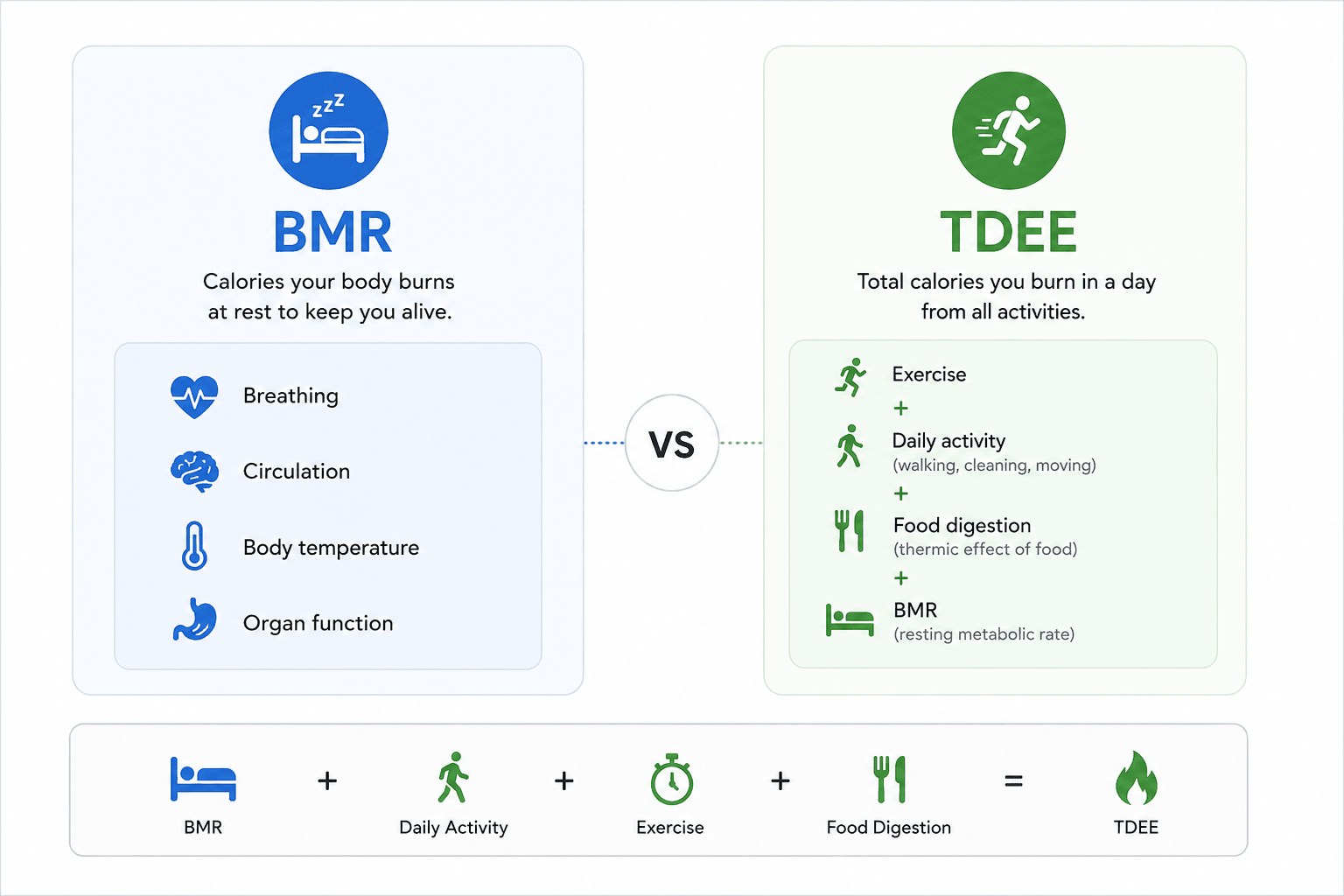
BMR represents resting calorie burn, while TDEE includes daily movement, exercise, digestion, and activity.
Why TDEE Matters More for Calorie Planning
BMR is useful, but TDEE is usually more practical because you do not live at complete rest. You move, work, walk, cook, clean, train, think, digest, and go through normal daily routines.
If you base your eating only on BMR, you may choose a calorie target that is too low for your actual lifestyle. That can make hunger, low energy, poor recovery, and inconsistency more likely.
Estimate BMR
Start with your resting calorie burn using age, height, weight, and sex.
Add Activity
Adjust for daily movement, steps, workouts, and activity level to estimate TDEE.
Choose a Goal
Eat below, near, or above TDEE depending on weight loss, maintenance, or muscle gain.
You can estimate both numbers with a BMR Calculator and a Calorie Needs Calculator.
The Biggest TDEE Mistake People Make
The most common problem with TDEE calculators is not the formula itself. It is choosing an unrealistic activity level.
Many people automatically select “very active” because they work out a few times per week. But TDEE calculators usually look at your entire lifestyle, not just your workouts.
Sedentary
Mostly sitting, low daily steps, minimal movement outside of normal tasks.
Lightly Active
Some walking and occasional exercise, but still a mostly sedentary lifestyle overall.
Moderately Active
Consistent workouts plus decent daily movement throughout the day.
Very Active
High daily movement, demanding physical work, intense training, or athletic routines.
A person who trains for one hour but sits for the other 12 hours of the day may still fall closer to lightly active than highly active.
Practical Advice
If you are unsure which activity level to choose, it is usually safer to start slightly lower and adjust based on real-world results after a few weeks.
How to Use BMR and TDEE Based on Your Goal
Once you understand BMR and TDEE, calorie planning becomes easier. BMR gives the baseline. TDEE gives the full-day estimate. Your goal tells you what to do with that number.
For Weight Loss
Eat below your estimated TDEE to create a calorie deficit. Avoid making the deficit too aggressive.
For Maintenance
Eat near your estimated TDEE and watch your weight trend over several weeks.
For Muscle Gain
Eat near or slightly above TDEE while training consistently and eating enough protein.
For Better Energy
Use TDEE to check whether your current intake is too low for your activity and lifestyle.
For more detailed calorie planning, read How Many Calories Do I Need Per Day?, Daily Calorie Intake for Weight Loss, and Calories to Maintain Weight.
A Realistic Calorie Deficit Example
One of the biggest misconceptions about weight loss is that bigger calorie deficits always produce better results. In reality, extremely low calorie targets are often harder to maintain consistently for more than a few weeks.
Many people start with an aggressive plan because they want faster progress, but very low calorie intake can sometimes lead to burnout, cravings, poor workout performance, and low energy. A more moderate approach is often easier to sustain long term.
| Situation | Estimated Calories | What It Means |
|---|---|---|
| Estimated TDEE | 2,200 calories | This is the estimated amount needed to maintain weight. |
| Moderate deficit | 1,800–1,900 calories | A more realistic starting point for steady weight loss. |
| Aggressive deficit | 1,300–1,500 calories | May feel harder to maintain and can affect energy or consistency. |
This does not mean aggressive deficits are always wrong. Some people may temporarily use them under proper guidance. The bigger issue is whether the plan is realistic enough to follow consistently without constantly feeling exhausted or overly restricted.
For many people, a moderate calorie deficit combined with resistance training, regular movement, enough protein, hydration, and proper sleep tends to feel more manageable and sustainable.
Consistency Usually Wins
The best calorie target is often the one you can realistically maintain for months, not just a few days. Slow and steady progress is usually easier to sustain than extreme dieting cycles.
What Affects BMR and TDEE?
BMR and TDEE can change over time. Your body size, muscle mass, age, activity, and routine all influence how many calories you burn.
Height and Weight
Taller or heavier bodies usually need more calories for basic function and movement.
Muscle Mass
More lean mass can increase energy needs because muscle uses energy even at rest.
Activity Level
Daily steps, workouts, chores, sports, and physical jobs can raise TDEE significantly.
Age
BMR can shift over time, often because of changes in body composition, lifestyle, and activity.
Sleep and Recovery
Sleep, stress, and recovery can influence activity, hunger, training quality, and consistency.
Food Intake and Digestion
Your body uses some energy to digest and process food, which is part of total daily expenditure.
Signs Your Calorie Target May Be Too Aggressive
Online calorie calculators can be useful starting points, but some people end up choosing targets that are unnecessarily low. This often happens when someone combines a low TDEE estimate with an aggressive calorie deficit.
Constant Low Energy
Feeling exhausted all day can sometimes be a sign that calorie intake is too low for your activity level.
Extreme Hunger
Constant cravings and strong hunger may make long-term consistency difficult.
Poor Workout Performance
Sudden drops in strength, endurance, or recovery can happen when energy intake is too aggressive.
Sleep Problems
Very low calorie intake may affect recovery, stress levels, and sleep quality in some people.
This does not mean every calorie deficit is harmful. It simply means calorie planning should be realistic and sustainable instead of based only on the smallest number possible.
How BMR Becomes TDEE
Most calorie calculators estimate BMR first, then multiply it by an activity factor. This is how they move from resting calories to full-day calorie needs.
Step 1
Estimate BMR from age, height, weight, and sex.
Step 2
Choose an activity level based on daily movement and exercise.
Step 3
Estimate TDEE by adjusting BMR for real-life activity.
This is why activity level matters so much. Two people with similar BMR values can have different TDEE values if one is sedentary and the other is very active.
Common Mistakes With BMR and TDEE
BMR and TDEE are helpful, but they can be misunderstood. These mistakes are common when people first start using calorie estimates.
Using BMR as Your Diet Target
BMR is your resting baseline, not your full daily calorie need.
Overestimating Activity
Choosing too high an activity level can make your TDEE estimate too high.
Expecting Exact Accuracy
Calculators estimate. Your real results may need adjustment.
Never Updating the Number
Your TDEE can change when your weight, routine, or activity level changes.
Best Way to Use These Numbers
Treat BMR and TDEE as starting points. Follow your calorie target for a few weeks, then adjust based on weight trend, energy, hunger, performance, and consistency.
How Long Should You Track Before Adjusting Calories?
One of the biggest mistakes people make is changing calorie targets too quickly. Body weight naturally fluctuates because of water retention, sodium intake, digestion, stress, sleep, hormones, and activity.
Looking at one random weigh-in usually does not tell the full story. Trends over time matter more than daily fluctuations.
Choose a Starting Target
Use your estimated TDEE as a baseline for maintenance or deficit planning.
Stay Consistent
Follow the plan consistently for at least 2 to 3 weeks before making major changes.
Adjust Slowly
Make small calorie adjustments based on trends, energy, recovery, and consistency.
Important Reminder
A calculator gives an estimate. Your actual body response is what helps fine-tune the number over time.
Simple Takeaway
- BMR is the calories your body burns at rest.
- TDEE is the calories your body burns in a full day.
- TDEE includes BMR plus movement, exercise, digestion, and daily activity.
- TDEE is usually more useful than BMR for calorie planning.
- Eat below TDEE for weight loss, near TDEE for maintenance, and slightly above TDEE for muscle gain.
- Use calculators as a starting point, then adjust based on real results.
Helpful Tools for Tracking Calories, Activity, and Progress
Disclosure: This section may contain affiliate links. If you buy through these links, LifeToolSuit may earn a small commission at no extra cost to you. These tools are optional and are meant to help with calorie tracking, activity monitoring, and fitness progress.
Smart Body Weight Scale
Helps track weight trends, body composition, and progress over time while using calorie and TDEE estimates.
View on AmazonFitness Tracker Watch
Useful for tracking steps, workouts, movement, and daily activity levels that affect TDEE.
View on AmazonDigital Food Scale
Makes calorie tracking more accurate by helping measure portion sizes and food intake more consistently.
View on AmazonAdjustable Dumbbells
Strength training can help improve body composition and increase overall daily calorie expenditure over time.
View on AmazonReferences and Sources
This guide combines widely used calorie estimation concepts with practical nutrition and fitness principles commonly used in calorie planning and weight management.
- Mifflin-St Jeor Equation
- Harris-Benedict Equation
- General nutrition and energy balance research
- Physical activity and calorie expenditure guidance
- Weight management best practices used in fitness and nutrition coaching
Editorial Note
LifeToolSuit guides are written to simplify complex health and calorie concepts into practical, beginner-friendly explanations. Calculator estimates should be treated as starting points rather than exact medical measurements.
Frequently Asked Questions
What is the difference between BMR and TDEE?
BMR is the energy your body uses at rest. TDEE is your total daily energy use, including BMR, movement, exercise, digestion, and daily activity.
Is BMR or TDEE more important?
TDEE is usually more important for calorie planning because it reflects your full daily calorie burn. BMR is still useful because it gives your baseline.
Is TDEE always higher than BMR?
Yes, TDEE is usually higher than BMR because it includes resting metabolism plus activity, movement, exercise, and digestion.
Should I eat my BMR or TDEE?
For most calorie goals, TDEE is the better starting point. You can adjust from TDEE based on whether you want to lose, maintain, or gain weight.
Should I eat below BMR to lose weight?
Eating below BMR can be too aggressive for many people. Weight loss planning is usually better based on a moderate deficit from TDEE, not from BMR alone.
Why did my TDEE change?
TDEE can change if your weight changes, activity level changes, training routine changes, or daily movement changes. Even small lifestyle changes can affect total energy use.
Are BMR and TDEE calculators exact?
No. They are estimates. Use them as a starting point, then adjust based on your weight trend, energy, hunger, and progress over time.
Related Guides
Related Tools
Important Note
This guide is for educational purposes only and is not medical advice. BMR, TDEE, and calorie estimates can vary based on body composition, health conditions, medications, pregnancy, breastfeeding, eating disorder recovery, intense training, and other personal factors. For personal medical or nutrition concerns, a qualified professional can provide guidance that fits your situation.