Most people just want a number that keeps their weight steady, but maintenance calories are not one exact value. They usually fall within a small range depending on your body and daily routine.
Maintenance calories are not a magic fixed number. They are more like a range. Your body weight may move a little from day to day because of water, sodium, digestion, hormones, workouts, and sleep. What matters most is the longer-term trend.
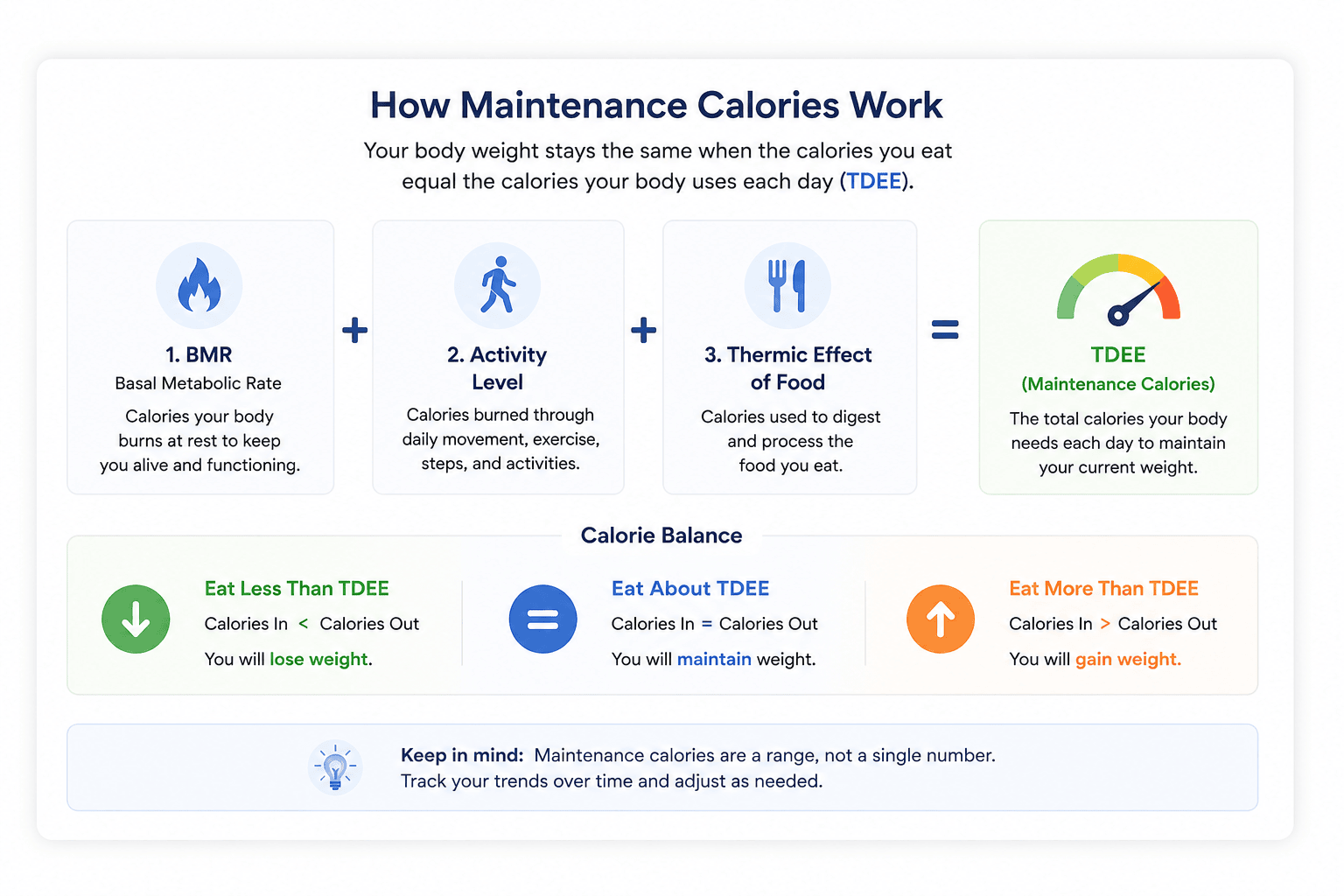
Maintenance calories are influenced by your metabolism, movement, workouts, and total daily energy expenditure.
Quick Navigation
- What maintenance calories mean
- What maintenance looks like in real life
- TDEE and maintenance calories
- What affects maintenance calories
- Realistic maintenance calorie examples
- How to estimate calories to maintain weight
- Signs your maintenance calories may be off
- Why maintenance is a range
- How activity changes your maintenance calories
- How to adjust your calories
- Maintenance after weight loss
- Common mistakes
- How people successfully maintain weight long term
- FAQ
- Editorial note and references
What Are Maintenance Calories?
Maintenance calories are the amount of calories you eat to keep your weight relatively stable over time. If you consistently eat more than maintenance, your weight may trend upward. If you consistently eat less than maintenance, your weight may trend downward.
The key phrase is over time. One high-calorie day does not automatically mean fat gain, and one low-calorie day does not automatically mean fat loss. Your body responds to patterns, not isolated moments.
Below Maintenance
Eating below maintenance over time usually leads to weight loss.
At Maintenance
Eating near maintenance usually keeps weight fairly stable.
Above Maintenance
Eating above maintenance over time usually leads to weight gain.
Maintenance Range
Most people maintain weight within a small calorie range, not one exact number.
In simple terms, it comes down to how much energy your body uses in a normal day.
What Maintenance Calories Look Like in Real Life
One reason people get frustrated with maintenance calories is because online advice often makes it sound too exact. In reality, maintaining weight usually looks much more flexible than people expect.
Someone might maintain their weight eating 2,100 calories on weekdays and 2,500 calories on weekends. Another person may eat almost the same meals every day and stay stable without tracking anything at all.
Real-life maintenance is usually built around patterns:
- Consistent meal habits
- Stable activity levels
- Reasonable portion awareness
- Not overeating constantly
- Adjusting when weight trends noticeably change
A Common Misunderstanding
Many people think maintenance means the scale never changes. That is not realistic. Even people who maintain their weight successfully for years still see normal fluctuations from water retention, sodium, stress, sleep, travel, workouts, hormones, and larger meals.
The goal is not perfect daily control. The goal is keeping your longer-term weight trend relatively stable while still living a normal life.
TDEE and Maintenance Calories
Maintenance calories are closely connected to TDEE, which means total daily energy expenditure. TDEE is the total amount of energy your body uses in a day.
BMR
Your basal metabolic rate is the energy your body uses at rest for basic functions like breathing, circulation, and cell repair.
Activity
Daily movement, steps, workouts, job activity, chores, and exercise increase your calorie needs.
TDEE
Your TDEE combines resting metabolism, movement, exercise, digestion, and daily activity.
Simple Way to Think About It
BMR is your baseline. TDEE is your real-life daily burn. Maintenance calories are usually close to your TDEE.
If you want to understand the baseline part more clearly, read What Is BMR and How Does It Work? or use a BMR Calculator.
What Affects Your Maintenance Calories?
Your maintenance calories can be very different from someone else’s because your body and routine are different. Even if two people weigh the same, their calorie needs may not match.
Height and Weight
Taller or heavier bodies usually need more calories to function and move throughout the day.
Muscle Mass
More lean mass can increase maintenance calories because muscle uses energy even at rest.
Daily Movement
Steps, chores, errands, active jobs, workouts, sports, and exercise can raise calorie needs.
Metabolism
Your resting energy use affects how many calories your body needs before activity is added.
Age and Routine
Maintenance needs can shift with age, weight changes, training changes, sleep, stress, and lifestyle changes.
Food Tracking Accuracy
If you track calories, oils, sauces, drinks, snacks, and portion sizes can affect your real intake.
Realistic Maintenance Calorie Examples
Maintenance calories can vary widely depending on body size, movement, muscle mass, and lifestyle. These examples are simplified, but they help show why there is no universal maintenance number.
| Example Person | Typical Lifestyle | Estimated Maintenance Range |
|---|---|---|
| Office worker with low activity | Mostly seated, fewer daily steps, little structured exercise | 1,800–2,100 calories/day |
| Active woman walking daily | Regular walking, light workouts, consistent daily movement | 2,000–2,400 calories/day |
| Man lifting weights 4–5x weekly | Strength training, moderate steps, higher lean body mass | 2,500–3,000+ calories/day |
| Highly active physical job | Warehouse, delivery, construction, sports, or very high daily movement | 3,000–4,000+ calories/day |
These are not fixed rules. They are realistic examples to show why two people can have very different calories needed to maintain weight even if their body weight looks similar.
Physical activity is one of the biggest variables. Someone doing regular cardio for weight loss or higher daily movement may maintain weight on significantly more calories than someone sedentary.
How to Estimate Calories to Maintain Weight
The easiest way to estimate maintenance calories is to start with a calculator, then use your real-life weight trend to adjust. A calculator gives a starting point, but your body gives the feedback.
Estimate BMR
Use age, height, weight, and sex to estimate resting calorie needs.
Add Activity Level
Adjust for daily movement, workouts, steps, and job activity to estimate TDEE.
Track the Trend
If your average weight stays stable for several weeks, you are likely near maintenance.
You can pair this guide with a Calorie Needs Calculator, How Many Calories Do I Need Per Day?, and Average Calories Per Day for more context.
Signs Your Maintenance Calories May Be Off
Maintenance calorie estimates are only starting points. Your real-world results matter more than any calculator.
Weight Slowly Keeps Increasing
If your average weight trends upward for several weeks, your intake may be slightly above maintenance.
Weight Continues Falling
If you are unintentionally losing weight, your intake may still be below maintenance.
Energy Feels Consistently Low
Constant fatigue, poor workout recovery, or extreme hunger may suggest your calorie intake is too low.
Your Activity Changed
More workouts, fewer steps, new job routines, or lifestyle changes can shift maintenance calories without people realizing it.
Important Reminder
Temporary scale changes do not automatically mean fat gain or fat loss. Always look at several weeks of trends before making aggressive calorie adjustments.
Why Maintenance Calories Are a Range, Not One Exact Number
Many people expect maintenance calories to be one perfect number. In real life, it is usually more of a range. You may maintain weight across a small range of daily calories because activity, digestion, water balance, and appetite change from day to day.
Daily Activity Changes
Some days include more walking, errands, workouts, or physical work.
Water Weight Shifts
Salt, carbs, workouts, hormones, and sleep can affect scale weight temporarily.
Food Volume Changes
More food volume or fiber can change digestion and scale weight without fat gain.
Weekly Average Matters
Your average intake and average weight trend matter more than one exact day.
This is why it is normal to see small scale changes even when you are eating at maintenance. A stable trend over several weeks is more useful than a single weigh-in.
How Activity Changes Your Maintenance Calories
One of the fastest ways maintenance calories change is through activity level. Many people underestimate how much walking, workouts, chores, and movement affect their calorie needs.
Someone who starts doing regular aerobic exercise for weight loss or adds several thousand extra daily steps may notice they can maintain their weight while eating more food than before.
Lower Activity
Desk jobs, long sitting hours, fewer steps, and inconsistent exercise usually lower maintenance calorie needs.
Moderate Activity
Regular walking, gym sessions, and consistent movement typically increase calorie requirements.
High Activity
Intense training, physical jobs, sports, and high daily movement can raise maintenance calories significantly.
This is also why maintenance calories during vacations, stressful work weeks, or lifestyle changes may feel different even if body weight has not changed much.
How to Adjust Your Calories to Maintain Weight
Once you have an estimate, the next step is testing it. Your weight trend, energy, hunger, and routine can tell you whether the number needs a small adjustment.
- Start with an estimated maintenance calorie target.
- Follow it consistently for at least a few weeks.
- Track average weight instead of reacting to one daily weigh-in.
- If weight is trending down, calories may be slightly too low.
- If weight is trending up, calories may be slightly too high.
- Make small adjustments instead of changing your target aggressively.
Small adjustments are usually enough. You do not need to overhaul your entire diet every time the scale changes. Look at the longer trend first.
Calories to Maintain Weight After Weight Loss
Maintenance after weight loss can feel different because your body is smaller than it was before. A smaller body usually burns fewer calories, so your new maintenance calories may be lower than your old maintenance calories.
Before Weight Loss
A heavier body often uses more calories for movement and basic daily function.
During Weight Loss
You usually eat below maintenance to create a calorie deficit.
After Weight Loss
Your new maintenance may be different, so it helps to re-estimate and adjust slowly.
If you are coming out of a fat-loss phase, raising calories gradually toward maintenance can help you learn your new balance point without jumping too far too fast.
Common Mistakes With Maintenance Calories
One of the biggest reasons people struggle with maintenance calories is unrealistic expectations. Online fitness content often makes maintenance sound extremely precise, but real-life body weight is naturally messy and constantly changing.
Many people panic after a heavier weigh-in, immediately cut calories, or assume they gained fat overnight. In reality, short-term changes are often caused by water retention, sodium, digestion, stress, hormones, poor sleep, travel, or simply eating more volume than usual.
Expecting the Scale to Never Move
Normal water and digestion changes can move the scale even at maintenance.
Using Only One Day of Data
One high or low day does not show your true maintenance. Trends matter more.
Ignoring Activity Changes
A more active or less active week can change your maintenance needs.
Forgetting Hidden Calories
Drinks, oils, sauces, snacks, and larger portions can change your real intake.
Helpful Mindset
Maintenance is not about perfection. It is about keeping your average intake and average output close enough that your weight trend stays stable.
How People Successfully Maintain Weight Long Term
Most people who maintain their weight successfully long term do not live in “diet mode” forever. Instead, they usually build routines that become sustainable enough to repeat without constant mental exhaustion.
They Keep Meals Fairly Consistent
Many people naturally maintain weight by repeating similar breakfasts, lunches, snacks, or portion habits most days.
They Stay Physically Active
Walking, workouts, exercise and fitness routines, or active hobbies often help maintain calorie balance without obsessive tracking.
They Make Small Adjustments Early
Small corrections are usually easier than waiting until significant weight gain or loss happens.
Maintenance Does Not Have to Feel Restrictive
For many people, successful maintenance eventually becomes less about strict calorie tracking and more about awareness, consistency, movement, and sustainable habits.
Simple Takeaway
- Calories to maintain weight are usually close to your TDEE.
- Maintenance calories keep your weight relatively stable over time.
- Your maintenance number can change with weight, activity, muscle mass, and routine.
- Maintenance is usually a range, not one perfect number.
- Track trends over several weeks before making changes.
- Use a calculator as a starting point, then adjust based on real results.
Helpful Tools for Tracking Maintenance Calories and Progress
Disclosure: This section may contain affiliate links. If you buy through these links, LifeToolSuit may earn a small commission at no extra cost to you. These tools are optional and are meant to help support calorie tracking, activity monitoring, and long-term weight maintenance.
Digital Food Kitchen Scale
One of the most useful tools for learning portion sizes and improving calorie tracking accuracy. Especially helpful when estimating maintenance calories.
View on AmazonFitness Tracker Watch
Tracks daily steps, workouts, calorie burn, and physical activity levels which can all affect maintenance calorie needs.
View on AmazonDigital Body Weight Scale
Helpful for monitoring long-term weight trends instead of reacting to daily fluctuations.
View on AmazonMeal Prep Containers
Useful for portion consistency, meal organization, and maintaining more predictable calorie intake during busy weeks.
View on AmazonFrequently Asked Questions
How many calories do I need to maintain weight?
It depends on your age, height, weight, sex, activity level, muscle mass, and metabolism. A calorie calculator can estimate your maintenance calories, but your weight trend over time gives the best feedback.
What are maintenance calories?
Maintenance calories are the calories you eat to keep your weight relatively stable. They roughly match the calories your body uses each day.
Is TDEE the same as maintenance calories?
TDEE is often used as an estimate of maintenance calories because it includes resting metabolism, activity, exercise, movement, and digestion.
Do maintenance calories change after weight loss?
Yes. If you lose weight, your body may use fewer calories than before because there is less body mass to maintain and move. Your new maintenance calories may be lower than your old maintenance.
Why am I gaining weight at maintenance calories?
Your estimate may be too high, your tracking may be off, your activity may have decreased, or the change may be temporary water weight. Look at several weeks of trends before making a big adjustment.
Can I maintain weight without tracking calories?
Yes. Some people maintain weight with regular meal habits, portion awareness, consistent activity, and occasional check-ins. Tracking can help you learn your range, but it does not have to be forever.
How often should I adjust maintenance calories?
You do not need to adjust daily. If your average weight trend changes over several weeks, then a small calorie or activity adjustment may help.
Related Health Tools
Related Guides
Editorial Note and References
This guide was created to simplify maintenance calories in a practical and realistic way. Instead of focusing only on formulas, the goal is to help readers understand how calorie maintenance actually works in day-to-day life.
Weight maintenance is influenced by many factors including metabolism, physical activity, food intake, body composition, sleep, stress, and consistency over time. Because of this, calorie calculators should be treated as starting estimates rather than exact guarantees.
References and Educational Sources
- National Institutes of Health (NIH)
- Centers for Disease Control and Prevention (CDC)
- Harvard T.H. Chan School of Public Health
- Academy of Nutrition and Dietetics
- Peer-reviewed nutrition and metabolism research
Important Note
This guide is for educational purposes only and is not medical advice. Calorie needs can vary widely, especially during pregnancy, breastfeeding, medical conditions, eating disorder recovery, intense training, or major lifestyle changes. If you have personal medical or nutrition concerns, a qualified professional can provide guidance that fits your situation.