One of the biggest reasons calorie advice online feels frustrating is because people talk about calories like everyone lives the same life.
A man working long shifts on his feet will not feel the same eating plan as someone sitting at a desk all day. A beginner lifting weights three times a week may need something completely different than a runner training for endurance. Even stress, sleep, weekends, and daily movement can quietly change how much food feels sustainable.
That is why copying random calorie targets from social media often fails. The better approach is understanding how calories actually work in real life, then adjusting based on your own routine, energy, hunger, and progress.
Quick Navigation
- What daily calories mean
- Average daily calories for men
- Real-life calorie examples
- What affects calorie needs
- How activity changes calorie needs
- Daily calories for weight loss
- Signs your calories may be too low
- Daily calories for maintenance
- Daily calories for muscle gain
- How to estimate your calories
- Common calorie mistakes
- Why weight loss sometimes stalls
- Quick self-check
- People also ask
- Frequently asked questions
- Editorial & review process
- Sources & references
Why Daily Calories Feel So Confusing for Many Men
Most men are not really asking what calories are. They are trying to figure out why they feel stuck, tired, hungry all the time, unable to lose weight, or unsure how much they should actually be eating.
Calories matter because they affect body weight, recovery, workout performance, hunger, energy, and long-term consistency. But the confusing part is that calorie needs are not fixed. The same person may need very different amounts during a stressful work season, a fat loss phase, a strength program, or a more active lifestyle.
This is also why online calorie advice often feels contradictory. One person says 1,500 calories is enough. Another says 2,800 calories feels low. Both people may be telling the truth based on their own situation.
Weight Loss
Eating below maintenance calories so the body gradually uses stored energy over time.
Maintenance
Eating around the amount your body regularly burns through normal life and activity.
Muscle Gain
Supporting training and recovery with enough calories, protein, and consistency.
Daily Performance
Eating enough to support focus, energy, workouts, recovery, movement, and normal life.
In real life, the best calorie target is usually not the lowest number. It is the number you can realistically maintain while still functioning well physically and mentally.
Average Daily Calories for Men Are Only a Starting Point
Many people search for an exact calorie number because they want clarity. The problem is that averages cannot see your lifestyle.
Two men can weigh the same but burn very different amounts of energy throughout the week. One might sit most of the day and barely move outside work. Another may walk 12,000 steps daily, lift weights after work, and play sports on weekends.
This is why generic calorie charts often feel inaccurate once people try applying them in real life.
Sedentary Lifestyle
Lower daily movement usually means lower calorie needs throughout the week.
Moderately Active Lifestyle
Regular walking, workouts, errands, and movement often increase maintenance calories noticeably.
Very Active Lifestyle
Intense training, physical jobs, sports, or high step counts can dramatically increase calorie demands.
One Thing Many Men Underestimate
Activity outside the gym matters more than most people realize. Walking, standing, physical work, chores, and general movement can significantly change calorie needs over time.
Instead of chasing a perfect number immediately, it is usually smarter to estimate a reasonable starting point and adjust based on real progress, recovery, hunger, and energy levels.
Why Calorie Needs Can Feel Completely Different From One Man to Another
One reason calorie advice online feels inconsistent is because people often compare themselves to someone living a completely different lifestyle.
In real life, calorie needs are shaped by movement, work routine, training style, recovery, and even how active someone is outside the gym.
Office Worker
A man sitting most of the day with limited movement may naturally burn fewer calories throughout the week, even if he exercises occasionally.
This is why some desk workers notice weight gain faster when activity drops.
Active Job
Someone working construction, warehouse shifts, delivery routes, or physically demanding jobs may burn hundreds of additional calories daily without realizing it.
Many active workers struggle more with under-eating than overeating.
Regular Gym Training
Men consistently lifting weights, walking more, or training several times weekly often need higher calories to support recovery and performance.
This becomes even more noticeable during muscle-building phases.
A Common Mistake
Many men copy calorie targets from social media without considering differences in height, muscle mass, activity level, work schedule, stress, or daily movement. What works for someone else may feel completely unsustainable for your own lifestyle.
What Actually Changes Calorie Needs From Person to Person?
One reason calorie advice feels inconsistent online is because people often ignore how different real-life routines can be.
Your body size matters, but so does your movement, training style, sleep quality, stress levels, work routine, and overall lifestyle. This is why some men maintain weight easily on calories that would feel exhausting for someone else.
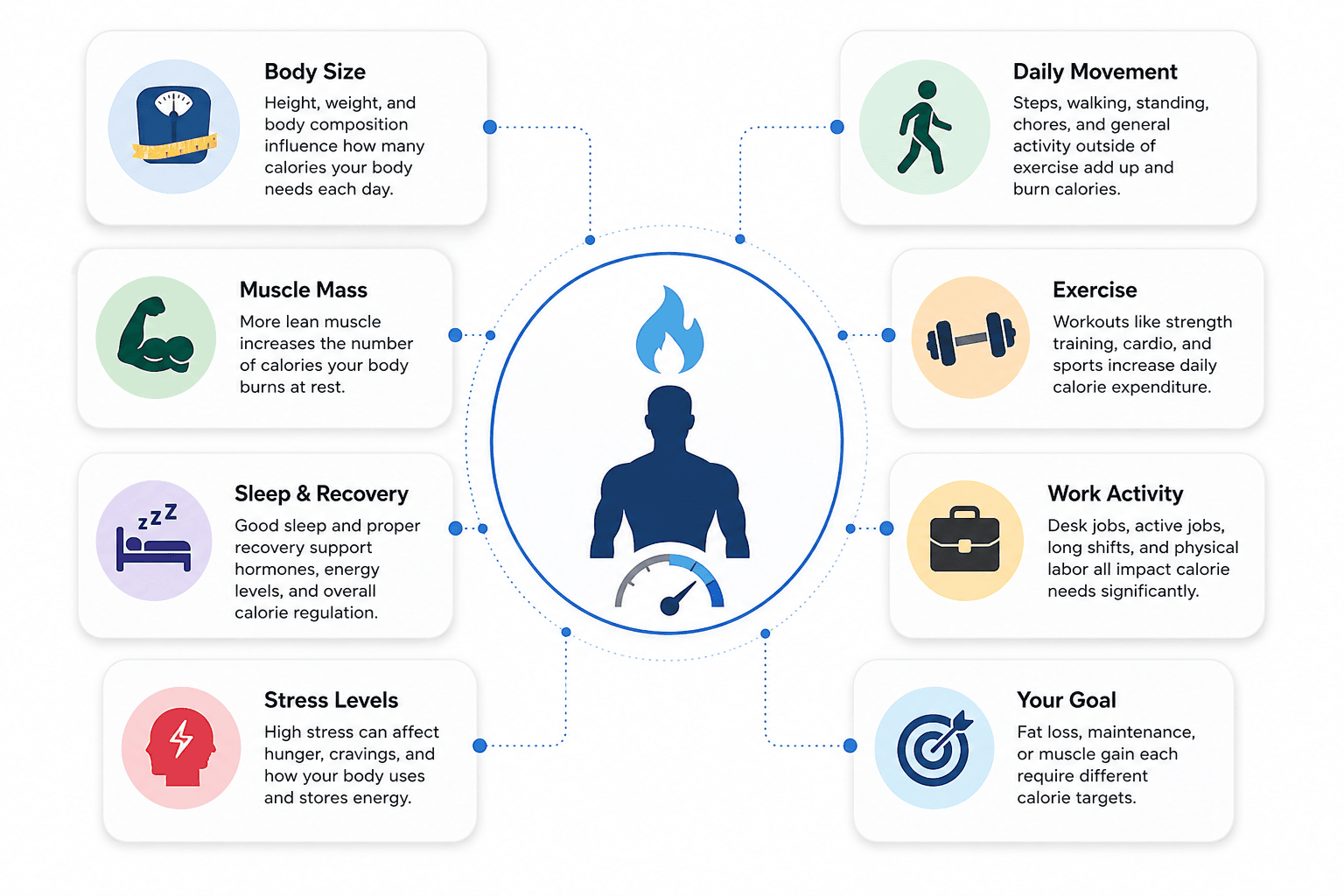
Daily calorie needs are influenced by activity, body size, muscle mass, movement, recovery, and overall lifestyle.
Height and Body Size
Larger bodies generally require more energy throughout the day, even before exercise is added.
Muscle Mass
Men with more lean muscle often burn more energy even while resting.
Daily Movement
Walking, sports, errands, gym sessions, active jobs, and step count can all change calorie needs substantially.
Metabolism and Recovery
Sleep, stress, recovery, and long-term dieting habits can all affect energy levels and appetite regulation.
Routine Changes
Busy work seasons, vacations, injuries, new training programs, or lifestyle changes can shift calorie needs quickly.
Your Current Goal
Fat loss, maintenance, athletic performance, and muscle gain all require different calorie strategies.
This is why the best calorie approach is usually flexible rather than rigid. Your needs can change throughout the year depending on how your life actually looks.
How Activity Level Changes Calorie Needs
Many men underestimate how much normal movement affects calorie burn. A man who walks 10,000 to 15,000 steps daily can have very different calorie needs compared to someone sitting most of the day.
Low Activity
Mostly sitting, driving, desk work, limited walking, and little structured exercise.
Moderate Activity
Regular workouts, daily errands, walking, and general movement throughout the week.
High Activity
Sports, construction work, warehouse jobs, running, intense training, or high daily step counts.
This is one reason online calorie comparisons can feel misleading. Two men at the same body weight can still have dramatically different maintenance calories depending on lifestyle.
Daily Calories for Men Who Want to Lose Weight
Weight loss usually requires a calorie deficit, which means eating less than your body uses over time. But the deficit does not need to be extreme. In fact, many men do better with a moderate target they can repeat consistently.
Start With Maintenance
It helps to estimate maintenance calories first, then reduce slightly from there.
Keep Protein High Enough
Protein supports fullness and helps preserve muscle during fat loss.
Do Not Cut Too Hard
Very low calories can make hunger, fatigue, training performance, and consistency worse.
Track Trends
Look at weight, waist, energy, strength, hunger, and consistency over several weeks.
About Very Low Calorie Targets
A common question is whether 1500 calories is enough. For some men, that can be too low, especially if they are active, taller, heavier, lifting, playing sports, or trying to maintain good energy. A better approach is to estimate your own needs instead of starting with the lowest number you see online.
If a calorie target makes you feel constantly drained, overly hungry, irritable, weak during workouts, or unable to recover from normal training, it may not be the right target for you.
Recommended Tools to Support Healthy Calorie Goals
Disclosure: This section may contain affiliate links. If you buy through these links, LifeToolSuit may earn a small commission at no extra cost to you. These tools are optional and are meant to help support calorie tracking, weight management, meal consistency, hydration, and fitness progress.
Digital Food Scale
Helps improve portion accuracy when tracking calories, protein intake, meal sizes, and nutrition habits at home.
View on AmazonMeal Prep Containers
Useful for meal planning, portion consistency, calorie awareness, and reducing impulsive eating during busy days.
View on AmazonSmart Body Weight Scale
Helps monitor long-term progress during weight loss, maintenance, muscle gain, and body composition changes.
View on AmazonProtein Shaker Bottle
Convenient for protein shakes, workout recovery drinks, meal replacements, and increasing protein intake on busy schedules.
View on AmazonSigns Your Calories May Be Too Low
A calorie deficit should feel manageable. If your plan feels impossible to sustain after only a few days, that usually matters more than the number itself.
Constant Hunger
Feeling hungry occasionally is normal during fat loss. Feeling obsessed with food all day is different.
Low Workout Performance
Struggling to recover, losing strength rapidly, or feeling weak during normal workouts can be a sign calories are too aggressive.
Energy Crashes
Some men notice brain fog, irritability, poor focus, or afternoon crashes when intake is too low.
Poor Consistency
Extreme calorie targets often lead to overeating weekends, binge cycles, or quitting entirely.
In practice, the best calorie target is usually the one you can repeat consistently while still functioning well in normal life.
Daily Calories for Men Who Want to Maintain Weight
Maintenance calories are the calories you can eat while your weight stays fairly stable over time. This does not mean your weight will never move. Normal water weight, digestion, sodium, soreness, and carbohydrate intake can all cause daily changes.
Estimate BMR
BMR is your resting energy use before activity is added.
Add Activity
Daily movement, workouts, lifting, walking, sports, and exercise increase your total calorie needs.
Watch the Trend
If your weight stays mostly stable over time, you are probably close to maintenance.
Maintenance is useful even if your long-term goal is weight loss or muscle gain. Spending time at maintenance can help you understand your normal intake, improve energy, and make your plan feel less all-or-nothing.
Daily Calories for Men Who Want to Gain Muscle
Men who want to build muscle need enough calories to support training and recovery. That does not always mean a huge surplus. Many beginners can improve body composition around maintenance, especially with consistent strength training and enough protein.
Body Recomposition
Some men can build muscle and lose fat slowly while eating near maintenance.
Small Surplus
A small calorie surplus may help support strength and muscle gain without rapid fat gain.
Training Recovery
Calories, protein, sleep, and progressive lifting all matter for muscle growth.
If you are lifting consistently but always feel weak, sore, under-recovered, or hungry, your calorie intake may be too low for your training routine.
How to Estimate Your Daily Calories
A calorie estimate is a starting point. The best method is to calculate a reasonable target, try it consistently, then adjust based on what happens in real life.
- Estimate your BMR using your age, height, weight, and sex.
- Adjust for activity level to estimate your maintenance calories.
- Choose your goal: lose weight, maintain weight, or gain muscle.
- Track your average weight, waist, energy, hunger, and performance for a few weeks.
- Adjust slowly if the trend is not matching your goal.
You can pair this guide with a Calorie Needs Calculator, BMR Calculator, and What Is BMR and How Does It Work? to get a better starting point.
Common Mistakes With Daily Calories for Men
Calorie planning should make things clearer, not more stressful. These are common mistakes that can make it harder to stay consistent.
Starting Too Low
Choosing the lowest number you find online can lead to fatigue, hunger, poor training, and poor consistency.
Ignoring Activity
A man who trains, walks a lot, plays sports, or has an active job may need more food than expected.
Reacting to Daily Scale Changes
Daily weight changes are normal. Trends over several weeks matter more than one weigh-in.
Forgetting Nutrition Quality
Calories matter, but protein, fiber, micronutrients, meal satisfaction, and recovery matter too.
Why Some Men Stop Losing Weight Even in a Calorie Deficit
One of the most frustrating parts of dieting is feeling like you're doing everything correctly while progress slows down.
In many cases, the issue is not that fat loss has completely stopped. It is usually a combination of water retention, inconsistent tracking, reduced activity, stress, poor sleep, or calorie intake slowly drifting upward over time.
Water Weight Fluctuations
Sodium, stress, soreness, sleep, and carbohydrates can temporarily hide fat loss on the scale.
Portion Creep
Extra snacks, sauces, drinks, and untracked portions can slowly erase a calorie deficit.
Recovery and Sleep
Poor sleep can increase hunger, reduce recovery, and make calorie control harder.
This is why weekly trends matter more than reacting emotionally to one weigh-in.
Simple Takeaway
- No single daily calorie number fits all men.
- Your needs depend on your body, activity, metabolism, and goal.
- Weight loss usually needs a moderate calorie deficit.
- Maintenance means eating close to total daily energy use.
- Muscle gain often needs enough calories to support training and recovery.
- Use calculators as a starting point, then adjust based on real results.
People Also Ask
Can a man lose weight on 1200 calories a day?
Some men may lose weight on 1200 calories, but for many adult men this can feel extremely restrictive and difficult to sustain long term, especially with exercise or physically active jobs.
Why am I not losing weight eating 1200 calories?
Tracking errors, water retention, stress, poor sleep, low activity outside workouts, or inconsistent weekends are common reasons progress appears slower than expected.
How many calories does walking burn?
Calorie burn depends on body size, pace, distance, and terrain. Longer walks and higher step counts can significantly increase daily energy use.
Do active men need more calories?
Yes. Men who lift weights, play sports, walk frequently, or work physically demanding jobs usually burn much more energy throughout the day.
What are signs of not eating enough calories?
Constant fatigue, low energy, irritability, poor recovery, extreme hunger, and declining workout performance may all be warning signs.
Quick Self-Check
Ask yourself these questions before lowering calories further:
- Am I getting enough sleep consistently?
- Am I tracking portions honestly?
- Has my daily movement dropped recently?
- Am I expecting faster results than realistic?
- Can I realistically maintain this calorie target next month?
Many calorie struggles are actually consistency problems, recovery problems, or expectation problems rather than metabolism problems.
Frequently Asked Questions
How many daily calories do men need?
Daily calories for men vary based on age, height, weight, activity level, muscle mass, and goal. A calorie calculator can give a useful starting estimate, but real needs may need adjustment over time.
How many calories should a man eat to lose weight?
Most men need a calorie deficit to lose weight. That means eating below maintenance calories while still getting enough protein, nutrients, and energy to stay consistent and train well.
How many calories should a man eat to maintain weight?
Maintenance calories are the calories a man can eat while his weight stays fairly stable. This includes calories used for BMR, movement, exercise, digestion, and daily activity.
Do active men need more calories?
Yes. Men who exercise, lift, walk often, play sports, or have physically demanding routines usually need more calories than men who are mostly sedentary.
Is 1500 calories enough for men?
For many men, 1500 calories may be too low, especially if they are active, taller, heavier, training, or trying to maintain energy. It is better to estimate your own needs instead of assuming one low number is right for everyone.
Should men eat more on workout days?
Some men prefer eating a little more on harder workout days, while others prefer keeping calories consistent. Either approach can work if the weekly intake supports the goal.
What if my calories feel too low?
If you feel constantly tired, hungry, weak, irritable, or unable to recover from workouts, your calorie target may be too low. Consider adjusting slowly or getting professional guidance if needed.
Related Health Tools
Related Guides
Editorial & Review Process
This guide was created to make calorie information more practical and easier to understand for everyday people, not just fitness enthusiasts.
Content is reviewed for clarity, readability, and alignment with current nutrition and energy balance principles. LifeToolSuit guides are regularly updated to improve accuracy, usability, and user experience.
Our Goal
We focus on realistic, sustainable health information that people can actually apply in real life instead of extreme or unrealistic advice.
Sources & References
- Harvard T.H. Chan School of Public Health
- Mayo Clinic Nutrition Resources
- National Institutes of Health (NIH)
- Centers for Disease Control and Prevention (CDC)
- Academy of Nutrition and Dietetics
- Dietary Guidelines for Americans
Important Note
This guide is for educational purposes only and is not medical advice. Calorie needs can vary widely, especially during medical conditions, eating disorder recovery, intense training, major lifestyle changes, or specific performance goals. If you have personal medical or nutrition concerns, a qualified professional can provide guidance that fits your situation.