Aerobic exercise is one of the most approachable ways to support weight loss because it does not require a complicated plan. You can walk, bike, swim, dance, use an elliptical, jog slowly, or follow a low-impact workout at home. The challenge is not knowing that cardio burns calories. Most people already know that. The harder part is figuring out how much to do, how intense it should be, and how to make it fit into real life without burning out.
A lot of beginners start too aggressively. They go from very little movement to long daily cardio sessions, then feel sore, tired, hungry, or discouraged when the scale does not move fast enough. Others do the opposite. They do a few short workouts, eat more than usual afterward, and wonder why the exercise is not changing their body.
The better approach is more practical: use aerobic exercise to raise your daily activity, improve your heart and lung fitness, and make your calorie deficit easier to maintain. For a full weight loss plan, you still need realistic eating habits, enough recovery, and a clear understanding of your calorie needs. If you are not sure where your intake should start, the Calorie Needs Calculator and daily calorie intake for weight loss guide can help you connect exercise with nutrition.
Quick Navigation
- What aerobic exercise means
- How aerobic exercise helps weight loss
- Best aerobic exercises for weight loss
- How much aerobic exercise you may need
- A realistic beginner weekly plan
- How hard should aerobic exercise feel?
- How many calories does aerobic exercise burn?
- Walking for weight loss
- Aerobic exercise vs strength training
- Why nutrition still matters
- Common mistakes
- Warning signs you are doing too much
- Helpful tools and trackers
- Practical takeaways
- References and sources
- Editorial and review process
- FAQ
What Is Aerobic Exercise?
Aerobic exercise is activity that raises your heart rate and breathing for a sustained period of time. People often call it cardio, but aerobic exercise does not have to mean running hard or doing exhausting gym workouts. It can be as simple as brisk walking, cycling, swimming, dancing, hiking, rowing, or using a treadmill at a comfortable pace.
The word “aerobic” means the body is using oxygen to help produce energy. During moderate aerobic activity, you can usually keep moving for longer than a few minutes because the effort is steady rather than all-out. That makes it different from short explosive exercise like sprinting, heavy lifting, or very intense intervals.
Moderate Aerobic Exercise
You breathe faster, feel warm, and can talk in short sentences. Brisk walking, steady cycling, and easy swimming often fit here.
Vigorous Aerobic Exercise
Your breathing is harder, conversation is difficult, and the workout feels more demanding. Running, faster cycling, and intense cardio classes may fit here.
For weight loss, both moderate and vigorous aerobic exercise can help. But harder is not always better. A beginner who can walk 30 minutes five days per week may get better long-term results than someone who does two brutal workouts, feels exhausted, and quits by the second week.
How Aerobic Exercise Helps With Weight Loss
Weight loss usually comes down to creating a calorie deficit over time. That means your body uses more energy than you take in from food and drinks. Aerobic exercise helps because it increases the “energy out” side of that equation.
But there is a practical detail people often miss: aerobic exercise is not magic. A workout can help create a deficit, but it can also be canceled out by extra snacks, larger portions, high-calorie drinks, or weekend overeating. This is why cardio works best when it is part of a bigger plan rather than the whole plan.
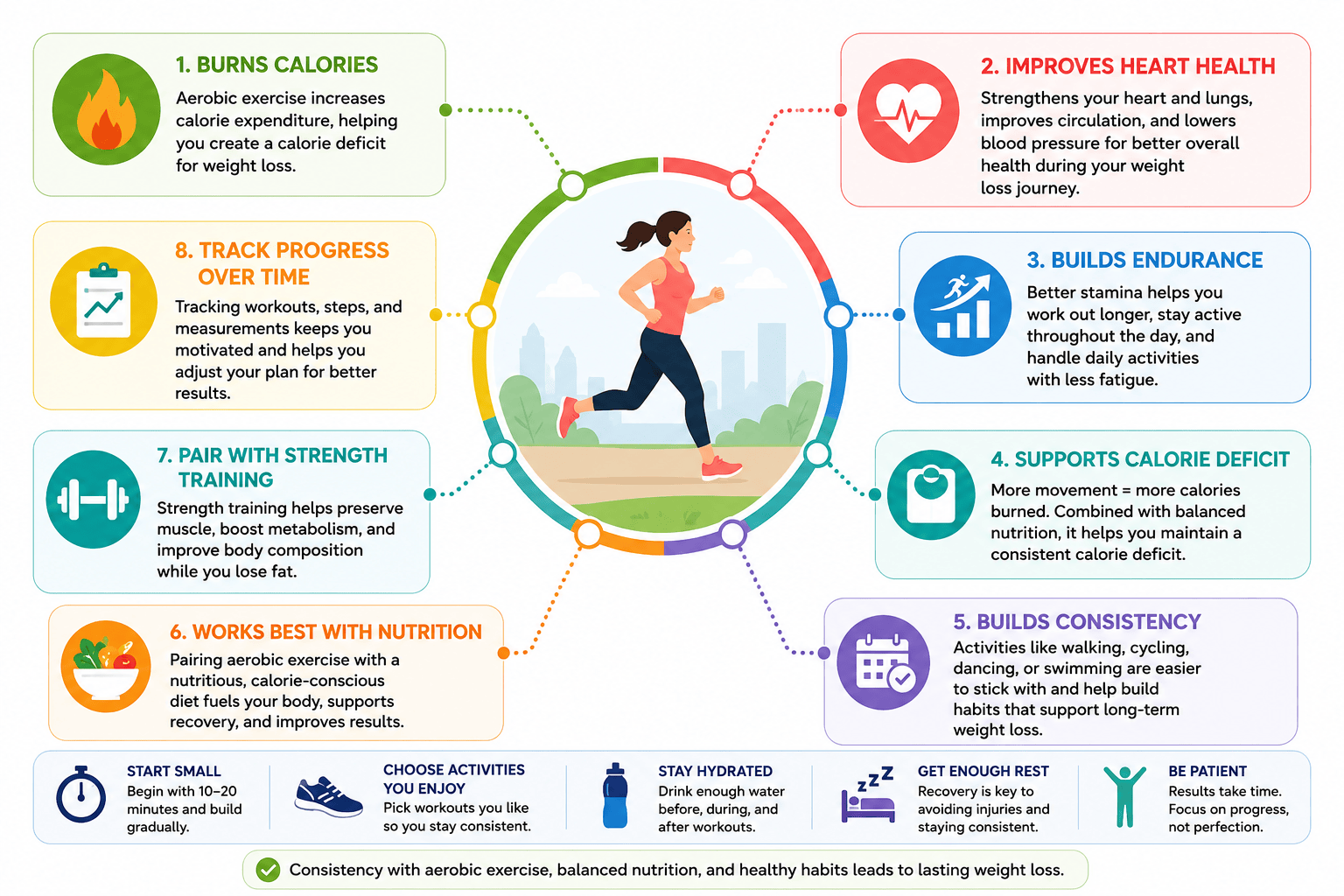
Aerobic exercise supports weight loss by increasing calorie burn, improving endurance, building consistency, and working together with nutrition, hydration, recovery, and strength training.
It Raises Daily Calorie Burn
Cardio adds movement to your day, which can make it easier to create a calorie deficit without dropping food intake too low.
It Improves Fitness
Better endurance can make everyday activity feel easier, from walking stairs to staying active on busy days.
It Builds Consistency
Simple aerobic habits like walking can become a repeatable routine instead of a short-term weight loss push.
The Real-Life Version
Aerobic exercise helps most when it makes your normal week more active. You do not need every session to feel extreme. You need enough movement, repeated often enough, to support your overall calorie balance.
If you want to understand how workouts are estimated, read how workout calories are estimated. For a calculator-based estimate, use the Workout Calorie Burn Calculator.
Best Aerobic Exercises for Weight Loss
The best aerobic exercise for weight loss is not automatically the one that burns the most calories per minute. It is the one you can actually do consistently while recovering well and staying motivated. A workout that looks impressive but leaves you dreading exercise is usually not the best long-term choice.
| Exercise | Best For | Beginner Notes |
|---|---|---|
| Brisk walking | Low-impact fat loss support and daily movement | Easy to start, gentle on joints, and simple to repeat |
| Cycling | Low-impact cardio and leg endurance | Good for people who prefer seated exercise |
| Swimming | Full-body low-impact cardio | Helpful if joints feel uncomfortable during walking or running |
| Jogging | Higher calorie burn and endurance | Start slowly and build gradually to avoid overuse pain |
| Elliptical | Indoor cardio with less impact than running | Good option for gym workouts and steady-state sessions |
| Dancing | Fun, mood-friendly cardio | Great if structured workouts feel boring |
| Rowing | Full-body cardio and conditioning | Technique matters, so start light and controlled |
If you are starting from a lower fitness level, walking is often underrated. It is not flashy, but it is repeatable. If you already enjoy harder workouts, cycling, jogging, rowing, or interval-based cardio can be useful as long as you manage recovery.
Simple Rule
Choose the aerobic exercise that fits your body, schedule, and personality. Consistency beats the “perfect” workout you only do once.
How Much Aerobic Exercise Do You Need to Lose Weight?
Many public health guidelines suggest adults aim for at least 150 minutes of moderate-intensity aerobic activity per week, or 75 minutes of vigorous activity. For additional health benefits, and for some weight loss goals, building toward around 300 minutes of moderate activity per week may be helpful.
That does not mean you need to jump straight to 300 minutes. If you currently do very little exercise, even 10 to 20 minutes at a time can be a useful start. Your body usually responds better when you build capacity gradually.
Beginner Start
10–20 minutes of easy or moderate cardio, 3–4 days per week. Focus on showing up and building the habit.
General Goal
Around 150 minutes per week of moderate activity, such as 30 minutes on 5 days.
Higher Weight Loss Support
Some people gradually build toward 250–300 minutes per week, depending on recovery, schedule, and nutrition.
The right amount also depends on your food intake. If your calorie intake is already controlled, a moderate amount of cardio may be enough. If your eating is inconsistent, adding more cardio without adjusting nutrition may not move the scale much.
To connect cardio with total daily energy needs, compare your activity level with BMR vs TDEE and use the BMR Calculator as a starting point.
A Realistic Beginner Aerobic Exercise Plan
A beginner plan should feel almost too easy at first. That may sound strange, but it works because you are not only training your body. You are training your schedule, your routine, and your ability to keep going when motivation drops.
| Week | Goal | Example Routine |
|---|---|---|
| Week 1 | Build the habit | 15–20 minutes brisk walking, 3 days |
| Week 2 | Add a little volume | 20–25 minutes brisk walking or cycling, 3–4 days |
| Week 3 | Improve consistency | 25–30 minutes moderate cardio, 4 days |
| Week 4 | Build toward a weekly target | 30 minutes moderate cardio, 4–5 days |
Make It Easier to Follow
Put cardio where it naturally fits. A walk after lunch, a cycling session after work, or a short treadmill walk while watching a show is often easier to repeat than a complicated workout plan.
Once the routine feels normal, you can increase duration, add a day, or slightly raise intensity. Do not change everything at once. Most people do better when they adjust one thing at a time.
How Hard Should Aerobic Exercise Feel?
For weight loss, aerobic exercise does not need to feel brutal. In fact, a lot of your weekly cardio can be moderate. You should feel like you are working, but not like you are fighting for survival every session.
Easy Pace
You can talk comfortably. Useful for warm-ups, recovery days, and building total movement.
Moderate Pace
You can talk in short sentences. This is a practical pace for many weight loss cardio sessions.
Hard Pace
Talking is difficult. This can be useful sometimes, but it requires more recovery.
Too Hard
You feel dizzy, unusually breathless, or unable to maintain control. Stop and reduce intensity.
A good beginner routine might include mostly easy-to-moderate cardio. You can add harder intervals later if your joints, recovery, sleep, and energy are holding up well. If you want structured intervals, the HIIT Interval Training Calculator can help plan work and rest periods.
How Many Calories Does Aerobic Exercise Burn?
Calories burned during aerobic exercise depend on body weight, duration, intensity, fitness level, and the type of activity. A heavier person usually burns more calories than a lighter person doing the same activity because moving a larger body requires more energy. A faster pace or longer session also increases calorie burn.
However, calorie burn estimates are not perfectly accurate. Fitness trackers, cardio machines, and online calculators can be useful, but they are still estimates. Treat them as a guide, not an exact measurement.
Duration
A 40-minute walk usually burns more total calories than a 10-minute walk at the same pace.
Intensity
Faster movement, hills, resistance, or higher effort generally increase calorie burn.
Body Weight
Body size affects energy use, which is why two people can burn different amounts from the same workout.
If you want a practical estimate, use the Workout Calorie Burn Calculator. For walking specifically, the Step Counter Walking Calories Calculator can help connect steps with estimated calorie burn.
Walking for Weight Loss: The Most Underrated Aerobic Exercise
Walking is often overlooked because it feels too simple. But for many people, that is exactly why it works. It is low impact, easy to recover from, flexible, and realistic for busy schedules. You can walk outside, on a treadmill, during a work break, after dinner, or while listening to a podcast.
Walking also helps solve one of the biggest weight loss problems: low daily movement. Someone may do three workouts per week but sit most of the day. Adding walks can raise total activity without the fatigue that comes from intense cardio.
Start Small
Begin with 10–15 minutes if that is what feels realistic. Small walks still count.
Add Frequency
Walking most days is often easier than doing long workouts only once or twice.
Increase Gradually
Add time, steps, hills, or pace slowly instead of forcing a huge jump overnight.
If you are tracking steps, do not obsess over one perfect number. Use your current average as the baseline. If you average 4,000 steps per day, moving toward 5,000 or 6,000 may be more realistic than forcing 10,000 immediately.
Aerobic Exercise vs Strength Training for Weight Loss
Aerobic exercise and strength training both help weight loss, but they help in different ways. Cardio is useful for burning calories, improving endurance, and increasing activity. Strength training helps preserve muscle, improve body composition, and make weight loss look and feel better.
Aerobic Exercise
Best for heart health, endurance, calorie burn, and increasing weekly activity.
Strength Training
Best for maintaining muscle, building strength, and improving body shape during fat loss.
Best Combination
Use cardio for activity and fitness, strength training for muscle, and nutrition for the calorie deficit.
A balanced week might include walking most days, strength training two or three times, and one or two longer cardio sessions. You do not have to copy someone else’s routine exactly. Your plan should match your current fitness level and recovery.
For a broader cardio breakdown, read Cardio for Weight Loss.
Why Nutrition Still Matters More Than People Want to Admit
Aerobic exercise can help create a calorie deficit, but food intake still matters. This does not mean you need a strict diet or perfect meals. It means your workouts and eating habits need to point in the same direction.
A common pattern looks like this: someone starts cardio, feels proud of working out, then eats bigger portions because they feel they “earned it.” That can be completely understandable, especially if exercise increases hunger. But if the extra food cancels out the workout calories, weight loss may stall.
Protein Helps Fullness
Protein can make meals more satisfying and support muscle while losing weight.
Fiber Adds Volume
Fruits, vegetables, beans, and whole grains can help meals feel larger without relying only on calories.
Liquid Calories Add Up
Sugary drinks, fancy coffees, juices, and alcohol can quietly reduce your calorie deficit.
Recovery Affects Hunger
Poor sleep and excessive exercise can make cravings and appetite harder to manage.
If you are unsure where to begin, read how many calories you should eat per day, how many calories you need per day, and calories to maintain weight.
Common Mistakes With Aerobic Exercise for Weight Loss
Most cardio mistakes are not about laziness. They usually come from doing too much too soon, expecting fast results, or treating exercise as a way to punish food choices.
Doing Too Much at the Start
Going from no exercise to daily intense cardio can lead to soreness, fatigue, shin pain, knee discomfort, or burnout. Start smaller and build.
Using Cardio to “Earn” Food
Exercise should support your health, not become punishment. This mindset can create guilt and inconsistency.
Trusting Calorie Burn Numbers Too Much
Machines and trackers can overestimate or underestimate. Use them as rough estimates, not permission to eat back every calorie.
Ignoring Strength Training
Cardio alone can help weight loss, but strength training helps maintain muscle and improve body composition.
Changing the Plan Every Week
If you constantly switch workouts, it becomes harder to measure progress. Keep the basics steady long enough to see what is working.
Warning Signs You May Be Doing Too Much Cardio
More cardio is not always better. Exercise should make your weight loss plan more sustainable, not make your body feel run down all the time.
Constant Fatigue
Feeling drained every day may mean your workouts, calories, or sleep need adjustment.
Persistent Joint Pain
Soreness can happen, but sharp or ongoing pain is a reason to reduce impact and seek guidance.
Worse Sleep
Too much intensity, especially with low calories, can make recovery and sleep harder.
Extreme Hunger
If cardio leaves you ravenous and overeating, a different balance may work better.
Adjust Before You Quit
If the plan feels too hard, reduce intensity, shorten sessions, add rest days, or switch to lower-impact movement. A smaller routine you can keep is better than an extreme routine you abandon.
Helpful Fitness Tools for Aerobic Exercise and Weight Loss
Disclosure: This section may contain affiliate links. If you buy through these links, LifeToolSuit may earn a small commission at no extra cost to you. These tools are optional and are meant to support tracking, activity, and consistency.
Walking Pad Treadmill
Helpful for adding low-impact walking at home, especially if weather, work, or schedule makes outdoor walking difficult.
View on AmazonFitness Tracker Watch
Useful for tracking steps, heart rate trends, workout time, and overall activity patterns throughout the week.
View on AmazonResistance Bands
A simple way to add beginner strength work alongside cardio without needing a full gym setup.
View on AmazonReusable Water Bottle
Helpful for staying hydrated during walks, cardio sessions, gym workouts, and daily routines.
View on AmazonPractical Takeaways
- Aerobic exercise supports weight loss by increasing total calorie burn and improving fitness.
- The best cardio is the activity you can repeat consistently, not necessarily the hardest one.
- Walking is a strong beginner option because it is low impact, flexible, and easy to recover from.
- Start with a realistic weekly routine before increasing duration or intensity.
- Use cardio with nutrition, not as a replacement for realistic eating habits.
- Strength training is still valuable because it helps preserve muscle during fat loss.
- If cardio makes you exhausted, ravenous, or sore all the time, the plan probably needs adjusting.
References and Sources
- CDC: Adult Physical Activity Guidelines
- Physical Activity Guidelines for Americans, 2nd edition
- Mayo Clinic: Exercise for Weight Loss
- Mayo Clinic: Aerobic Exercise Benefits
- American Heart Association: Physical Activity Recommendations
This guide combines public health activity guidelines, practical weight loss principles, and beginner-friendly fitness planning to help readers use aerobic exercise safely and realistically.
Editorial and Review Process
LifeToolSuit health guides are written to make fitness, nutrition, and body metric topics easier to understand for everyday readers. The goal is to explain practical concepts clearly without making the content feel overwhelming, extreme, or unrealistic.
This article was reviewed for clarity, usefulness, internal linking, source alignment, and readability. It is educational content and should not replace personal medical advice, physical therapy, or individualized coaching.
Frequently Asked Questions
Is aerobic exercise good for weight loss?
Yes. Aerobic exercise can help with weight loss by increasing calorie burn and supporting a calorie deficit. It works best when paired with realistic nutrition, sleep, recovery, and consistency.
What is the best aerobic exercise for weight loss?
The best aerobic exercise is the one you can repeat. Brisk walking, cycling, swimming, jogging, rowing, dancing, and elliptical workouts can all support weight loss.
How much aerobic exercise do I need to lose weight?
Many adults start with about 150 minutes of moderate aerobic activity per week. Some people gradually build toward 250–300 minutes per week for more weight loss support, depending on recovery and calorie intake.
Can walking help me lose weight?
Yes. Walking can support weight loss when it increases your daily activity and is paired with a calorie-conscious eating pattern. It is one of the easiest aerobic habits to maintain.
Is aerobic exercise enough to lose belly fat?
Aerobic exercise can help reduce overall body fat, but you cannot choose where fat comes off first. Belly fat loss usually requires a consistent calorie deficit over time.
Should I do cardio every day?
Light or moderate movement most days can be helpful, but intense cardio every day is not necessary for everyone. Beginners usually do better with gradual progression and rest days.
Is cardio or strength training better for weight loss?
Both are helpful. Cardio increases calorie burn and endurance, while strength training helps maintain muscle and improve body composition. A combination is often best.
Related Health Tools
Related Weight Loss Guides
Build a Weight Loss Plan You Can Actually Repeat
Start with your calorie needs, choose an aerobic exercise you enjoy enough to repeat, and track progress over several weeks instead of judging one workout or one weigh-in.
Important Note
This guide is for educational purposes only and is not medical advice. If you have heart disease, chest pain, dizziness, breathing problems, injuries, pregnancy-related concerns, diabetes, high blood pressure, or another medical condition, talk with a qualified healthcare professional before starting or changing an exercise program.