BMR, or basal metabolic rate, is simply a way to estimate how many calories your body uses at rest. In other words, it gives you an idea of how much energy your body needs just to keep you alive and functioning.
It is not your full daily calorie burn, but it is a useful starting point. Understanding your BMR can help you make better sense of your metabolism, your resting calorie burn, and how calorie targets are usually built for weight loss, maintenance, or weight gain.
BMR Meaning (Simple Definition)
BMR (Basal Metabolic Rate) is the number of calories your body needs at complete rest to maintain essential functions such as breathing, circulation, and cell production.
Quick Navigation
What Is BMR?
BMR stands for basal metabolic rate. In simple terms, it is an estimate of the calories your body needs at complete rest to support essential functions such as:
Breathing
Your body uses energy to keep oxygen moving in and carbon dioxide moving out.
Circulation
Your heart, blood vessels, and tissues require energy even when you are not active.
Temperature Regulation
Your body burns calories to help maintain a stable internal temperature.
Cellular Maintenance
Repair, hormone activity, organ function, and basic survival processes all require energy.
That is why people often describe BMR as calories burned at rest, resting metabolism, or baseline calorie burn. Even when you are not exercising, your body still needs energy to stay alive.
How Does BMR Work?
At a basic level, BMR is the energy your body uses just to stay alive. Even when you are resting, your body is still working in the background to keep everything running.
Your Body Is Always Active
Breathing, circulation, temperature control, and organ function all require energy, even at rest.
BMR Estimates That Resting Energy
Your basal metabolic rate gives an estimate of how many calories your body may burn without movement.
Daily Activity Adds More
Walking, exercise, and everyday movement increase your total calorie burn beyond your resting level.
Simple Way to Think About It
BMR is your baseline calorie burn. Your full daily calorie needs are higher once activity is included.
Once you understand your resting calorie burn, it becomes much easier to estimate your full daily needs and adjust your intake based on your goal.
This page may contain affiliate links. If you buy through these links, we may earn a small commission at no extra cost to you.
Helpful Tools for Understanding Your Metabolism and Calories
BMR is only one part of your daily calorie needs. These simple tools can help you track food, activity, and body changes more consistently.
Digital Kitchen Scale
Helpful for measuring portions more accurately when you are using BMR to plan calories.
View on AmazonFitness Tracker
Useful for tracking steps, workouts, and activity that affect your total daily calorie burn.
View on AmazonBody Weight Scale
Helps you monitor weight trends while adjusting calories based on BMR and activity level.
View on AmazonResistance Bands
A simple home workout tool that can support strength training and muscle maintenance.
View on AmazonWhat Does Basal Metabolic Rate Include and Exclude?
One reason BMR is confusing is that people sometimes assume it means all the calories burned in a day. It does not.
BMR Includes
Breathing, circulation, organ function, temperature control, and basic cell maintenance at rest.
BMR Does Not Include
Walking, workouts, household activity, job movement, and most movement through the day.
Why That Matters
If you confuse BMR with full daily calorie needs, you may set your intake too low or too high.
BMR vs TDEE: What Is the Difference?
A very common search is BMR vs TDEE, and understanding this difference is essential.
BMR
Your estimated calorie burn at rest. Think of it as your baseline metabolism.
TDEE
Your total daily energy expenditure. This includes BMR plus movement, activity, exercise, and other daily energy use.
Simple Relationship
BMR is part of TDEE. You usually start with BMR, then adjust upward for activity to estimate maintenance calories.
If your goal is calorie planning, BMR gives you the foundation, but TDEE is usually the more useful number for setting weight loss, maintenance, or muscle gain targets.
Quick Summary
Here’s a simple way to understand how BMR fits into your total calorie needs:
| Term | Meaning |
|---|---|
| BMR | Calories your body burns at rest to maintain basic functions |
| TDEE | Total daily calorie burn including activity, movement, and exercise |
What Affects Basal Metabolic Rate?
Basal metabolic rate is not the same for everyone. Several factors can influence your estimated resting calorie needs:
Body Size
Larger bodies generally require more energy at rest than smaller bodies.
Muscle Mass
People with more lean mass often have a higher BMR because muscle tissue uses more energy than fat tissue at rest.
Age
Metabolism can change over time, especially as body composition and activity levels change.
Sex
Average BMR differences often reflect body composition and size differences, not just sex alone.
Genetics and Physiology
Some variation in metabolic rate is individual and can differ from person to person.
Overall Physiology
Normal biological differences, body composition, and health-related factors can influence resting energy needs.
Many people search for ways to increase metabolism, but most changes come from long-term factors such as muscle mass, activity level, and overall lifestyle rather than quick fixes.
Helpful tool for tracking body changes
If you are tracking weight, body composition, or calorie progress, a body weight scale or fitness tracker can make your BMR estimate more useful over time.
Shop tracking tools on AmazonWhat Is a Normal or Good BMR?
A common question is whether there is a “normal” or “good” BMR. The truth is that BMR is highly individual and depends on your body size, age, muscle mass, and sex.
Instead of comparing your BMR to a fixed number, it is more useful to understand that:
- A higher BMR usually reflects larger body size or more muscle mass
- A lower BMR often reflects smaller body size or less lean mass
- There is no universal “perfect” BMR value
What matters more is how your BMR fits into your total calorie needs and your personal goals.
How to Estimate BMR
If you want to know how to calculate BMR, the most practical approach is to use a BMR formula or calculator. These tools estimate your resting calorie burn using details like age, sex, height, and weight.
One commonly used method is the Mifflin-St Jeor equation. It gives a practical estimate of your basal metabolic rate using your weight, height, age, and sex.
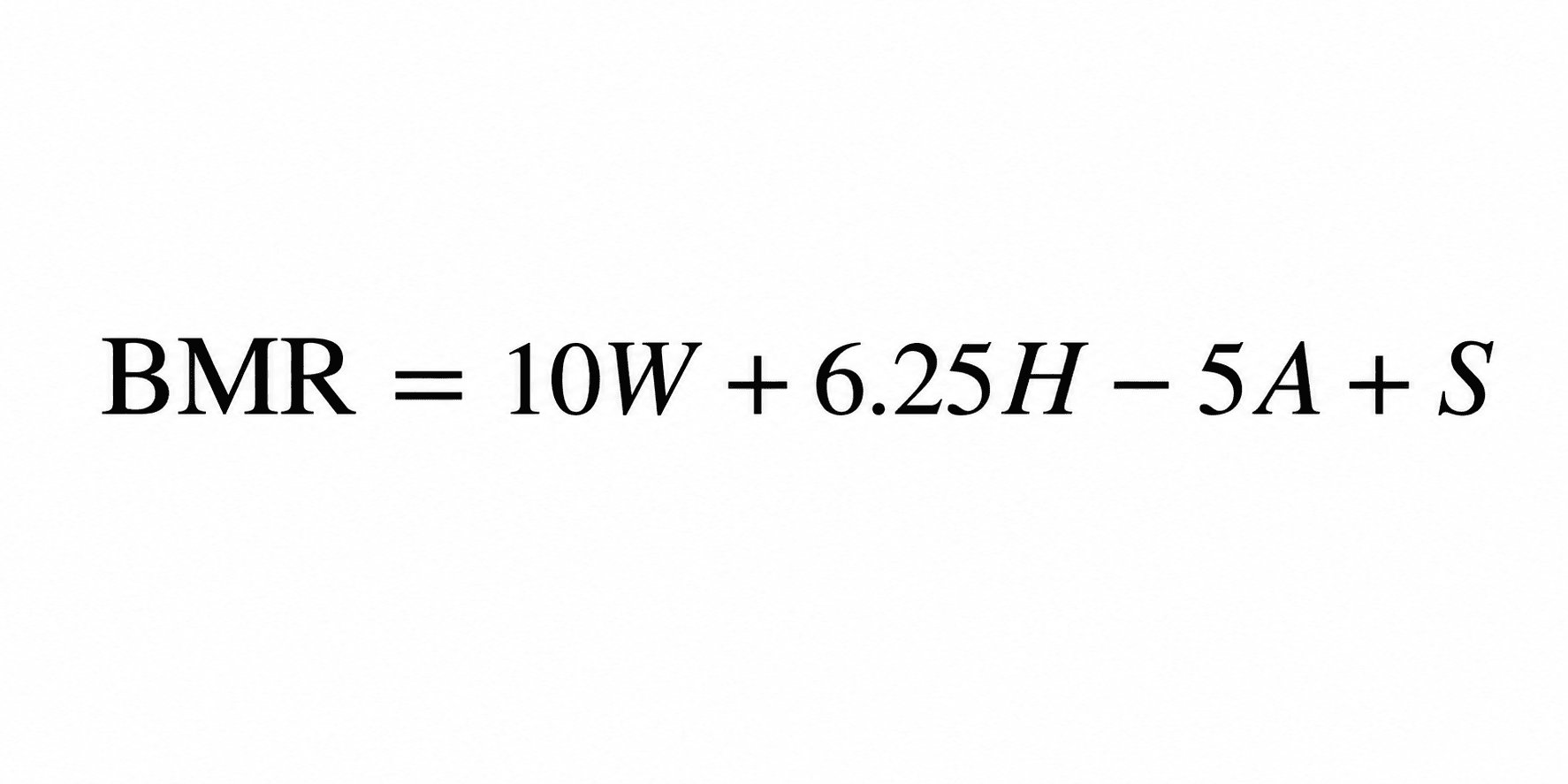
In this formula, W means weight in kilograms, H means height in centimeters, and A means age in years. The final number changes slightly depending on sex.
For Men
BMR = 10 × weight + 6.25 × height − 5 × age + 5
For Women
BMR = 10 × weight + 6.25 × height − 5 × age − 161
What It Means
The result estimates how many calories your body may burn each day at rest before activity is added.
Enter Basic Body Data
Most BMR formulas use age, height, weight, and sex as key inputs.
Estimate Resting Calorie Burn
The formula gives an estimated baseline number of calories your body may use each day at rest.
Add Activity Later
After estimating BMR, activity level can be added to estimate maintenance calories more realistically.
Important Note
BMR is only an estimate. Your real calorie needs can still vary based on activity, muscle mass, health, sleep, stress, and daily routine.
You can pair this guide with a BMR Calculator, Calorie Needs Calculator, Macro Calculator, and How Many Calories Should You Eat Per Day? to make the number more useful in real life.
BMR vs RMR: Are They the Same?
BMR (basal metabolic rate) and RMR (resting metabolic rate) are often used interchangeably, but they are slightly different.
BMR is measured under strict conditions, while RMR is a more practical estimate of calories burned at rest in everyday situations.
In most cases, the difference is small, and both are used to estimate baseline calorie needs.
Why BMR Matters for Weight Loss, Maintenance, and Nutrition Planning
Your basal metabolic rate gives you a starting point. It shows the baseline amount of energy your body may need before you factor in movement, exercise, and daily activity.
Once you have that baseline, it becomes much easier to adjust your daily calorie intake depending on your goal:
Weight Loss
You can create a calorie deficit from a more realistic starting point instead of guessing too low.
Weight Maintenance
You can estimate maintenance calories more accurately when BMR is combined with your activity level.
Muscle Gain
You can increase calories in a controlled way to support training, recovery, and gradual progress.
Better Awareness
You start to understand how your metabolism works instead of relying on random numbers or trends.
Instead of following a fixed number, BMR helps you build a calorie target that actually fits your body and your routine.
Helpful tools for calorie planning
If you are using BMR for weight loss, maintenance, or muscle gain, a digital kitchen scale and meal prep containers can help you stay more consistent.
Shop calorie planning tools on AmazonShould You Eat Only Your BMR to Lose Weight?
A common misconception is that eating at your BMR will lead to weight loss. In reality, this is usually too low for most people.
Your BMR only represents calories burned at rest. Your body still needs additional energy for daily movement, digestion, and activity.
Eating only your BMR can be too restrictive and may not be sustainable.
A more practical approach is to estimate your total daily energy expenditure (TDEE) and create a moderate calorie deficit from that number.
Common Misunderstandings About BMR
BMR is not your full calorie burn
Your total daily calorie burn is usually higher because daily activity and exercise are not included in BMR alone.
A higher BMR is not automatically better
BMR is simply an estimate of resting energy use. It is not a grade or a score of health on its own.
BMR formulas are estimates
They are helpful starting points, but real-world calorie needs can still differ based on individual physiology and lifestyle.
BMR should be used with context
For practical nutrition planning, it usually works best when combined with activity level, goals, and real progress tracking.
Simple Takeaway
- Understand that BMR means calories burned at rest.
- Use BMR as a baseline, not as your complete daily calorie target.
- Add activity to move from BMR toward a more realistic daily calorie estimate.
- Adjust intake based on your goal: fat loss, maintenance, or gain.
- Use calculators and real progress over time to refine your estimate.
Related Health Tools
Use these calculators to turn what you learned about BMR into more practical calorie, nutrition, and body metric estimates.
Related Health Guides
Read these guides next if you want to better understand calories, metabolism, body composition, and healthy weight planning.
Frequently Asked Questions
What is BMR?
BMR stands for Basal Metabolic Rate. It refers to the number of calories your body needs at rest to support essential functions such as breathing, circulation, and temperature regulation.
How does BMR work?
BMR works as your body's baseline energy requirement. Even when you are resting, your body still uses calories to keep vital systems functioning properly.
Is BMR the same as TDEE?
No. BMR is the calories your body uses at rest, while TDEE includes BMR plus activity, exercise, and daily movement.
Why is BMR important for weight loss?
BMR helps estimate your baseline calorie needs. From there, you can better understand maintenance calories, calorie deficits, and calorie targets for weight goals.
How do you calculate BMR?
BMR is commonly estimated using formulas based on age, sex, height, and weight. Many people use a BMR calculator for a quick and practical estimate.
Important Note
This guide is for educational purposes only and is not medical advice. BMR formulas provide estimates, not exact measurements, and real calorie needs can vary. People with medical conditions, nutrition concerns, or specialized goals may need individualized professional guidance.