Most people looking up calorie recommendations are really trying to figure out whether they are eating too much, too little, or somewhere close to what their body actually needs.
The confusing part is that calorie needs are rarely identical from one person to another. Someone who sits most of the day may feel fine eating far less than someone constantly moving, training, working long shifts, or recovering from intense workouts.
That is why generic calorie charts only tell part of the story. Real-life factors like activity level, consistency, muscle mass, stress, sleep, and daily routine can all change how many calories actually feel sustainable and realistic.
Calorie recommendations are useful because they help people understand energy needs. But they can also be confusing when they are treated like exact rules. A sedentary person, an active parent, an athlete, a desk worker, and someone with a physical job may all need very different calorie intakes.
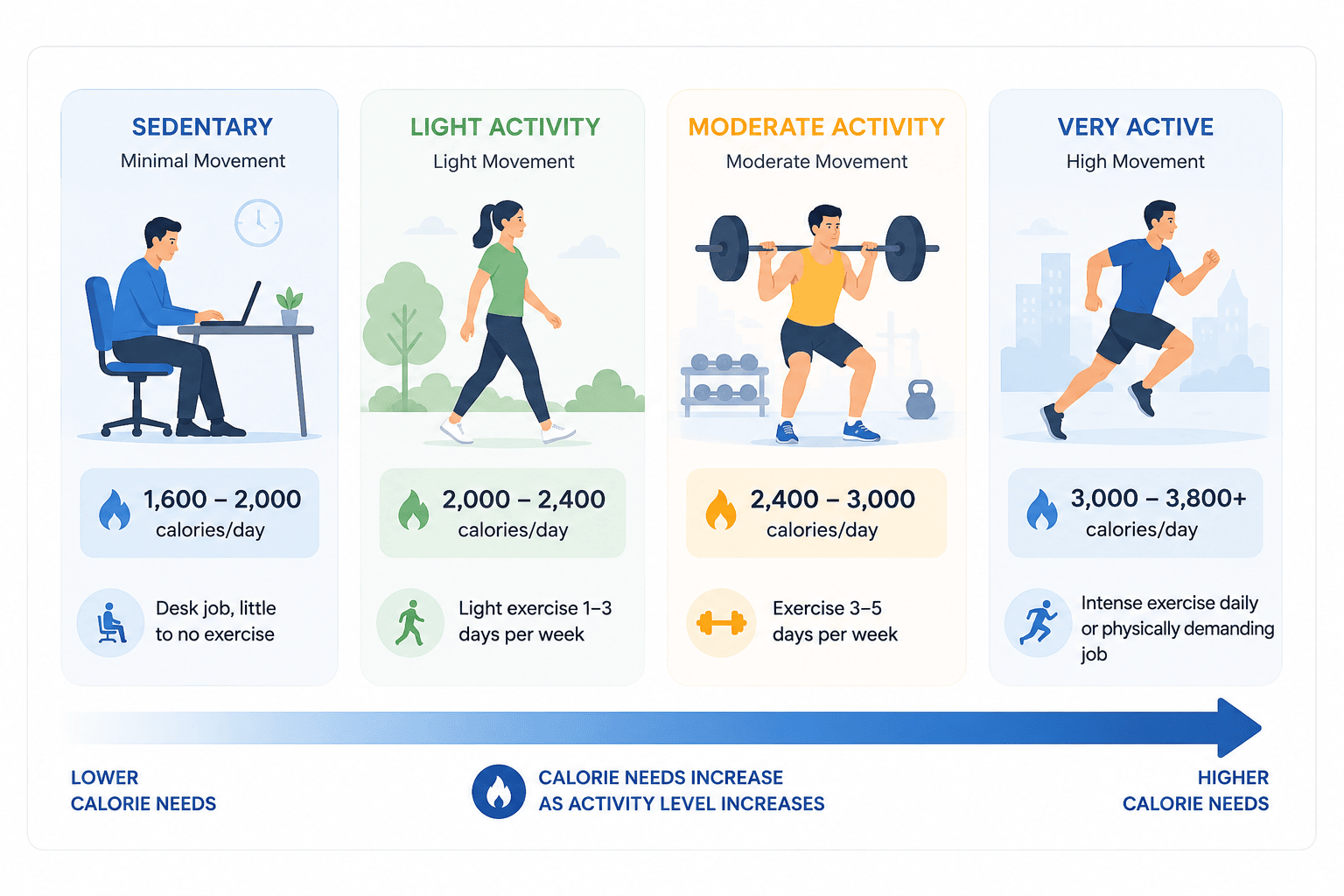
Daily calorie needs can vary significantly depending on activity level, lifestyle, movement, and overall routine.
Quick Navigation
- What recommended daily calories actually mean
- Why the same calories work differently for different people
- Average daily calorie ranges
- Recommended calories for women and men
- How activity level changes calorie needs
- Real-life calorie intake examples
- Recommended calories by goal
- Signs your calorie intake may not match your body
- How to estimate your calorie intake
- Healthy tracking vs obsessive tracking
- Common calorie intake mistakes
- Practical ways to manage calories realistically
- FAQ
- References & Sources
What Daily Calorie Recommendations Actually Mean
Daily calorie recommendations are best thought of as starting points, not strict rules. They can help you estimate where to begin, but they cannot perfectly predict how every individual body responds.
Two people can eat the same number of calories and still experience completely different results. One person may maintain weight easily while another feels constantly hungry, low on energy, or unable to recover properly from workouts.
A lot of factors influence calorie needs in everyday life, including movement, muscle mass, workout intensity, sleep quality, stress levels, work routine, and eating consistency over time.
This is one reason long-term progress usually comes from adjustment and observation instead of trying to follow a single “perfect” calorie number forever.
General Recommendation
A broad estimate that helps explain typical calorie needs for adults.
Personal Target
A more useful number based on your age, size, activity, and goal.
Maintenance Calories
The calories you eat to keep your weight relatively stable over time.
Goal-Based Calories
Your calorie intake adjusted for weight loss, maintenance, or muscle gain.
That is why two people can follow the same recommended calorie chart and get different results. One person may lose weight, another may maintain, and another may gain depending on their actual calorie needs.
Why the Same Calorie Intake Works Differently for Different People
One of the biggest reasons people get frustrated with calorie advice is because they assume calorie recommendations should work the same way for everyone.
In reality, calorie intake is highly personal. A person working from home at a desk all day may burn far fewer calories than someone who walks 15,000 steps daily without even exercising. Someone with more muscle mass usually burns more calories than someone with less muscle, even at the same body weight.
Sleep, stress, dieting history, hormones, food choices, and consistency can also affect how people feel at the same calorie intake.
| Person | Same Calories | Possible Result |
|---|---|---|
| Office worker with low movement | 2,200/day | Possible weight gain |
| Active gym-goer | 2,200/day | Maintenance or weight loss |
| Manual labor worker | 2,200/day | Possible fatigue and hunger |
Important Takeaway
Generic calorie charts are useful for learning, but long-term success usually comes from adjusting based on your own body, routine, hunger, energy, and progress.
Average Daily Calorie Intake Ranges
Average calorie ranges can help provide context, but they are not meant to work as exact targets for everyone. They are more useful for understanding general patterns than creating a personal nutrition plan.
Lower Calorie Needs
Usually seen in smaller bodies, older adults, or people with low daily movement.
Moderate Calorie Needs
Common for people with average activity levels, regular walking, and normal daily routines.
Higher Calorie Needs
Usually seen in taller bodies, active jobs, athletes, frequent exercisers, or people with more muscle.
Helpful Reminder
Average calorie ranges are not good or bad. They are just broad references. Your personal intake should be based on your own body, lifestyle, and progress.
For more context, you can read Average Calories Per Day.
Recommended Daily Calorie Intake for Women and Men
Calorie charts are often separated for women and men, but daily routine and activity level usually influence calorie needs just as much as biological differences.
Women
Women often need fewer calories on average, but active women, taller women, and women with more muscle may need much more than a generic estimate.
Men
Men often need more calories on average, but sedentary men may need fewer calories than very active women.
Adults
Adult calorie needs vary widely because work, activity, training, sleep, and lifestyle patterns vary widely.
Individual Needs
Your personal number is more useful than a broad recommendation because it reflects your actual routine.
For deeper guides, see Daily Calories for Women and Daily Calories for Men.
How Activity Level Changes Recommended Calories
Daily movement changes calorie needs far more than many people expect. Someone with a mostly seated routine will usually need fewer calories than someone walking all day, training regularly, or working a physically demanding job.
Sedentary Routine
Mostly seated work, low daily steps, and little structured exercise usually mean lower calorie needs.
Light Activity
Some walking, errands, chores, or light workouts can raise calorie needs above a sedentary estimate.
Moderate Activity
Regular workouts, higher steps, and more movement throughout the day increase energy needs.
High Activity
Hard training, sports, physical labor, or long active days can raise daily calorie needs significantly.
This is why the same recommended calorie intake will not work for everyone. Your actual routine matters more than the label on a chart.
Real-Life Examples of Daily Calorie Needs
Sometimes calorie recommendations make more sense when you compare them to real routines instead of generic labels.
College Student
A student walking around campus daily may burn more calories than expected even without structured workouts.
Remote Worker
Someone working from home with very little movement may need fewer calories than they assume.
Gym Beginner
Starting exercise can increase calorie needs slightly, but many beginners overestimate how many calories workouts burn.
Busy Parent
Constant movement, errands, chores, and childcare can significantly increase energy needs throughout the day.
This is one reason calorie calculators are usually more useful than relying only on average charts. Your daily lifestyle often matters more than broad labels like “active” or “sedentary.”
Recommended Daily Calories by Goal
The same calorie intake can lead to very different outcomes depending on your goal. A number that maintains weight for one person could feel too low for muscle gain or too high for steady fat loss.
Weight Loss
Most people need to eat below maintenance calories to lose weight over time.
Maintenance
Maintenance means eating close to your total daily energy use so weight stays fairly stable.
Muscle Gain
Muscle gain often needs enough calories to support training, protein intake, and recovery.
For weight loss, see Daily Calorie Intake for Weight Loss. For maintenance, see Calories to Maintain Weight.
How to Estimate Your Recommended Daily Calorie Intake
A calorie calculator is usually the easiest way to get a realistic starting estimate. From there, real-life progress, hunger levels, energy, workouts, and consistency help determine whether adjustments are needed.
- Estimate your BMR using age, height, weight, and sex.
- Adjust for activity level to estimate total daily energy expenditure.
- Choose your goal: weight loss, maintenance, or muscle gain.
- Follow the target consistently for a few weeks.
- Track weight trend, energy, hunger, workouts, and measurements.
- Adjust slowly if your results do not match your goal.
You can use a Calorie Needs Calculator, BMR Calculator, and How Many Calories Do I Need Per Day? to estimate a more personal target.
Helpful Tools for Tracking Calories, Activity, and Progress
Disclosure: This section may contain affiliate links. If you buy through these links, LifeToolSuit may earn a small commission at no extra cost to you. These tools are optional and are meant to help you track calorie intake, activity, and long-term progress more easily.
Digital Food Kitchen Scale
A simple food scale can make calorie tracking much more accurate, especially for beginners learning portion sizes.
View on AmazonFitness Tracker Watch
Helpful for tracking daily movement, step count, workouts, and activity trends throughout the week.
View on AmazonSmart Body Weight Scale
Useful for monitoring long-term weight trends alongside calorie intake and activity changes.
View on AmazonMeal Prep Containers
Helps simplify meal planning, portion consistency, and calorie management during busy weeks.
View on AmazonHealthy Tracking vs Obsessive Tracking
Tracking calories can be useful, especially for beginners learning portion sizes and eating patterns. But many people eventually discover that tracking works best when it stays flexible and realistic.
Some people benefit from detailed calorie tracking. Others do better with simpler habits like eating more protein, improving meal consistency, reducing liquid calories, or becoming more active.
Helpful Tracking
Uses calorie awareness as a guide without creating guilt or stress around every meal.
Obsessive Tracking
Creates anxiety, constant food thoughts, fear of social eating, or unrealistic perfection.
Balanced Approach
Focuses on long-term consistency instead of trying to eat “perfectly” every day.
Most Sustainable Plans Feel Realistic
The best calorie target is usually one you can maintain consistently without feeling miserable, socially isolated, or mentally exhausted.
Common Mistakes With Recommended Calorie Intake
Most calorie mistakes are not caused by lack of effort. They usually happen because people follow overly simplified advice that ignores real-life routines, hunger, consistency, stress, or sustainability.
Many calorie-related frustrations happen because people expect generic recommendations to work perfectly without adjustment. In reality, calorie planning usually works best when it stays flexible and realistic.
Treating Recommendations as Rules
A general recommendation is not automatically your personal target.
Ignoring Activity Level
Movement, steps, workouts, and job activity can change calorie needs significantly.
Choosing Too Low a Target
Very low calorie targets can make hunger, fatigue, and consistency harder.
Never Adjusting
Your needs can change when your weight, routine, training, or lifestyle changes.
Think of It as a Starting Point
The best calorie target is not the most generic one. It is the one that works with your actual body, habits, and progress over time.
Simple Takeaway
- Recommended daily calorie intake is a general guideline, not an exact personal rule.
- Your needs depend on body size, activity level, age, metabolism, and goal.
- Weight loss usually needs calories below maintenance.
- Maintenance means eating close to your total daily energy use.
- Muscle gain often needs enough calories to support training and recovery.
- Use a calculator as a starting point, then adjust based on real results.
Practical Ways to Manage Calories Without Making Life Miserable
Sustainable calorie management usually looks much more flexible than social media makes it seem.
- Build meals around protein and filling foods first.
- Do not panic over one high-calorie meal or weekend.
- Track trends over time instead of obsessing over daily fluctuations.
- Increase movement gradually instead of relying only on eating less.
- Choose calorie targets you can realistically maintain for months.
- Focus on consistency more than perfection.
People who succeed long term usually create habits they can repeat consistently. The goal is not to eat perfectly. The goal is to build an approach that still works during busy weeks, holidays, stress, travel, and normal life.
Frequently Asked Questions
What is the recommended daily calorie intake?
It is a general estimate of how many calories a person may need per day. Your own number depends on age, height, weight, sex, activity level, metabolism, and goal.
How many calories should I eat per day?
It depends on your body and goal. If you want to lose weight, you usually need fewer calories than maintenance. If you want to maintain, you need to eat near maintenance. If you want to gain muscle, you may need more.
Are recommended calorie intake numbers accurate?
They are broad estimates, not exact personal targets. They are helpful for context, but a calculator and progress tracking are usually better for planning.
What affects my daily calorie intake?
Body size, age, sex, muscle mass, activity level, exercise, daily steps, metabolism, sleep, stress, and your goal all affect calorie needs.
What is the recommended calorie intake for weight loss?
Weight loss usually requires eating below maintenance calories. The best calorie deficit is often moderate and sustainable rather than extremely low.
What is the recommended calorie intake for maintenance?
Maintenance calories are the calories you can eat while weight stays relatively stable. This number is usually close to your total daily energy expenditure.
Should I use average recommendations or a calculator?
Average recommendations are useful for learning, but a calculator is better for estimating your own needs because it uses your personal information.
References & Sources
This guide was created using publicly available nutrition and energy balance references combined with practical calorie-planning principles commonly used in weight management and fitness education.
- Dietary Guidelines for Americans
- National Institutes of Health (NIH)
- Centers for Disease Control and Prevention (CDC)
- World Health Organization (WHO)
- Sports nutrition and energy balance research
Editorial Note
This guide is regularly reviewed to improve accuracy, clarity, readability, and usefulness for everyday readers trying to better understand calorie intake and nutrition planning.
Related Health Tools
Related Calorie & Nutrition Guides
Important Note
This guide is for educational purposes only and is not medical advice. Calorie needs can vary widely, especially during pregnancy, breastfeeding, medical conditions, eating disorder recovery, intense training, or major lifestyle changes. If you have personal medical or nutrition concerns, a qualified professional can provide guidance that fits your situation.