Most people just want a clear number to follow, but calorie needs don’t really work that way. What works for one person can feel completely off for someone else.
Your calorie needs shift based on things like your body size, activity level, and daily routine. Even for the same person, the “right” number can change depending on whether you’re trying to lose weight, maintain, build strength, or just get through a busy season with enough energy.
Quick Navigation
- What daily calories mean
- Average daily calories for women
- Real-life calorie scenarios
- What affects calorie needs
- Daily calories for weight loss
- Warning signs calories may be too low
- Daily calories for maintenance
- Daily calories for muscle gain
- How to estimate your calories
- Quick self-check section
- Common calorie myths
- Common mistakes women make
- Editorial process
- References and sources
- Frequently asked questions
Why Calorie Advice Feels So Confusing for Many Women
Most women start looking into calories because something feels off. Maybe progress has stalled, energy feels low, workouts are getting harder, or online advice keeps giving completely different numbers.
Calories are simply your body’s fuel source, but how much fuel you personally need can vary a lot depending on your lifestyle, movement, body size, muscle mass, stress levels, and overall routine.
For some women, the problem is eating too much without realizing it. For others, it is actually under-eating for long periods and constantly feeling drained, hungry, or stuck in a restrict-and-binge cycle.
Weight Loss
Eating fewer calories than your body uses over time. The goal is steady progress, not extreme restriction.
Maintenance
Eating roughly the same amount of calories your body burns so weight stays fairly stable.
Muscle Gain
Eating enough calories, protein, and nutrients to support training, recovery, and gradual muscle growth.
General Wellness
Eating enough to support energy, focus, mood, workouts, daily movement, and normal body function.
A useful calorie target should match the goal. A woman trying to lose weight may need a different intake than the same woman training for strength, maintaining weight, or recovering from a demanding routine.
Why Two Women Can Need Completely Different Calories
A lot of women search for a single “correct” calorie number, but real life rarely works that neatly.
Two women can be the same age and height while needing very different amounts of food depending on how active they are, how much muscle they carry, how often they walk, how they train, and what their daily routine looks like.
This is why generic charts sometimes feel frustrating. They can give a rough starting point, but they cannot fully account for your actual lifestyle.
Sedentary Women
Women with low daily movement usually need fewer calories because they burn less through activity.
Moderately Active Women
Women who walk, exercise a few times per week, or move often may need more calories.
Very Active Women
Women who train hard, have active jobs, or walk many steps may need significantly more calories.
Important Reminder
Averages can give context, but your actual calorie needs may be higher or lower. Think of them as a rough map, not your exact destination.
This is why a Calorie Needs Calculator can be more useful than a generic chart. It lets you estimate calories based on your own details instead of guessing from a broad average.
Why Two Women Can Need Completely Different Calories
One of the biggest reasons calorie advice feels confusing is because two women can look similar on paper while living completely different lifestyles.
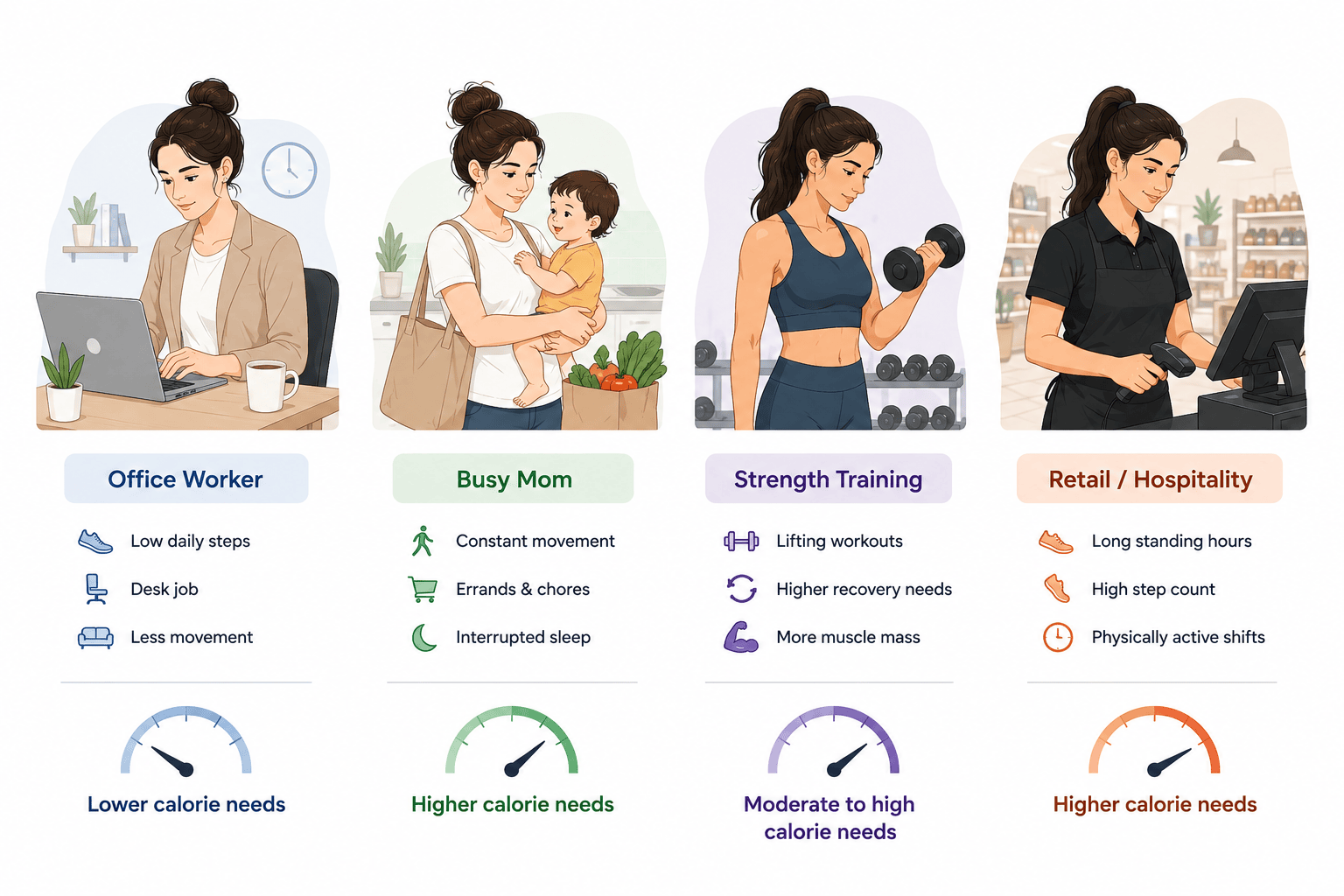
| Scenario | What Daily Life Looks Like | Likely Calorie Needs |
|---|---|---|
| Office Worker | Sits most of the day, low daily steps, little structured exercise | Usually lower |
| Busy Mom | Constant movement, errands, carrying kids, interrupted sleep | Often higher than expected |
| Strength Training Woman | Lifts weights 4–5 times weekly with high protein intake | Moderate to high |
| Retail or Hospitality Worker | Long hours standing, walking, lifting, and moving through shifts | Often much higher |
This is why copying someone else’s calorie target from TikTok, YouTube, or Reddit often backfires. Their routine may look nothing like yours.
What Actually Changes a Woman’s Calorie Needs?
One reason calorie tracking feels confusing is because people often underestimate how much daily habits affect energy needs.
Someone who walks 12,000 steps daily, lifts weights after work, and sleeps well may burn far more energy than someone with a mostly sedentary routine, even if their body size looks similar.
Small things add up too. Busy work shifts, frequent errands, chasing kids around, poor sleep, stress eating, and inconsistent routines can all influence appetite, recovery, and calorie needs over time.
Height and Weight
Taller or heavier bodies usually need more energy to function and move throughout the day.
Muscle Mass
Muscle uses energy even at rest, so women with more lean mass often have higher calorie needs.
Activity Level
Daily steps, workouts, chores, errands, and physical jobs can raise calorie needs a lot.
BMR and Metabolism
Your BMR is the energy your body uses at rest for basic functions like breathing and circulation.
Age and Life Stage
Calorie needs can shift with age, pregnancy, breastfeeding, hormonal changes, stress, sleep, and routine changes.
Your Goal
Fat loss, maintenance, and muscle gain all call for different calorie strategies.
If your activity changes, your calorie needs can change too. A desk-work week, a vacation with more walking, a new strength program, or a busier season at work can all shift your daily energy use.
Why Aggressive Low-Calorie Diets Often Backfire
Most women already know weight loss involves eating fewer calories than the body burns. The difficult part is finding a deficit that still feels realistic enough to maintain.
This is where many people struggle. Online advice often pushes aggressive calorie targets that technically create faster weight loss, but become mentally exhausting after a few weeks.
In practice, slower and more sustainable progress usually works better long term because it is easier to repeat consistently without feeling miserable all day.
Start With Maintenance
It helps to estimate maintenance calories first, then reduce slightly from there.
Keep Protein High Enough
Protein supports fullness and helps preserve muscle during fat loss.
Do Not Cut Too Hard
Very low calories can make hunger, fatigue, and inconsistency worse.
Track Trends
Look at weight, waist, energy, strength, and consistency over several weeks.
About Very Low Calorie Targets
Many women search whether 1200 calories is enough. For some women, that can be too low, especially if they are active, taller, training, breastfeeding, or trying to maintain good energy. A better approach is to estimate your own needs instead of starting with the lowest number you see online.
If a calorie target makes you feel constantly drained, overly hungry, irritable, or unable to recover from normal workouts, it may not be the right target for you.
Warning Signs Your Calories May Be Too Low
Many women assume feeling exhausted or constantly hungry is just part of dieting. In reality, some calorie targets become so aggressive that they are difficult to sustain for more than a few weeks.
Constant Food Thoughts
If you spend most of the day thinking about food, meals, snacks, or cravings, your intake may be too restrictive.
Energy Crashes
Feeling drained during workouts, afternoon crashes, or struggling to focus can sometimes signal under-eating.
Poor Workout Recovery
If soreness lasts unusually long or strength keeps dropping, your body may not be recovering properly.
Binge-and-Restrict Cycles
Extremely low calorie targets often create a cycle of “being good” followed by overeating later.
Important Perspective
A calorie target only works if you can realistically maintain it. The “best” calorie goal is not the lowest number. It is the one you can follow consistently while still functioning well physically and mentally.
What Maintenance Calories Actually Look Like in Real Life
Maintenance calories are usually less precise than people expect. Your body weight naturally fluctuates from day to day because of water retention, hormones, digestion, sodium intake, stress, and sleep.
This means maintenance is better viewed as a range rather than one perfect number. If your weight stays relatively stable across several weeks, you are probably eating somewhere close to maintenance.
Many women are surprised to discover their maintenance calories are actually higher than they assumed, especially once activity levels and daily movement are factored in properly.
Estimate BMR
BMR is your resting energy use before activity is added.
Add Activity
Daily movement, workouts, and exercise increase your total calorie needs.
Watch the Trend
If your weight stays mostly stable over time, you are probably close to maintenance.
Maintenance is useful even if your long-term goal is weight loss. Spending time at maintenance can help you understand your normal intake, improve energy, and make your plan feel less all-or-nothing.
Why Eating Too Little Can Hurt Muscle Growth and Recovery
One of the most common mistakes women make during strength training is trying to build muscle while eating too little for recovery.
Muscle growth requires more than just workouts. Your body also needs enough food, protein, sleep, and recovery support to actually adapt to training.
Some women are afraid that eating slightly more will automatically lead to excessive fat gain, but in many cases a small increase in calories can improve training performance, recovery, strength, and body composition over time.
Body Recomposition
Some women can build muscle and lose fat slowly while eating near maintenance.
Small Surplus
A small calorie surplus may help support strength and muscle gain without rapid fat gain.
Training Recovery
Calories, protein, sleep, and progressive lifting all matter for muscle growth.
If you are lifting consistently but always feel weak, sore, under-recovered, or hungry, your calorie intake may be too low for your training routine.
How to Find a Calorie Target You Can Actually Sustain
The biggest mistake people make with calorie calculators is treating the result like a guaranteed answer instead of an estimate.
Your real maintenance calories are discovered through observation over time. The calculator simply gives you a smarter place to begin instead of guessing randomly.
This is why tracking trends matters more than obsessing over a single day of eating or one weigh-in on the scale.
- Estimate your BMR using your age, height, weight, and sex.
- Adjust for activity level to estimate your maintenance calories.
- Choose your goal: lose weight, maintain weight, or gain muscle.
- Track your average weight, energy, hunger, and performance for a few weeks.
- Adjust slowly if the trend is not matching your goal.
You can pair this guide with a Calorie Needs Calculator, BMR Calculator, and What Is BMR and How Does It Work? to get a better starting point.
Quick Self-Check: Is Your Current Calorie Target Working?
Instead of asking whether your calories are “perfect,” ask whether your current approach is producing realistic results you can actually maintain.
- Are you constantly hungry all day?
- Do you feel physically drained most afternoons?
- Are your workouts getting weaker?
- Can you realistically follow this plan next month?
- Are you obsessing over every meal?
- Is your progress steady instead of extreme?
Many successful long-term transformations happen slower than social media makes them look. A slower plan that you can repeat consistently usually beats an aggressive plan that collapses after two weeks.
Common Calorie Myths That Confuse Women
“1200 Calories Is Standard”
This number became popular online, but many women need significantly more depending on activity and body size.
“Eating Less Always Means Faster Results”
Extremely low calories often increase burnout, cravings, and inconsistency.
“One Calculator Is Perfect”
Calculators provide estimates, not guarantees. Real-life adjustments matter.
“You Must Be Perfect Every Day”
Long-term progress usually comes from consistency across weeks and months, not perfection every single day.
Why So Many Women Struggle to Stay Consistent With Calories
A lot of calorie advice online unintentionally creates more stress instead of more clarity.
Many women end up constantly adjusting numbers, restarting diets every Monday, or chasing unrealistic targets they found on social media.
In most cases, consistency matters far more than trying to follow a “perfect” calorie number every single day.
Starting Too Low
Choosing the lowest number you find online can lead to fatigue, hunger, and poor consistency.
Ignoring Activity
A woman who trains, walks a lot, or has an active job may need more food than expected.
Reacting to Daily Scale Changes
Daily weight changes are normal. Trends over several weeks matter more than one weigh-in.
Forgetting Nutrition Quality
Calories matter, but protein, fiber, micronutrients, and meal satisfaction matter too.
Simple Takeaway
- No single daily calorie number fits all women.
- Your needs depend on your body, activity, metabolism, and goal.
- Weight loss usually needs a moderate calorie deficit.
- Maintenance means eating close to total daily energy use.
- Muscle gain often needs enough calories to support training and recovery.
- Use calculators as a starting point, then adjust based on real results.
Frequently Asked Questions
How many daily calories do women need?
There is no single calorie number that works for every woman. Someone with an active job, regular workouts, and higher muscle mass may need far more food than someone with a mostly sedentary routine.
This is why calorie calculators are best used as starting points rather than strict rules.
How many calories should a woman eat to lose weight?
Most women need a calorie deficit to lose weight. That means eating below maintenance calories while still getting enough protein, nutrients, and energy to stay consistent.
How many calories should a woman eat to maintain weight?
Maintenance calories are the calories a woman can eat while her weight stays fairly stable. This includes calories used for BMR, movement, exercise, digestion, and daily activity.
Do active women need more calories?
Yes. Women who exercise, walk often, train hard, or have physically demanding routines usually need more calories than women who are mostly sedentary.
Is 1200 calories enough for women?
For many women, 1200 calories may be too low, especially if they are active, taller, training, breastfeeding, or trying to maintain energy. It is better to estimate your own needs instead of assuming one low number is right for everyone.
Should women eat more on workout days?
Some women prefer eating a little more on harder workout days, while others prefer keeping calories consistent. Either approach can work if the weekly intake supports the goal.
What if my calories feel too low?
If you feel constantly tired, hungry, weak, irritable, or unable to recover from workouts, your calorie target may be too low. Consider adjusting slowly or getting professional guidance if needed.
Helpful Products That Can Support Calorie Tracking and Healthy Habits
Calorie tracking does not need to become obsessive or overly complicated. Sometimes a few simple tools can make portion awareness, meal consistency, hydration, and progress tracking much easier in daily life.
Disclosure: This section may contain affiliate links. If you buy through these links, LifeToolSuit may earn a small commission at no extra cost to you. These tools are optional and are meant to help support calorie tracking, portion awareness, hydration, and overall nutrition habits.
Digital Food Scale
Helps improve portion accuracy when tracking calories, protein, and meal sizes at home.
View on AmazonMeal Prep Containers
Useful for meal planning, portion control, calorie consistency, and reducing random snacking.
View on AmazonSmart Body Weight Scale
Tracks body weight trends over time and can help monitor progress during weight loss or maintenance.
View on AmazonHydration Tracking Water Bottle
Staying hydrated may help energy levels, appetite control, workout recovery, and daily consistency.
View on AmazonEditorial Process
This guide was reviewed for clarity, practicality, and consistency with current nutrition and calorie-management principles. The goal of LifeToolSuit health guides is to make complex health and fitness topics easier to understand for everyday readers without relying on extreme dieting advice or unrealistic fitness expectations.
Content is periodically updated to improve accuracy, readability, and user usefulness.
References and Sources
- Dietary Guidelines for Americans
- Academy of Nutrition and Dietetics
- National Institutes of Health (NIH)
- Harvard T.H. Chan School of Public Health
- Peer-reviewed research on calorie expenditure, metabolism, and weight management
Important Note
This guide is for educational purposes only and is not medical advice. Calorie needs can vary widely, especially during pregnancy, breastfeeding, medical conditions, eating disorder recovery, intense training, or major lifestyle changes. If you have personal medical or nutrition concerns, a qualified professional can provide guidance that fits your situation.