A lot of people try to lose weight by eating as little as possible, but that usually creates more frustration than progress. Understanding how BMR actually works can help you build a calorie target that feels more realistic, sustainable, and easier to maintain long term.
BMR is often misunderstood. Some people treat it like the exact number they should eat to lose weight, but that is not usually the best approach. Your BMR is only your resting calorie burn. Your actual daily calorie needs are higher once movement, walking, work, exercise, digestion, and normal daily life are included.
Quick Navigation
- What BMR means for weight loss
- Why so many people misunderstand BMR
- BMR vs TDEE for weight loss
- A realistic BMR and calorie deficit example
- Should you eat below your BMR?
- Warning signs your calorie target may be too aggressive
- How BMR helps create a calorie deficit
- What affects BMR during weight loss
- How exercise and fitness affect weight loss calories
- Cardio vs strength training for fat loss
- How to use BMR the right way
- Common mistakes
- Beginner misconceptions about metabolism
- Practical takeaways
- References and sources
- Editorial and review process
- FAQ
What Does BMR Mean for Weight Loss?
BMR stands for basal metabolic rate. It is the number of calories your body uses at rest for essential functions like breathing, circulation, organ function, brain activity, body temperature, and cell repair.
In weight loss, BMR matters because it is the foundation of your calorie needs. Before you count workouts, steps, or daily movement, your body already uses energy just to keep you alive.
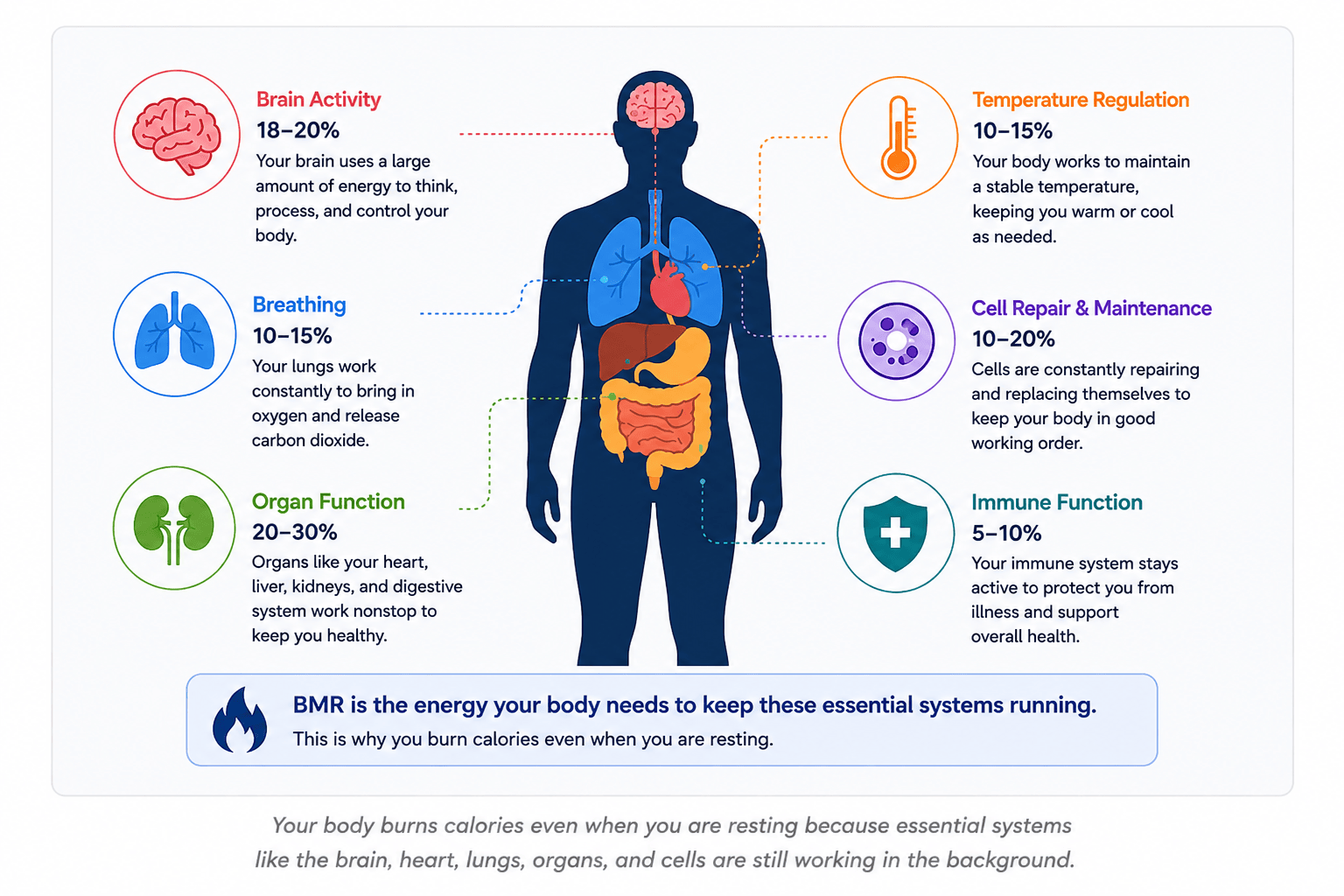
Your body burns calories even when you are resting because systems like the brain, lungs, organs, immune system, and cells are constantly working in the background.
Breathing
Your body uses calories to keep your respiratory system working all day and night.
Circulation
Your heart and blood vessels use energy to move blood and oxygen through your body.
Brain and Nerves
Your brain and nervous system need energy even when you are not exercising.
Organ Function
Your organs use energy for digestion, repair, filtering, regulation, and basic maintenance.
So when it comes to using BMR for weight loss, the simplest way to think about it is this: use BMR as a baseline, then estimate your full daily needs before setting a calorie deficit.
Why So Many People Misunderstand BMR
One of the biggest reasons people struggle with weight loss is because they misunderstand what BMR actually means in real life.
A lot of people search for their BMR, see a number like 1,400 or 1,600 calories, and immediately assume that eating below that number must lead to faster fat loss. On paper it sounds logical, but real life usually feels very different.
This is where many people accidentally create diets that are too restrictive to maintain. They start skipping meals, constantly thinking about food, losing energy during workouts, struggling with cravings at night, or feeling exhausted during work and daily life.
What Most People Realize Too Late
Your body is not only burning calories while lying still. Walking, standing, cleaning, working, exercising, digestion, stress, movement, and even fidgeting all increase daily energy use beyond BMR.
This is why two people with the exact same BMR can have very different calorie needs. Someone working a physically demanding job or walking 12,000 steps daily will usually need far more calories than someone sitting most of the day.
In practice, successful weight loss usually comes from consistency rather than choosing the lowest calorie number possible.
BMR vs TDEE for Weight Loss
BMR and TDEE are related, but they are not the same. BMR is what your body burns at rest. TDEE is what your body burns in a full day.
BMR
Your resting calorie burn before exercise, walking, work, or daily activity is included.
TDEE
Your total daily energy expenditure, including BMR, movement, workouts, digestion, and activity.
For Weight Loss
TDEE is usually the better number to use when setting your calorie target.
Simple Way to Think About It
BMR is your baseline. TDEE is your real-life daily burn. A weight loss calorie target is usually set below TDEE, not automatically below BMR.
If you want a deeper breakdown, read BMR vs TDEE. You can also estimate your full daily needs with a Calorie Needs Calculator.
A Realistic BMR and Calorie Deficit Example
Weight loss numbers usually make more sense when you see them in a realistic day-to-day example instead of only reading formulas.
Example Scenario
Imagine someone with a BMR of around 1,550 calories. They work an office job, walk daily, do light workouts a few times per week, and stay moderately active throughout the day.
BMR
1,550 calories
Resting calorie burn
Daily Activity
+550 calories
Walking, workouts, chores, digestion, work
Estimated TDEE
2,100 calories
Total daily calorie burn
Moderate Weight Loss Target
A realistic calorie target might be around 1,700–1,800 calories per day, which still creates a deficit while allowing more flexibility and consistency.
What Most People Miss
Notice that the weight loss target is still ABOVE the person's BMR. Fat loss happens from being below total daily calorie burn, not necessarily below BMR itself.
Why This Matters
Many people assume they need to eat as little as possible to lose weight. In reality, a moderate and sustainable deficit is often easier to maintain, better for workout performance, and more realistic long term.
This is one reason many successful weight loss plans focus on consistency, exercise and fitness habits, walking, strength training, sleep, and realistic nutrition instead of extreme restriction.
Should You Eat Below Your BMR to Lose Weight?
This is one of the most common questions people have about BMR. In many cases, eating below BMR is too aggressive, especially if you are active, training, busy, or trying to maintain energy and consistency.
Remember, BMR does not include your daily activity. If you eat far below BMR, you may be creating a much larger deficit than you realize once your full daily energy use is included.
Too Low
May lead to fatigue, constant hunger, poor workouts, mood changes, and poor sustainability.
Moderate Deficit
Usually easier to follow because it supports weight loss while leaving more room for normal eating.
Too High
May not create enough deficit for weight loss if intake is close to or above maintenance.
Important Reminder
A calorie deficit should not feel like punishment. If your target makes you feel weak, distracted, constantly hungry, or unable to recover, it may be too low.
Warning Signs Your Calorie Target May Be Too Aggressive
Fast weight loss sounds appealing at first, but an overly aggressive calorie deficit often becomes difficult to maintain after a few weeks.
Many people mistake these warning signs as “lack of discipline” when the real issue is that the plan itself is unrealistic.
Constant Food Thoughts
Thinking about food all day is often a sign the deficit is too extreme.
Low Workout Performance
If your strength, endurance, or recovery drops hard, calories may be too low.
Poor Sleep
Very low calorie intake can increase hunger and make sleep quality worse.
Binge-Rebound Cycles
Extreme restriction often leads to overeating later because the plan is too difficult to sustain.
Better Long-Term Strategy
A slower but repeatable approach usually beats an aggressive plan that only lasts two weeks.
How BMR Helps You Create a Calorie Deficit
Weight loss usually requires a calorie deficit, which means eating fewer calories than your body uses over time. BMR helps you understand the baseline, but your deficit should usually be based on your total daily calorie burn.
Estimate BMR
Start by estimating your resting calorie burn with a BMR calculator.
Estimate TDEE
Add activity level, movement, workouts, and daily routine to estimate your full daily burn.
Create a Deficit
Eat below TDEE by a realistic amount and track progress over time.
For a detailed weight loss calorie guide, see Daily Calorie Intake for Weight Loss.
What Affects BMR During Weight Loss?
BMR can change during weight loss because your body is changing. As body weight decreases, the body often uses fewer calories than it did at a higher weight.
Body Size
A smaller body usually needs fewer calories to maintain basic functions.
Muscle Mass
Maintaining muscle can help support resting metabolism and body composition.
Activity Level
Steps, workouts, chores, and general movement affect total calorie burn more than BMR alone.
Dieting Approach
Very aggressive dieting can make energy, training, and consistency harder to maintain.
Sleep and Recovery
Poor sleep can affect hunger, cravings, energy, and workout quality.
Age and Routine
Changes in age, routine, stress, and activity can influence calorie needs over time.
How Exercise and Fitness Affect Weight Loss Calories
Exercise and fitness habits affect your total calorie burn far more than most people realize.
This is why physical activity matters so much during weight loss. Your workouts are not only about “burning calories.” They also affect muscle retention, energy levels, daily movement, fitness performance, and long-term sustainability.
For many people, increasing activity slightly is easier than endlessly lowering calories. Walking, cycling, treadmill sessions, and other forms of cardio for weight loss can help increase calorie burn while improving overall fitness and endurance.
Walking
Daily walking is underrated. Increasing steps consistently can support fat loss without making recovery harder.
Cardio Workouts
Cardio for weight loss can help increase calorie burn and improve fitness, especially when paired with realistic eating habits.
Strength Training
Resistance training helps preserve muscle while dieting and often improves body composition results.
For beginners, aerobic exercise for weight loss is often easier to maintain consistently than extreme workout plans because it can be adjusted to different fitness levels and recovery needs.
A common mistake is relying only on intense workouts while ignoring sleep, stress, recovery, and eating consistency. Sustainable fat loss usually comes from the combination of nutrition, exercise, fitness habits, and realistic expectations.
Cardio vs Strength Training for Fat Loss
Cardio and strength training can both support fat loss, but they help in different ways. Cardio usually helps you burn more calories during the workout, while strength training helps protect muscle and improve body composition over time.
Cardio
Best for improving endurance, increasing calorie burn, and supporting heart health.
Strength Training
Best for maintaining muscle, building strength, and helping your body look firmer as weight changes.
Best Approach
Combine both when possible. Use cardio for fitness and calorie burn, and strength training to support muscle and long-term results.
Simple Way to Think About It
Cardio helps you spend energy. Strength training helps you keep muscle. A realistic calorie deficit helps fat loss happen.
When Cardio Helps Most
Cardio workouts can be useful if you enjoy walking, cycling, treadmill workouts, swimming, or aerobic exercise for weight loss. They can help increase daily calorie burn without needing to lower food intake too aggressively.
When Strength Training Helps Most
Strength training is especially helpful when you want to lose fat without looking or feeling weak. It supports lean muscle, posture, strength, and better body composition.
Practical Weekly Example
- Strength training 3 times per week
- Walking most days
- Optional cardio 1–3 times per week
- A moderate calorie deficit based on TDEE, not BMR alone
You do not need to choose one forever. Many people get better results by using strength training as the foundation, then adding cardio or daily walking based on their energy, schedule, and recovery.
Helpful Fitness Tools for Weight Loss and Activity Tracking
Disclosure: This section may contain affiliate links. If you buy through these links, LifeToolSuit may earn a small commission at no extra cost to you. These tools are optional and are meant to support tracking, workouts, recovery, and long-term consistency.
Walking Pad Treadmill
Useful for increasing daily steps, walking during work hours, and adding low-impact cardio for weight loss at home.
View on AmazonFitness Tracker Watch
Helps track steps, workouts, calorie burn estimates, heart rate, and overall activity throughout the day.
View on AmazonAdjustable Dumbbells
Strength training can help maintain muscle while dieting and improve overall body composition during fat loss.
View on AmazonProtein Shaker Bottle
Helpful for protein shakes, hydration, and convenient nutrition during busy schedules or workouts.
View on AmazonHow to Use BMR for Weight Loss the Right Way
The best way to use BMR is to treat it as a starting point. It helps you understand your baseline, but your calorie target should also reflect your actual day.
- Calculate or estimate your BMR using your age, height, weight, and sex.
- Estimate your TDEE by adding activity level and daily movement.
- Set a moderate calorie deficit from your estimated TDEE.
- Prioritize protein, fiber, and meals you can repeat consistently.
- Track average weight and waist changes over several weeks.
- Adjust slowly if your progress is too fast, too slow, or too difficult to maintain.
You can start with a BMR Calculator, then use a Calorie Needs Calculator to estimate your total daily calorie needs.
Why Protein and Strength Training Matter
BMR is only one part of weight loss. If you want to lose fat while keeping your body strong, protein and strength training can make a big difference.
Protein
Supports fullness and helps maintain muscle while dieting.
Strength Training
Helps protect lean mass and supports better body composition.
Daily Steps
Walking and daily movement can support calorie burn without feeling like intense exercise.
Recovery
Sleep and rest help with hunger, energy, training, and consistency.
You can use a Macro Calculator to estimate protein, carbs, and fat targets for your plan.
Common Mistakes When Using BMR for Weight Loss
BMR is useful, but it can be misleading if you use it the wrong way. These are the most common mistakes people make.
Using BMR as the Diet Target
BMR is your resting baseline, not your full daily calorie need.
Eating Too Little
Very low calories can make hunger, fatigue, and poor consistency worse.
Ignoring Activity
Your daily steps, workouts, job, and routine can change calorie needs a lot.
Expecting Exact Accuracy
BMR calculators estimate. Your real results may require adjustment.
Best Mindset
Use BMR to understand your baseline, not to punish yourself with the lowest possible calorie target. A moderate, repeatable deficit usually works better than an extreme one.
Beginner Misconceptions About Metabolism
"My metabolism is broken"
In many cases, calorie intake, activity levels, consistency, sleep, or tracking habits explain more than metabolism alone.
"Eating less always means faster fat loss"
Extremely low calories can backfire by increasing hunger, reducing consistency, and making workouts harder.
"Cardio alone fixes everything"
Exercise helps, but nutrition, protein intake, sleep, and long-term habits still matter heavily.
"One calculator is perfectly accurate"
BMR and TDEE calculators are estimates. Real-world results still require adjustments over time.
Practical Takeaways
- BMR is your resting calorie baseline, not your complete daily calorie burn.
- TDEE is usually more useful for weight loss because it includes exercise, movement, and daily activity.
- Most people lose weight more consistently with a moderate calorie deficit instead of extreme restriction.
- Exercise and fitness habits help support long-term fat loss, especially when paired with realistic eating habits.
- Walking, strength training, sleep, and protein intake often matter more than trying to “hack” metabolism.
- If your diet feels impossible to maintain, constantly exhausting, or mentally draining, the deficit may be too aggressive.
- The best weight loss approach is usually the one you can realistically repeat for months, not days.
References and Sources
- National Institutes of Health (NIH)
- Academy of Nutrition and Dietetics
- Harvard T.H. Chan School of Public Health
- Mayo Clinic nutrition and weight management resources
- Research on basal metabolic rate, TDEE, and calorie expenditure
This guide combines established nutrition principles, calorie expenditure research, and practical weight loss observations commonly used in fitness and nutrition coaching.
Editorial and Review Process
LifeToolSuit health guides are written to make complex health and nutrition topics easier to understand for everyday readers.
Content is reviewed for clarity, accuracy, readability, and practical usefulness. Our goal is to create realistic, beginner-friendly resources that explain health concepts in a way that feels understandable instead of overly technical.
This article was reviewed and updated for readability, consistency, and user experience.
Frequently Asked Questions
How do I use BMR for weight loss?
Use BMR to understand your baseline resting calorie burn. Then estimate TDEE, which includes activity. For weight loss, most people create a moderate calorie deficit from TDEE.
Should I eat below my BMR to lose weight?
For many people, eating below BMR can be too aggressive. BMR does not include daily movement or exercise. It is usually better to set a moderate deficit from TDEE instead.
Is BMR the same as maintenance calories?
No. BMR is resting calorie burn. Maintenance calories are closer to TDEE because they include activity, movement, exercise, digestion, and daily life.
Why does BMR matter for weight loss?
BMR matters because it helps explain your baseline calorie needs. It can keep you from choosing a random calorie target that is too low or unrealistic.
What is better for weight loss, BMR or TDEE?
TDEE is usually better for weight loss planning because it estimates your full daily calorie burn. BMR is still useful as the starting baseline.
Can my BMR go down during weight loss?
Yes. As weight decreases, the body may use fewer calories. BMR can also be affected by muscle mass, age, activity, and body composition changes.
What if my weight loss calories feel too low?
If your target causes constant hunger, low energy, poor recovery, weak workouts, or poor sleep, it may be too aggressive. A smaller deficit may be more sustainable.
Related Health Tools
Related Weight Loss and Metabolism Guides
Important Note
This guide is for educational purposes only and is not medical advice. BMR, calorie needs, and weight loss targets can vary based on body composition, medical conditions, medications, hormones, pregnancy, breastfeeding, eating disorder recovery, intense training, and other personal factors. If you have personal medical or nutrition concerns, a qualified professional can provide guidance that fits your situation.