One person may lose weight eating 2,200 calories while another struggles on the same amount. That is why calorie advice online often feels confusing. Your body size, movement, muscle mass, work routine, sleep, and eating habits all affect how much energy you realistically need each day.
Calories are simply energy. Your body uses them to breathe, think, digest food, walk, exercise, recover, and get through the day. The right calorie target depends on your body size, activity level, goal, and how your body responds over time.
Quick Navigation
- What daily calories mean
- Realistic daily calorie ranges
- BMR, TDEE, and daily calorie needs
- What affects how many calories you need
- Calories for weight loss
- Calories for maintenance
- Calories for muscle gain
- How to estimate your daily calories
- How to adjust your calorie target
- Common calorie mistakes
- Warning signs your calories may be too low
- Real-life calorie examples
- Editorial note
- Sources and references
- FAQ
What Does Daily Calorie Intake Mean?
Every movement your body makes requires energy, even the things you never think about. Breathing, walking, digesting food, staying warm, recovering from workouts, concentrating at work, and even sleeping all use calories throughout the day.
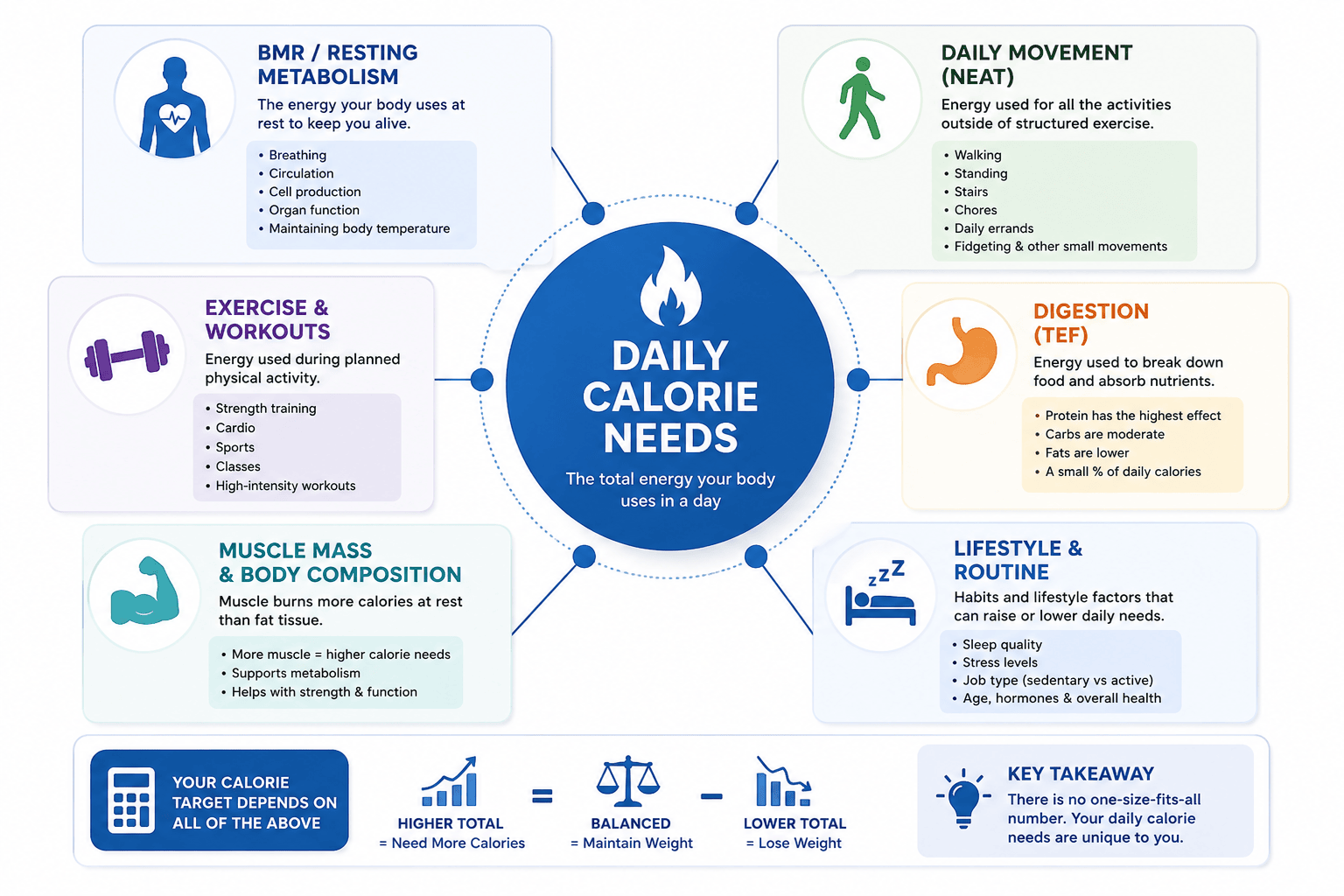
Daily calorie needs are influenced by resting metabolism, movement, workouts, digestion, muscle mass, and overall lifestyle activity throughout the day.
For Weight Loss
You usually need to eat fewer calories than your body uses over time.
For Maintenance
You eat close to the amount of calories your body burns each day.
For Muscle Gain
You may need enough calories to support training, recovery, and gradual growth.
For Energy
Your calories should support daily function, workouts, focus, and a routine you can maintain.
The goal is not to find a perfect number forever. The goal is to find a practical starting point, then adjust based on real progress, energy, hunger, and consistency.
Realistic Daily Calorie Ranges for Adults
A helpful way to think about daily calories is to see them as a range, not a fixed number. Your calorie needs can move up or down depending on your body size, daily movement, workouts, job, sleep, stress, and goal.
Simple Reality Check
Most adults do not need one perfect calorie number forever. A calorie estimate gives you a starting point, then your real-life progress tells you whether that number should stay the same, go slightly lower, or go slightly higher.
| Goal | What Your Calories Usually Do | What to Watch |
|---|---|---|
| Weight loss | Usually below maintenance calories | Weekly weight trend, hunger, energy, and workout recovery |
| Maintenance | Close to your total daily energy use | Stable weight trend over several weeks, not one daily weigh-in |
| Muscle gain | Often near maintenance or slightly above it | Strength progress, recovery, appetite, and unwanted fat gain |
Lower Needs
Smaller bodies, less daily movement, desk jobs, and lighter routines may need fewer calories.
Higher Needs
Taller bodies, more muscle, active jobs, regular workouts, and higher step counts can raise calorie needs.
This is why two people can search for “how many calories do I need per day” and still get very different answers. The better approach is to estimate your daily calorie needs, follow the target for a few weeks, then adjust based on your actual results.
BMR, TDEE, and Daily Calorie Needs
A lot of calorie calculators use terms like BMR and TDEE, which can sound overly technical at first. In reality, they are just ways of estimating how much energy your body burns at rest and throughout normal daily life.
BMR
Basal metabolic rate is the energy your body uses at rest for basic functions like breathing, circulation, and cell maintenance.
TDEE
Total daily energy expenditure is your full daily calorie burn, including BMR, movement, exercise, and digestion.
Your Calorie Target
Your target is usually based on TDEE, then adjusted up or down depending on your goal.
Simple Way to Think About It
BMR is your baseline. TDEE is your real-life daily burn. Your calorie target depends on whether you want to eat below, near, or above that number.
You can learn more in our What Is BMR and How Does It Work? guide or use a BMR Calculator to estimate your resting calorie needs.
What Affects How Many Calories You Need?
Two people can be the same age and weight yet feel completely different eating the same number of calories. One person may sit most of the day while the other walks constantly, trains after work, and sleeps differently.
Height and Weight
Taller or heavier bodies usually need more energy to function and move throughout the day.
Muscle Mass
Muscle uses energy even at rest, so people with more lean mass often have higher calorie needs.
Activity Level
Daily steps, workouts, chores, errands, sports, and physical jobs can raise calorie needs a lot.
Metabolism
Your natural resting energy use affects how many calories your body needs before activity is included.
Age and Routine
Calorie needs can change with age, training habits, work demands, sleep, stress, and lifestyle changes.
Your Goal
Weight loss, maintenance, muscle gain, and performance goals all require different calorie strategies.
This is why a number that works for one person may not work for another. Even your own calorie needs can change as your weight, activity level, and routine change.
How Many Calories Do I Need Per Day to Lose Weight?
For weight loss, you usually need a calorie deficit. That means eating fewer calories than your body uses over time. The key is making the deficit realistic enough to repeat.
One of the biggest mistakes people make is trying to lose weight as fast as possible. Extremely low calorie targets may look effective on paper, but they often lead to constant hunger, low energy, cravings, poor workouts, and eventually giving up altogether.
Start With Maintenance
Estimate your maintenance calories first, then reduce from that number.
Choose a Moderate Deficit
A moderate deficit is often easier to follow than an extreme cut.
Protect Protein and Strength
Protein and resistance training can help support muscle while losing fat.
Track Trends
Watch weight averages, waist changes, energy, hunger, and consistency over several weeks.
Do Not Start Too Low
Eating as little as possible is not always better. Very low calorie targets can make hunger, fatigue, poor recovery, and inconsistency worse. A plan you can repeat usually works better than a plan you can only follow for a few days.
If your goal is fat loss, use a Weight Loss Calculator together with a calorie needs estimate so you can understand the pace and trade-offs more clearly.
How Many Calories Do I Need to Maintain Weight?
Maintenance calories are the calories you can eat while your weight stays fairly stable over time. This does not mean the scale will never move. Water weight, digestion, sodium, sleep, and workouts can all cause normal daily changes.
Estimate Your BMR
BMR gives a baseline for how many calories your body uses at rest.
Add Daily Activity
Movement, exercise, work, walking, and daily routines raise your total calorie burn.
Watch the Pattern
If your weight stays mostly stable over time, you are likely close to maintenance.
Maintenance is not failure. It can be a useful phase for energy, training, routine building, and learning what your body needs when you are not actively trying to lose or gain weight.
In fact, many people feel physically and mentally better during maintenance phases because they finally have enough energy to train properly, recover well, sleep better, and build sustainable eating habits without constantly thinking about food.
How Many Calories Do I Need Per Day to Gain Muscle?
Building muscle is difficult when your body constantly feels underfed. If your workouts feel weaker every week, recovery is poor, or you always feel exhausted, your intake may not be supporting the amount of training you are doing.
Maintenance Recomposition
Some people can gain muscle and lose fat slowly while eating near maintenance.
Small Surplus
A small calorie surplus can support strength and muscle gain without pushing fat gain too quickly.
Training Recovery
Calories, protein, sleep, and progressive training all matter for muscle growth.
If you are training consistently but always feel weak, sore, under-recovered, or hungry, your current calorie intake may not be enough for your routine.
How to Estimate How Many Calories You Need Per Day
The best method is to start with a reasonable estimate, follow it consistently, then adjust based on what happens in real life. Calorie calculators are useful, but they are still estimates.
- Estimate your BMR using age, height, weight, and sex.
- Adjust for activity level to estimate your TDEE.
- Choose your goal: weight loss, maintenance, or muscle gain.
- Follow the target consistently for a few weeks.
- Track average weight, energy, hunger, strength, and measurements.
- Adjust slowly if the trend does not match your goal.
You can pair this guide with a Calorie Needs Calculator, Macro Calculator, and How Many Calories Should You Eat Per Day? to create a better starting point.
How to Adjust Your Calorie Target After a Few Weeks
This is where many people get stuck. They calculate a number once, follow it for a few days, then feel confused when the scale does not move exactly the way they expected. A calorie target is not supposed to be perfect on day one. It is a starting point that you refine.
- Follow your target for 2 to 4 weeks. A few days is not enough because water weight, digestion, sodium, hormones, and workouts can all shift the scale.
- Look at your average weight, not one weigh-in. Compare weekly averages instead of reacting to one high or low day.
- Check your energy and hunger. If you are constantly exhausted, your target may be too aggressive.
- Adjust slowly. If nothing is changing, small changes are usually better than cutting hundreds of calories overnight.
- Repeat the process. Your calorie needs can change as your weight, activity, and routine change.
A Practical Rule
If your plan only works when life is perfect, it is probably too strict. A good calorie target should support progress while still allowing normal meals, workdays, family events, and occasional imperfect days.
Common Mistakes When Estimating Calories
Calorie planning should make things clearer, not more stressful. These are common mistakes that can make it harder to stay consistent.
Starting Too Low
Choosing the lowest number you find online can lead to fatigue, hunger, poor recovery, and poor consistency.
Ignoring Activity
Someone who trains, walks a lot, or has an active job may need more food than expected.
Reacting to Daily Scale Changes
Daily weight changes are normal. Trends over several weeks matter more than one weigh-in.
Forgetting Food Quality
Calories matter, but protein, fiber, micronutrients, meal satisfaction, and recovery matter too.
Warning Signs Your Calorie Target May Be Too Low
A calorie deficit can help with weight loss, but more restriction is not always better. If your target is too low, it can make your plan harder to follow and may affect your energy, mood, workouts, and relationship with food.
Constant Hunger
Feeling hungry sometimes is normal in a deficit, but feeling distracted by hunger all day may be a sign the cut is too aggressive.
Low Energy
If normal tasks, workouts, or workdays feel unusually draining, your intake may not be supporting your routine.
Poor Recovery
Soreness that lingers, weaker workouts, or poor sleep can happen when calories are too low for your activity level.
All-or-Nothing Eating
If you restrict hard during the week and overeat on weekends, the plan may be too strict to maintain.
If you have a medical condition, a history of disordered eating, are pregnant, breastfeeding, underweight, or unsure what is safe for you, it is better to work with a qualified health professional instead of guessing.
Real-Life Examples of Daily Calorie Needs
These examples are not prescriptions. They simply show why two people can need very different calorie targets even if they both search for the same question: “How many calories do I need per day?”
Example 1: Desk Job and Light Activity
Someone who works at a desk, drives most places, and only exercises occasionally may need fewer calories than they expect. For this person, increasing steps may be just as helpful as cutting food aggressively.
Example 2: Active Job and Regular Workouts
Someone who walks a lot at work, trains several times per week, and has more muscle may need a higher calorie target even when trying to lose fat.
Example 3: Weight Loss Plateau
A person may lose weight at first, then stall because their body weight, movement, or tracking habits changed. This does not always mean the plan failed. It may simply need a small adjustment.
This is why it helps to pair a calorie needs calculator with real-life tracking. The calculator gives you a starting number. Your weekly trend tells you whether that number fits.
Simple Takeaway
- No single calorie number fits everyone.
- Your needs depend on your body, activity, metabolism, and goal.
- BMR is your baseline, while TDEE is your full daily burn.
- Weight loss usually needs a moderate calorie deficit.
- Maintenance means eating close to total daily energy use.
- Muscle gain often needs enough calories to support training and recovery.
- Use calculators as a starting point, then adjust based on real results.
Editorial Note
This guide was written for general education and practical calorie planning. The goal is to help readers understand how daily calorie needs are estimated, why calorie calculators are not perfect, and how to adjust a target based on real-life progress instead of chasing a random number online.
The information is based on commonly used nutrition concepts such as BMR, TDEE, calorie deficit, maintenance calories, activity level, and gradual weight-management habits. It should not replace personal medical or nutrition advice.
Sources and References
This guide uses general nutrition and weight-management guidance from established health sources, including:
- Dietary Guidelines for Americans, 2020–2025
- CDC guidance on gradual, sustainable weight loss
- Mayo Clinic guidance on calories, weight loss, and why the 3,500-calorie rule is not exact for everyone
- Academy of Nutrition and Dietetics guidance on estimating total energy needs from resting metabolic rate and activity
Calorie needs vary from person to person, so these references should be used as general education, not a personal meal plan.
Frequently Asked Questions
How many calories do I need per day?
It depends on your age, height, weight, activity level, metabolism, body composition, and goal. A calorie calculator can give a useful starting estimate, but real needs may need adjustment over time.
How many calories do I need to lose weight?
Most people need a calorie deficit to lose weight. That means eating below maintenance calories while still getting enough protein, nutrients, and energy to stay consistent.
How many calories do I need to maintain weight?
Maintenance calories are the calories you can eat while your weight stays fairly stable. This includes calories used for BMR, movement, exercise, digestion, and daily activity.
What is the difference between BMR and TDEE?
BMR is your resting calorie burn. TDEE is your total daily calorie burn after adding activity, exercise, movement, and digestion.
Should I eat more on workout days?
Some people prefer eating a little more on harder workout days, while others prefer keeping calories consistent. Either approach can work if the weekly intake supports the goal.
Can calorie calculators be wrong?
Yes. They estimate based on formulas and averages. Your real calorie needs may be higher or lower depending on your body, routine, tracking accuracy, and metabolism.
What if my calories feel too low?
If you feel constantly tired, hungry, weak, irritable, or unable to recover from workouts, your calorie target may be too low. Consider adjusting slowly or getting professional guidance if needed.
Related Guides
If you want to understand calorie intake more deeply, these guides explain how metabolism, activity, body composition, hydration, and exercise affect your daily energy needs.
Related Health Tools
These calculators can help you estimate calorie needs, maintenance intake, body composition, and nutrition targets more practically.
Helpful Tools for Tracking Calories and Daily Health Habits
Disclosure: This section may contain affiliate links. If you buy through these links, LifeToolSuit may earn a small commission at no extra cost to you. These products are optional and are meant to help support calorie tracking, meal awareness, activity monitoring, and long-term consistency.
Digital Food Kitchen Scale
One of the easiest ways to improve calorie tracking accuracy. Helpful for measuring portions, protein servings, snacks, and ingredients more consistently.
View on AmazonMeal Prep Containers
Useful for organizing meals, planning portions ahead of time, and avoiding random overeating during busy days.
View on AmazonFitness Tracker Watch
Tracks steps, workouts, movement, heart rate, and daily activity levels to help estimate calorie burn more realistically.
View on AmazonHydration Water Bottle
Staying hydrated can help support appetite awareness, workout performance, energy levels, and overall daily routine consistency.
View on AmazonImportant Note
This guide is for educational purposes only and is not medical advice. Calorie needs can vary widely, especially during pregnancy, breastfeeding, medical conditions, eating disorder recovery, intense training, or major lifestyle changes. If you have personal medical or nutrition concerns, a qualified professional can provide guidance that fits your situation.