It’s natural to look for a simple number, but calorie needs don’t really work that way. Averages can be helpful for context, but your actual needs depend on your body and your daily routine.
Average calorie numbers can be useful for context, but they should not be treated as a rule. A smaller sedentary adult may need fewer calories, while an active adult, taller person, athlete, or someone with more muscle may need much more. The best target is the one that fits your body, your routine, and your goal.
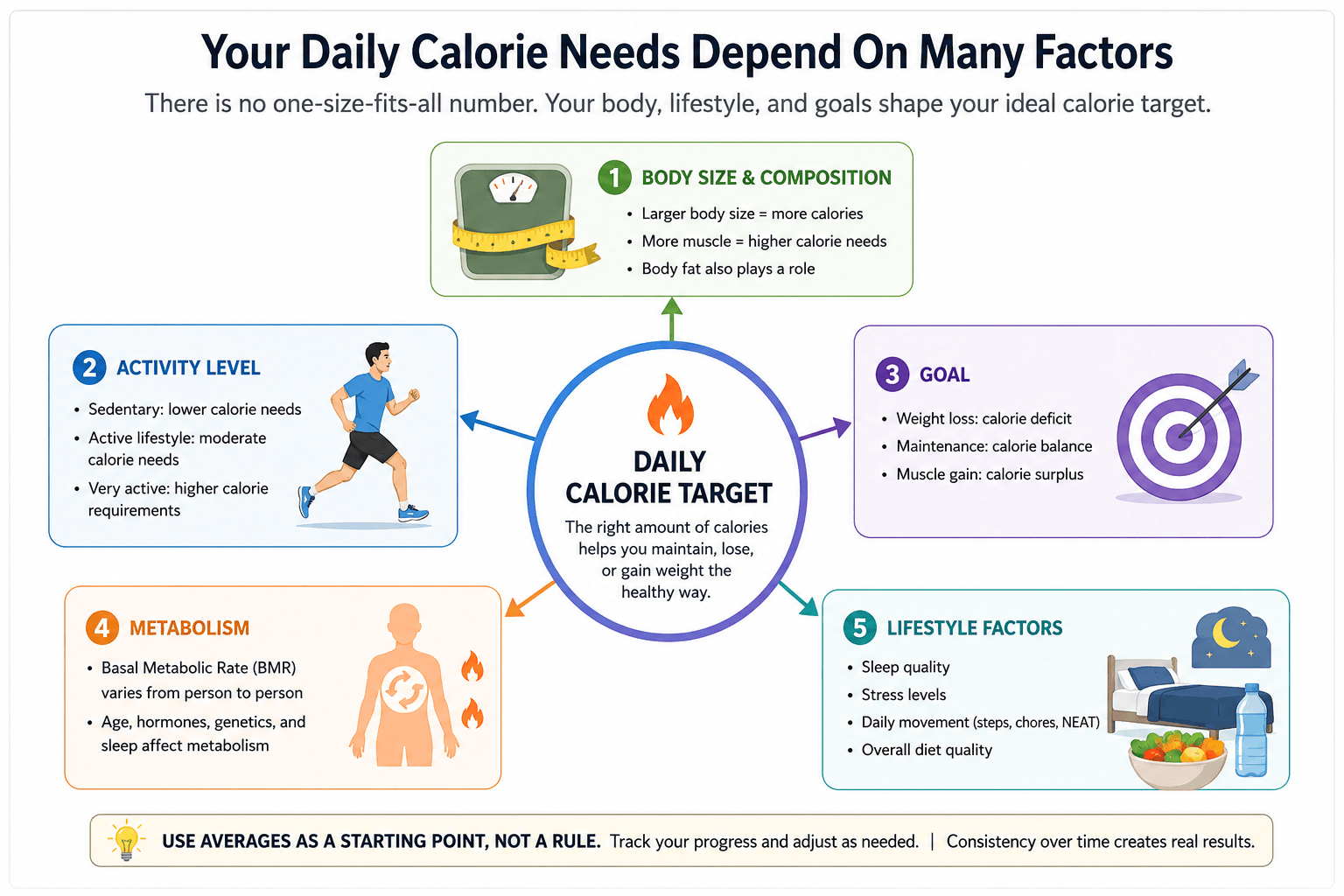
Average calorie numbers are only a starting point because daily needs change based on body size, activity level, goal, and metabolism.
Quick Navigation
- What average calories per day means
- Why calorie averages vary
- Why two people can need very different calories
- Average calories for women and men
- Average calories by activity level
- Average calories burned per day
- Calories by goal
- Signs your calorie target may be unrealistic
- How to estimate your own calories
- Why tracking beats averages
- Common mistakes with average calories
- Simple habits that affect calorie burn
- FAQ
- References & sources
What Does Average Calories Per Day Mean?
Average calories per day refers to a general estimate of how much energy people may need in a day. Calories come from food and drinks, and your body uses them for basic functions, movement, digestion, exercise, and recovery.
The important thing to understand is that an average is not the same as your personal calorie target. It may be close for some people, too high for others, and too low for many active people.
Average Intake
A broad reference number that can help explain typical calorie needs.
Personal Target
A more useful estimate based on your body, routine, and goal.
Maintenance Calories
The calories you can eat while your weight stays fairly stable over time.
Goal Calories
A calorie target adjusted for weight loss, maintenance, or muscle gain.
That’s why averages can be a helpful starting point, but they don’t give you the full picture on their own.
Why Average Calories Per Day Vary So Much
Calorie needs vary because people use different amounts of energy. Two people can be the same age and weight but still need different calories because of muscle mass, steps, workouts, job activity, and metabolism.
Body Size
Taller and heavier bodies usually require more energy than smaller bodies.
Muscle Mass
More lean mass can raise calorie needs because muscle uses energy even at rest.
Daily Activity
Walking, workouts, chores, errands, sports, and physical jobs can change daily calorie burn.
Metabolism
Resting energy use differs from person to person and affects daily calorie needs.
Age and Lifestyle
Age, sleep, stress, routine, and life stage can all influence calorie needs over time.
Your Goal
Weight loss, maintenance, and muscle gain all require different calorie targets.
Why Two People Can Need Very Different Calories
One of the biggest reasons people get confused about “average calories per day” is because calorie needs are heavily influenced by daily life — not just body weight.
For example, a nurse working long shifts on their feet may burn far more calories than someone with a desk job, even if they are the same age and weight. The same thing happens with people who walk a lot during the day, train regularly, or naturally move more without realizing it.
This is also why some people feel hungry eating what is considered a “normal calorie intake,” while others feel completely satisfied with less.
| Person | Lifestyle | Possible Calorie Needs |
|---|---|---|
| Office worker | Mostly seated, low daily movement | Lower average calorie intake |
| Retail worker | Standing and walking for hours | Moderate calorie needs |
| Construction worker | Heavy physical labor | Much higher calorie burn per day |
| Gym athlete | Regular intense training | Higher calorie intake needs |
One Common Mistake
Many people compare their calorie intake to friends, family members, influencers, or online averages without considering how different their routines actually are.
Average Calories for Women and Men
It’s common to look at calorie ranges for men and women separately. While there are general differences, your individual needs still matter more than any average.
Women
Women often need fewer calories on average than men, but active women, taller women, and women with more muscle may need significantly more than a generic average.
Men
Men often need more calories on average because of higher body size and lean mass, but sedentary men may need fewer calories than very active women.
Individual Needs
Your actual calorie needs depend on your own body, movement, metabolism, and goal more than a broad category.
For more specific pages, you can read Daily Calories for Women and Daily Calories for Men.
Average Calories by Activity Level
Activity level can make a major difference in calorie needs. A person who trains, walks a lot, or works a physical job may need much more food than someone with a mostly seated routine.
Sedentary
Mostly seated work, low daily steps, and little structured exercise usually mean lower calorie needs.
Lightly Active
Some walking, errands, chores, or light exercise can raise calorie needs slightly.
Moderately Active
Regular workouts, more steps, or an active routine can increase daily energy needs.
Very Active
Hard training, sports, physical labor, or high daily steps can raise calorie needs significantly.
Activity Is Easy to Underestimate
Two people can do the same workout but have different calorie needs because the rest of the day matters too. Daily steps, job movement, chores, and time spent sitting all affect total energy use.
Average Calories Burned Per Day
Many people search for the average calories burned per day because they want to understand how much energy the body actually uses daily.
The important thing to understand is that your body burns calories all day long — even while resting. Breathing, circulation, digestion, body temperature regulation, and recovery all require energy.
Exercise is only one part of total calorie burn. In reality, daily movement, walking, chores, work activity, and overall lifestyle often make a bigger difference than people expect.
Resting Calories
Calories your body burns simply staying alive and functioning.
Movement Calories
Calories burned through walking, standing, errands, chores, and daily activity.
Exercise Calories
Calories burned during workouts, sports, cardio, and training sessions.
Digestive Calories
Your body also burns calories processing and digesting food.
This is why someone with a high daily step count may burn significantly more calories than someone who only exercises briefly but spends most of the day sitting.
Average Calories by Goal
Your goal changes how you use an average calorie estimate. The same maintenance estimate may be adjusted downward for weight loss or upward for muscle gain.
Weight Loss
Most people need a calorie deficit, which means eating below maintenance calories over time.
Maintenance
Maintenance means eating close to the calories your body burns each day.
Muscle Gain
Muscle gain often requires enough calories to support training, recovery, and growth.
If you are trying to change your weight, average calories are not enough by themselves. You need to know whether you are eating below, near, or above your own maintenance needs.
Signs Your Calorie Target May Be Unrealistic
One of the biggest problems with online calorie advice is that many targets are far too aggressive to maintain in real life.
If your calorie intake is too low for your body and activity level, you may notice signs that your plan is becoming difficult to sustain.
Constant Fatigue
Feeling drained all day can be a sign your intake is too low.
Extreme Hunger
Constant cravings and binge urges often happen with overly aggressive calorie deficits.
Declining Workout Performance
Poor recovery and weaker workouts can happen when energy intake is too low.
Difficulty Concentrating
Low energy intake may affect focus, mood, and mental clarity.
Consistency Usually Beats Aggression
A moderate calorie target that you can maintain for months is usually more effective than a highly restrictive plan that only lasts a few days.
How to Estimate Your Own Calories Per Day
The best way to use average calories is to treat them as context, then estimate your own number. A personal calorie estimate is usually based on BMR, TDEE, activity level, and goal.
- Estimate your BMR using age, height, weight, and sex.
- Adjust for activity level to estimate total daily calorie burn.
- Choose a goal: weight loss, maintenance, or muscle gain.
- Follow the estimate consistently for a few weeks.
- Track weight trends, energy, hunger, strength, and measurements.
- Adjust slowly if progress does not match your goal.
You can pair this guide with a Calorie Needs Calculator, BMR Calculator, and How Many Calories Do I Need Per Day? to build a more realistic calorie target.
Why Tracking Real Results Matters More Than Average Numbers
Online averages can help you estimate a starting point, but your real-world results matter more than any calculator or calorie chart.
Two people can follow the exact same calorie target and still experience different outcomes because metabolism, movement, recovery, sleep, and consistency vary from person to person.
This is why long-term trends are more useful than short-term perfection.
What to Track
Weight trends, energy, hunger, strength, recovery, sleep, and consistency.
What NOT to Obsess Over
Daily scale fluctuations, single meals, or occasional higher-calorie days.
What Usually Works Better
Small sustainable adjustments instead of dramatic calorie cuts.
In practice, the best calorie target is usually the one that supports your goals while still feeling realistic enough to maintain consistently.
Helpful Tools for Tracking Calories and Daily Activity
Disclosure: This section may contain affiliate links. If you buy through these links, LifeToolSuit may earn a small commission at no extra cost to you. These tools are optional and are meant to help you track calorie intake, activity levels, and overall progress more consistently.
Digital Food Kitchen Scale
Makes calorie tracking more accurate by helping measure portion sizes, ingredients, and meal prep servings at home.
View on AmazonFitness Tracker Watch
Useful for monitoring steps, workouts, heart rate, and estimated calories burned throughout the day.
View on AmazonMeal Prep Containers
Helps with portion control, meal organization, and maintaining more consistent calorie intake during busy weeks.
View on AmazonAdjustable Dumbbells
Strength training can support muscle retention, increase daily energy use, and improve long-term body composition.
View on AmazonSimple Daily Habits That Can Affect Calorie Burn
Many people focus only on workouts, but small daily habits can meaningfully affect average calories burned per day over time.
- Walking more throughout the day
- Standing instead of sitting for long periods
- Improving sleep consistency
- Eating enough protein for fullness and recovery
- Strength training to support lean mass
- Reducing long periods of inactivity
- Building routines that are realistic long-term
These habits may seem small individually, but together they can change your daily energy expenditure more than many people realize.
Common Mistakes With Average Calories Per Day
Average calorie numbers can be helpful, but they are easy to misuse. These are some common mistakes to avoid.
Treating Averages as Rules
An average is not automatically your personal target. Your body and routine matter.
Ignoring Activity Level
A highly active person may need much more than a general average suggests.
Starting Too Low
Very low calorie targets can lead to hunger, fatigue, poor recovery, and poor consistency.
Forgetting to Adjust
Your needs can change when your weight, activity, training, or lifestyle changes.
Simple Takeaway
- Average calories per day are helpful for context, but they are not personal targets.
- Your real calorie needs depend on body size, activity, metabolism, and goal.
- Men and women may have different averages, but individual needs still matter most.
- Activity level can change calorie needs more than many people expect.
- Weight loss, maintenance, and muscle gain all require different calorie strategies.
- Use a calculator as a starting point, then adjust based on real results.
Frequently Asked Questions
What are average calories per day?
Average calories per day are general estimates of how many calories people may need daily. They are useful for context, but your own needs depend on your body, activity level, metabolism, and goals.
Are average calorie numbers accurate?
They can be useful as broad references, but they are not exact for everyone. A personal estimate is usually more helpful because it includes your height, weight, age, sex, and activity level.
What is the average calorie intake for women?
Average calorie intake for women varies by age, body size, activity level, and goal. A sedentary woman usually needs fewer calories than a very active woman or someone with more lean mass.
What is the average calorie intake for men?
Average calorie intake for men varies by height, weight, muscle mass, activity level, and goal. Active men and men with more lean mass often need more calories than sedentary men.
How many calories per day for weight loss?
Weight loss usually requires eating below maintenance calories. The exact number depends on your personal maintenance level and how aggressive or moderate the deficit is.
How many calories per day for maintenance?
Maintenance calories are the calories you can eat while your weight stays fairly stable. This includes your resting metabolism, activity, exercise, and digestion.
Should I use average calories or a calorie calculator?
Average calories are good for learning, but a calorie calculator is usually better for planning because it uses your own information. You can start with a calculator, then adjust based on progress.
Related Health Tools
Related Calorie and Nutrition Guides
Editorial Note
This guide was created to help readers understand how average calorie intake actually works in real life, not just in theory.
Many calorie articles online rely heavily on generic averages without explaining how daily movement, lifestyle, recovery, muscle mass, and consistency affect calorie needs in practice.
The goal of this guide is to provide practical context so readers can make more realistic decisions instead of relying on oversimplified numbers alone.
Important Note
This guide is for educational purposes only and is not medical advice. Calorie needs can vary widely, especially during pregnancy, breastfeeding, medical conditions, eating disorder recovery, intense training, or major lifestyle changes. If you have personal medical or nutrition concerns, a qualified professional can provide guidance that fits your situation.
References & Sources
- National Institutes of Health (NIH) — Energy Balance and Weight Management
- Dietary Guidelines for Americans
- Academy of Nutrition and Dietetics
- Harvard T.H. Chan School of Public Health — Nutrition Resources
- Mayo Clinic — Calorie and Metabolism Guidance
Calorie needs vary significantly between individuals. Information in this guide is educational and should be interpreted within the context of personal health, activity level, and medical guidance where appropriate.