There is no single calorie number that works for every man. Your best target depends on your body size, daily movement, training, work routine, and goal.
A desk worker trying to lose fat will not need the same calorie intake as someone who lifts, plays sports, walks all day, or works a physical job. Instead of chasing one perfect number, start with a realistic estimate and adjust based on your energy, hunger, weight trend, and performance.
Quick Navigation
- Quick calorie chart for men
- What calorie needs mean for men
- Average calories per day for men
- Calories for men by age
- How many calories should a 70 kg man eat?
- What affects male calorie needs
- Calories for weight loss
- Is 1500 calories enough for a man?
- Calories for maintenance
- Calories for muscle gain
- Is 500 calories a lot for breakfast?
- How many calories do 10,000 steps burn?
- Signs you are not eating enough calories
- How men can support metabolism
- Best foods for men’s calorie goals
- How to estimate your calorie target
- Common calorie mistakes men make
- FAQ
Simple Calorie Starting Points for Men
A calorie chart can help you compare different situations, but it should not be treated as your exact number. Your body size, activity level, training, and goal matter more than any general chart.
| Situation | Common Goal | What Usually Matters Most |
|---|---|---|
| Mostly sedentary | Maintenance or gradual fat loss | Portions, daily steps, protein, and consistency |
| Moderately active | Maintenance, fat loss, or recomposition | Workout routine, step count, meal quality, and recovery |
| Very active | Performance, muscle gain, or high-energy lifestyle | Enough calories, carbs, protein, hydration, and sleep |
| Trying to lose weight | Fat loss without feeling drained | A moderate calorie deficit, strength training, and enough protein |
| Trying to gain muscle | Strength and lean mass gain | A small calorie surplus, progressive training, and recovery |
Use this as a guide, then compare it with real feedback from your body. Hunger, energy, workouts, waist size, and weight trends will tell you whether your target needs adjusting.
Why Calorie Needs Are Different for Every Man
Two men can eat the same number of calories and get very different results. Height, weight, muscle mass, daily movement, training, job activity, sleep, stress, and goals all affect how much food a man may need.
Weight Loss
The goal is to eat below maintenance without feeling weak, drained, or unable to stay consistent.
Maintenance
The goal is to eat close to what your body uses each day so your weight stays fairly stable.
Muscle Gain
The goal is to eat enough to support lifting, recovery, strength, and gradual muscle growth.
Daily Energy
The goal is to feel fueled, focused, and able to keep up with your normal routine.
Your target can also change over time. A fat-loss phase, a muscle-building phase, a new job, more walking, harder training, poor sleep, or a stressful season can all change what feels realistic.
Typical Calorie Ranges for Men
Average calorie ranges can be useful for context, but they are not personal enough to follow blindly. Your real needs may be higher or lower depending on your height, weight, muscle mass, activity level, age, and goal.
Lower Activity
Men with mostly seated routines usually need fewer calories than men who walk often, train, or have active jobs.
Moderate Activity
Men who exercise a few times per week or move throughout the day often need more food to support energy.
High Activity
Men who train hard, play sports, work physical jobs, or get many steps per day may need much higher calorie intake.
Use Averages as a Starting Point
A calorie chart can give you a rough estimate. Your actual progress, energy, hunger, workouts, and weight trend will tell you more.
The goal is not to find the number every man should eat. The goal is to find the range that fits your body, your schedule, and your current goal.
How Age Can Change Calorie Needs
Age can affect calorie needs, but it should not be used by itself. A man in his 40s who lifts weights and walks often may need more calories than a sedentary man in his 20s. Muscle mass, activity, work routine, sleep, and goal matter too.
Men in Their 20s
Many men in their 20s have higher calorie needs because of more activity, training, muscle mass, or faster daily routines. But sedentary men may still need fewer calories than expected.
Men in Their 30s and 40s
This is often when work, family, stress, and lower movement start affecting weight. Calories may need to match your current lifestyle, not the routine you had years ago.
Men Over 50
Muscle maintenance, protein intake, strength training, and daily movement become even more important. The goal is not just eating less, but supporting health and function.
Best Way to Use Age
Age is a helpful clue, but your actual calorie needs are better estimated by combining age with body size, activity level, and your goal.
How Many Calories Should a 70 kg Man Eat?
A 70 kg man may need different calories depending on whether he is sedentary, lightly active, training regularly, or trying to lose fat or gain muscle. Weight alone does not give the full answer.
If He Is Sedentary
A 70 kg man with a desk job and low movement may need a lower calorie target than someone who walks often or exercises regularly.
If He Is Active
If he trains, walks many steps, plays sports, or has a physical job, his daily calorie needs may be much higher.
If He Wants Fat Loss
He would usually aim below maintenance calories while keeping protein high enough to support fullness and muscle retention.
If He Wants Muscle Gain
He may need maintenance calories or a small surplus, especially if he is lifting weights and trying to improve strength.
Weight is only one part of the estimate. Activity level, training, height, muscle mass, appetite, energy, and progress over time all help decide whether the number is working.
Why Your Calorie Needs May Be Higher or Lower
Calorie needs can change from person to person and from season to season. These are the main factors that affect how much energy your body uses each day.
Height and Weight
Taller or heavier bodies usually require more energy than smaller bodies, even before exercise is included.
Muscle Mass
Muscle is metabolically active tissue, so men with more lean mass often have higher calorie needs.
Daily Movement
Steps, chores, errands, active jobs, sports, and exercise can make a big difference in daily calorie burn.
Metabolism and BMR
Your basal metabolic rate is the energy your body uses at rest for essential functions like breathing and circulation.
Age and Routine Changes
Calorie needs may change with age, training changes, muscle loss or gain, stress, sleep, and lifestyle shifts.
Your Goal
Weight loss, maintenance, and muscle gain all require different calorie strategies.
Calories for Weight Loss
Weight loss usually requires a calorie deficit, which means eating below what your body uses over time. The goal is to create progress without cutting so low that energy, training, mood, and consistency fall apart.
Moderate Deficit
A smaller, more realistic deficit is often easier to follow than an aggressive cut.
Enough Protein
Protein can support fullness and muscle maintenance during a weight-loss phase.
Strength Training
Lifting or resistance training helps protect lean mass while losing fat.
Progress Tracking
Weight, waist size, strength, energy, hunger, and consistency matter more than one perfect daily number.
Be Careful With Very Low Calorie Targets
Many men search whether 1500 calories is enough. For some, it may be too low, especially if they are active, taller, heavier, lifting, playing sports, or trying to maintain energy. Very low calorie plans should be approached carefully.
A better approach is choosing a calorie level you can realistically stick to, while still making steady progress over time.
Is 1500 Calories Enough for a Grown Man?
Many men search this because 1500 calories is often shown as a common diet number. For some smaller or less active men, it may create weight loss. For many others, it may feel too low, especially if they are taller, heavier, active, lifting weights, or working a physical job.
Why 1500 Calories Can Be Too Low for Some Men
A very low calorie target can make it harder to get enough protein, fiber, vitamins, minerals, and energy. It can also make workouts, recovery, mood, sleep, and consistency harder.
May Be Too Low If...
You feel weak, hungry all day, lose strength quickly, sleep poorly, or cannot stay consistent.
May Need Adjusting If...
Your weight is dropping too fast, your training is suffering, or you feel mentally drained.
Instead of copying a fixed number, estimate your maintenance calories first, then create a realistic deficit from there.
How Many Calories Should a Man Eat to Maintain Weight?
Maintenance calories are simply the amount you can eat while your weight stays fairly stable over time. This number is often called your TDEE, or total daily energy expenditure.
Start With BMR
BMR is the energy your body uses at rest for basic functions.
Add Activity
Walking, workouts, chores, sports, physical work, and daily movement raise calorie needs.
Watch Your Trend
If weight stays fairly stable over time, you are likely near maintenance.
You can pair this guide with a Calorie Needs Calculator, BMR Calculator, and What Is BMR and How Does It Work? to better understand your starting point.
How Many Calories Should a Man Eat for Muscle Gain?
For muscle gain, many men do best with enough calories to support training, recovery, and progressive strength work. This often means eating around maintenance or slightly above maintenance, depending on the goal.
Maintenance Recomposition
Some beginners or returning lifters can build muscle and lose fat while eating near maintenance.
Small Surplus
A modest calorie surplus can support muscle growth without pushing fat gain too quickly.
Training Support
Calories, protein, sleep, and progressive strength training all matter for muscle gain.
If your workouts feel weak, recovery is poor, strength is not progressing, or hunger is high, your current calorie intake may not be enough for your training demands.
Is 500 Calories a Lot for Breakfast?
A 500-calorie breakfast is not automatically too much. Whether it is a lot depends on your total daily calorie target, appetite, schedule, workouts, and food choices.
For Weight Loss
A 500-calorie breakfast can still fit if the rest of the day is planned well and it helps prevent overeating later.
For Maintenance
It may be a normal breakfast size for many men, especially if it includes protein, fiber, and satisfying foods.
For Muscle Gain
It may even be on the lower side for men who need more calories to support training and recovery.
A better breakfast question is: does this meal help you stay full, energized, and consistent with your total calorie goal?
How Many Calories Do 10,000 Steps Burn for Men?
The calories burned from 10,000 steps can vary widely. A heavier man usually burns more calories walking the same distance than a lighter man. Walking speed, terrain, stride length, and fitness level also matter.
Body Weight Matters
Heavier bodies usually use more energy during walking than lighter bodies.
Pace Matters
Brisk walking usually burns more calories than slow casual walking.
Terrain Matters
Hills, stairs, and uneven ground can increase effort compared with flat walking.
Consistency Matters Most
Daily steps can support fat loss by increasing total daily energy expenditure.
Walking is not just about calorie burn. It can also help with appetite control, mood, heart health, routine, and long-term weight management.
Signs You May Not Be Eating Enough Calories
Eating too few calories can make progress harder, not easier. A calorie deficit should help you move toward your goal without making everyday life feel miserable.
Low Energy
You feel tired, sluggish, or drained most of the day.
Poor Workout Performance
Your strength, endurance, or motivation drops quickly and does not recover.
Constant Hunger
You feel preoccupied with food or struggle to feel satisfied after meals.
Poor Sleep and Recovery
You feel sore longer, sleep worse, or do not recover well from training.
If these signs continue, your calorie target may be too aggressive, your food quality may need improvement, or your routine may need better recovery support.
How Can Men Support a Healthy Metabolism?
“Boosting metabolism” does not usually mean finding a magic food or supplement. For most men, the biggest wins come from building habits that support muscle, movement, sleep, and consistency.
Build or Maintain Muscle
Strength training helps support lean mass, which plays a role in daily energy use.
Walk More
Daily steps can raise calorie burn without needing intense workouts every day.
Eat Enough Protein
Protein supports fullness, muscle maintenance, and recovery during weight changes.
Simple Metabolism Rule
The most realistic metabolism strategy is not extreme dieting. It is eating enough protein, lifting weights, moving daily, sleeping well, and avoiding repeated crash diets.
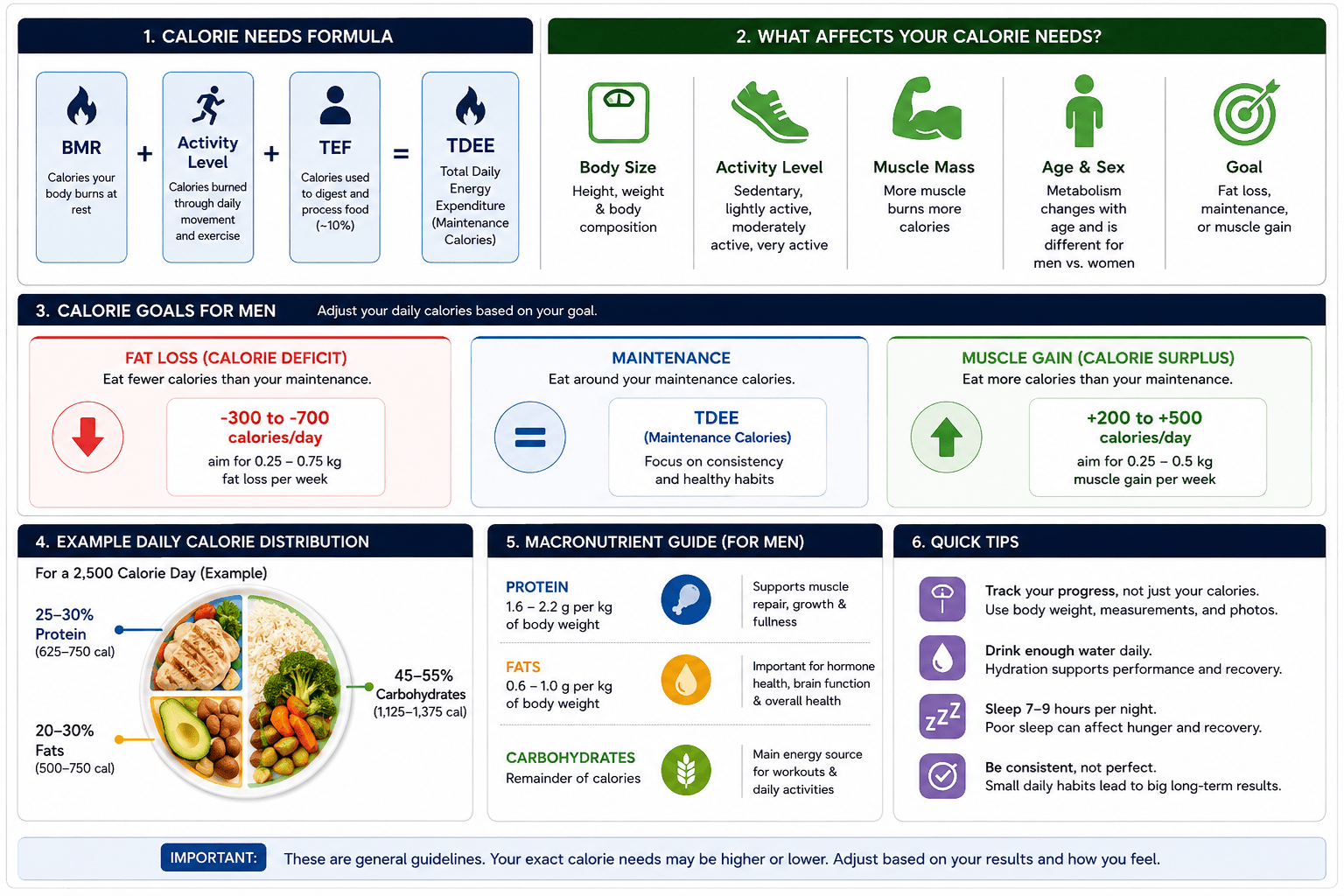
Visual guide explaining how calorie needs for men can change based on body size, activity level, metabolism, muscle mass, and goals such as fat loss, maintenance, or muscle gain.
Recommended Tools to Support Healthy Calorie Goals
Disclosure: This section may contain affiliate links. If you buy through these links, LifeToolSuit may earn a small commission at no extra cost to you. These tools are optional and are meant to help support calorie tracking, weight management, meal consistency, hydration, and fitness progress.
Digital Food Scale
Helps improve portion accuracy when tracking calories, protein intake, meal sizes, and nutrition habits at home.
View on AmazonMeal Prep Containers
Useful for meal planning, portion consistency, calorie awareness, and reducing impulsive eating during busy days.
View on AmazonSmart Body Weight Scale
Helps monitor long-term progress during weight loss, maintenance, muscle gain, and body composition changes.
View on AmazonProtein Shaker Bottle
Convenient for protein shakes, workout recovery drinks, meal replacements, and increasing protein intake on busy schedules.
View on AmazonHow to Estimate Your Daily Calorie Target
The easiest way to figure this out is to start with a rough estimate, then adjust based on what actually happens in real life. No calculator can know your body perfectly, but it can give you a useful starting point.
- Estimate your BMR or resting calorie needs.
- Adjust for activity level to estimate maintenance calories.
- Choose your goal: weight loss, maintenance, or muscle gain.
- Track progress for a few weeks instead of changing the number every day.
- Adjust slowly if weight, energy, hunger, or performance are not moving in the right direction.
For a more complete view, you can also use a Macro Calculator, Body Fat Calculator, and How to Understand BMI Results.
Best Foods to Help Men Hit Their Calorie Goals
Calories matter, but food quality still matters too. The right foods can make it easier to stay full, support workouts, manage cravings, and reach your goal without feeling like you are guessing all day.
For Protein
Eggs, Greek yogurt, chicken, tuna, lean beef, tofu, beans, lentils, cottage cheese, and protein-rich meals.
For Fiber and Fullness
Vegetables, berries, apples, oats, beans, potatoes, whole grains, and salads with satisfying toppings.
For Training Energy
Rice, oats, potatoes, fruit, pasta, whole-grain bread, and other carbohydrate sources that fit your calorie target.
For Healthy Fats
Avocado, olive oil, nuts, seeds, eggs, fatty fish, and balanced meals with moderate fat portions.
If your goal is fat loss, focus on filling meals. If your goal is muscle gain, focus on enough total calories and protein. If your goal is maintenance, focus on repeatable meals you can actually sustain.
Common Mistakes Men Make With Calorie Targets
Calorie planning should make your routine clearer, not more stressful. These are the mistakes that usually make the process harder than it needs to be.
Picking a Number That Is Too Low
Very low calories may lead to low energy, high hunger, poor training, and poor consistency.
Ignoring Activity Level
A man who lifts, runs, plays sports, or works a physical job may need much more food than someone sedentary.
Changing Too Quickly
Daily weight changes are normal. Look for trends before changing your calorie target.
Only Focusing on the Scale
Waist size, strength, energy, sleep, recovery, and body composition can also show progress.
Simple Takeaway: How Many Calories Should a Man Eat?
- There is no single daily calorie number for all men.
- Your calorie needs depend on body size, age, metabolism, activity, and goals.
- A 70 kg man, a taller man, an older man, and an active man may all need different targets.
- Weight loss usually needs a calorie deficit, but it should be sustainable.
- Maintenance calories are based on total daily energy use.
- Muscle gain often needs enough calories, protein, training, and recovery.
- Very low targets like 1200 or 1500 calories may be too aggressive for many men.
- Use calculators as a starting point, then adjust based on real progress.
Frequently Asked Questions
How many calories should a man eat per day?
It depends on his body size, age, activity level, metabolism, and goal. A smaller sedentary man may need fewer calories, while an active man, taller man, heavier man, or man with more muscle may need significantly more.
How many calories should a man eat to lose weight?
Most men need a calorie deficit to lose weight. The goal is to eat below maintenance calories while still getting enough protein, nutrients, and energy to stay consistent and train well.
How many calories should a man eat to maintain weight?
Maintenance calories are roughly the number of calories a man burns per day through BMR, movement, exercise, digestion, and daily activity. This number is different for every person.
Is 1500 calories enough for a man?
For many men, 1500 calories may be too low, especially if they are active, taller, heavier, lifting, or trying to maintain energy. It is better to estimate your own needs instead of assuming one low number is right for everyone.
Do men need more calories than women?
Men often need more calories on average because of differences in body size and lean mass, but this is not always true. A sedentary man may need fewer calories than a very active woman.
Should men eat more calories on workout days?
Some men feel better eating a little more on harder training days, especially if workouts are intense. Others prefer keeping calories consistent across the week. Both approaches can work.
How do I know if I am eating too few calories?
Possible signs include low energy, constant hunger, poor workout recovery, strength loss, trouble focusing, irritability, and difficulty staying consistent. If symptoms are severe or ongoing, it may be best to seek professional guidance.
Related Health Guides
Related Health Tools
Important Note
This guide is for educational purposes only and is not medical advice. Calorie needs can vary widely, especially with medical conditions, eating disorder recovery, intense training, major lifestyle changes, or specific performance goals. If you have personal medical or nutrition concerns, a qualified professional can provide guidance that fits your situation.