There isn’t one fixed calorie number that works for every woman. The right amount depends on your body, your routine, and what you’re trying to achieve.
Some women maintain weight on fewer calories because they are smaller or less active. Others need much more because they are taller, have more muscle, walk a lot, train regularly, or have a physically demanding schedule. That is why a good calorie guide should help you understand the factors behind the number instead of handing you a one-size-fits-all target.
Quick Navigation
- What calorie needs mean for women
- Average calories per day for women
- Calories for weight loss, maintenance, and gain
- What affects female calorie needs
- Calories for weight loss
- Is 1200 calories enough for a woman?
- Is 3000 calories a day too much?
- Is 500 calories a lot for breakfast?
- Walking, steps, and calorie burn
- How to burn 500 calories per day
- Best snacks and food choices for weight loss
- Signs you are not eating enough calories
- Calories for maintenance
- Calories for muscle gain
- How to estimate your calorie target
- The 3-3-3 rule for losing weight
- Common calorie mistakes
- FAQ
There Is No One Perfect Calorie Number
A woman’s calorie target depends on what she wants her body to do right now. Losing weight, maintaining weight, gaining muscle, and simply feeling energized all require a slightly different approach.
Weight Loss
The goal is to eat below maintenance without feeling drained, overly restricted, or unable to stay consistent.
Maintenance
The goal is to eat close to what your body uses each day so your weight stays fairly stable over time.
Muscle Gain
The goal is to eat enough to support training, recovery, strength, and gradual lean mass gain.
Everyday Energy
The goal is to feel fueled, focused, and satisfied while still supporting your long-term health.
Your needs can also change during different seasons of life. A stressful work schedule, a new workout routine, pregnancy, breastfeeding, less sleep, more walking, or a fat-loss phase can all change what feels realistic.
Typical Calorie Ranges for Women
Online calorie charts can be helpful as a rough starting point, but they should not be treated like a personal rule. Your real number may be higher or lower depending on your body size, activity, muscle mass, and goal.
Lower Activity
Women with mostly seated routines usually need fewer calories than women who move often throughout the day.
Moderate Activity
Women who exercise a few times per week or walk regularly often need more food to support daily energy.
High Activity
Women who train hard, work active jobs, or get a lot of steps may need much higher calorie intake.
Use Averages Carefully
A calorie range is only a starting point. The better number is the one that fits your actual weight trend, energy, hunger, activity, and goal.
Instead of trying to copy a number from a chart, use it as a starting estimate and adjust based on what happens in real life.
Calories for Weight Loss, Maintenance, and Muscle Gain
Your calorie target should match your goal. A fat-loss phase usually needs a different strategy than maintenance, workout performance, or muscle gain.
| Goal | Calorie Direction | Best For | What to Watch |
|---|---|---|---|
| Weight loss | Below maintenance | Fat loss, smaller waist, lower body weight | Energy, hunger, protein, consistency |
| Maintenance | Close to TDEE | Stable weight, balanced routine, long-term health | Weight trend, activity changes, portions |
| Muscle gain | At or slightly above maintenance | Strength, lean mass, workout recovery | Protein, training progress, gradual gain |
| Active lifestyle | Higher than sedentary needs | Women who walk often, train, or have active jobs | Recovery, fatigue, appetite, performance |
The same calorie amount can feel too low for one woman, too high for another, and just right for someone else. Body size, movement, muscle mass, and goals make a big difference.
Why Your Calorie Needs May Be Higher or Lower
Calorie needs can change from person to person and even from season to season. These are the main factors that affect how much energy your body uses each day.
Height and Weight
Taller or heavier bodies usually require more energy than smaller bodies, even before exercise is included.
Muscle Mass
Muscle is metabolically active tissue, so women with more lean mass often have higher calorie needs.
Daily Movement
Steps, chores, errands, active jobs, and exercise can make a big difference in daily calorie burn.
Metabolism and BMR
Your basal metabolic rate is the energy your body uses at rest for essential functions like breathing and circulation.
Age and Life Stage
Calorie needs may change with age, hormone changes, pregnancy, breastfeeding, stress, and activity changes.
Your Goal
Weight loss, maintenance, and muscle gain all require different calorie strategies.
How a Woman’s Daily Calorie Needs Are Determined
Your calorie target is not chosen from one random number. It usually starts with your basic body details, then your resting metabolism, then your activity level, and finally your personal goal.
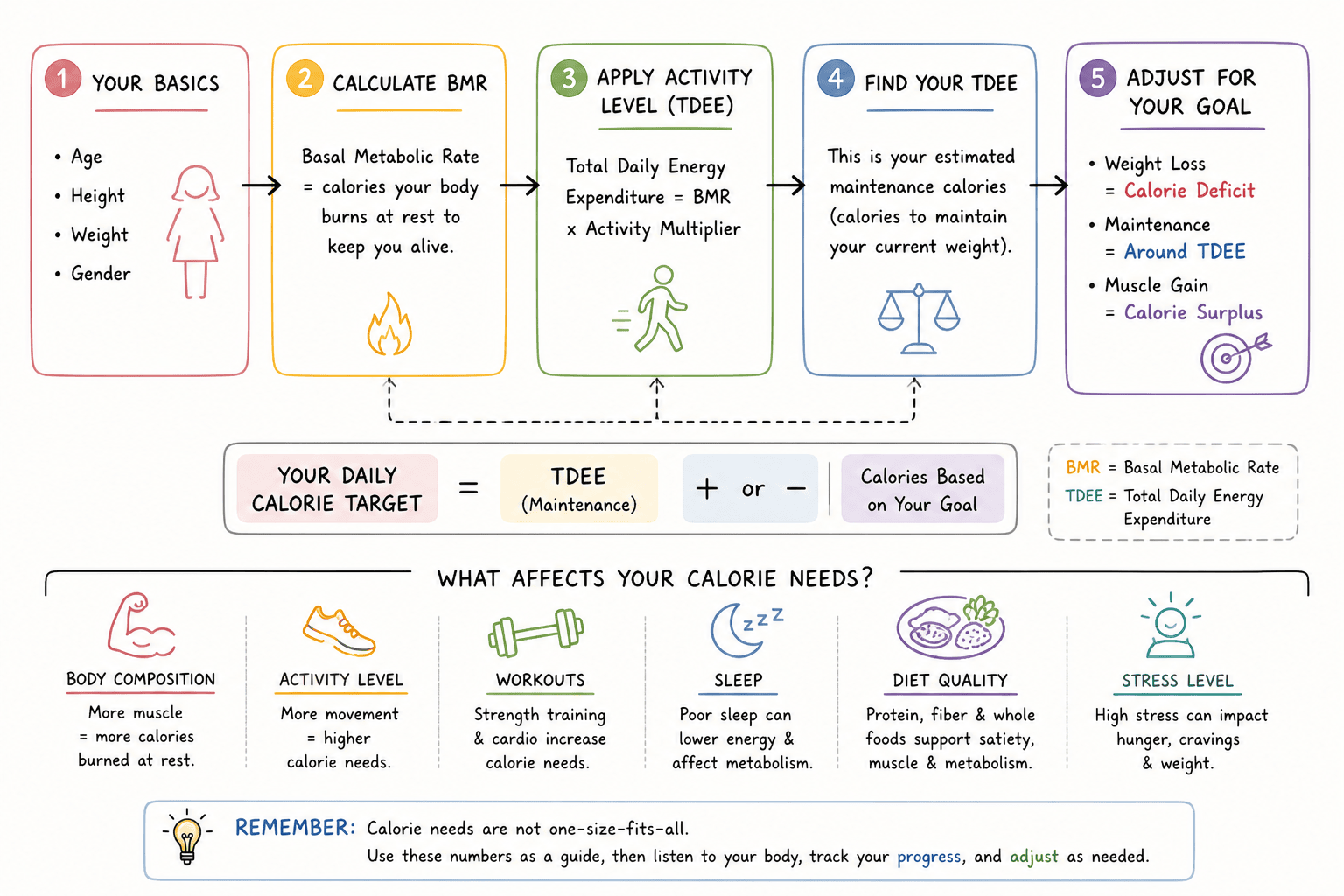
A simple visual guide showing how BMR, activity level, TDEE, and goals work together to estimate daily calorie needs.
How Many Calories Should a Woman Eat Per Day to Lose Weight?
For weight loss, most women need a calorie deficit. That means eating fewer calories than the body uses over time. The mistake many people make is choosing a number that is too low to sustain.
If you are working on fat loss, it can also help to understand daily calorie intake for weight loss and how many calories you need per day so you are not guessing your target.
Moderate Deficit
A smaller, more realistic deficit is often easier to follow than an aggressive cut.
Enough Protein
Protein can support fullness and muscle maintenance during a weight-loss phase.
Strength Training
Lifting or resistance training helps protect lean mass while losing fat.
Progress Tracking
Weight, measurements, energy, hunger, and consistency matter more than one perfect daily number.
Be Careful With Very Low Calorie Targets
Many women search whether 1200 calories is enough. For some, it may be too low, especially if they are active, taller, training, breastfeeding, or trying to maintain energy. Very low calorie plans should be approached carefully.
Is 1200 Calories a Day Enough?
For many women, 1200 calories can be difficult to sustain comfortably. It may also be too low for proper energy, training recovery, and nutrition, especially if you are active or have higher calorie needs.
A smaller, sedentary woman may be able to lose weight on a lower calorie target, but an active woman, taller woman, heavier woman, breastfeeding woman, or woman who strength trains may need much more food to feel well and recover properly.
When It May Be Too Low
If you feel constantly hungry, tired, cold, irritable, weak in workouts, or unable to focus, your calorie target may be too aggressive.
Why It Can Backfire
Very low calorie targets can make it harder to get enough protein, fiber, vitamins, minerals, and consistent energy.
Better Approach
Estimate your maintenance calories first, then create a moderate calorie deficit instead of picking a random low number.
Who Should Be Extra Careful
Pregnant women, breastfeeding women, teens, athletes, and anyone with medical or eating-related concerns should seek professional guidance.
Quick Answer
1200 calories is not automatically “enough” for a woman. It may be too low if it leaves you exhausted, overly hungry, or unable to meet your nutrition needs.
Is 3000 Calories a Day Too Much for a Woman?
3000 calories a day may sound high, but it is not automatically too much for every woman. Calorie needs can rise significantly with body size, muscle mass, training volume, daily steps, physical work, pregnancy, breastfeeding, or athletic goals.
It May Be Too Much If
You are sedentary, gaining weight quickly, rarely exercise, and your goal is fat loss.
It May Fit If
You are very active, taller, heavier, strength training, walking a lot, or trying to gain muscle.
Watch the Trend
The best clue is your 2 to 4 week trend in weight, measurements, energy, hunger, and performance.
If you wonder, “Will I gain weight if I eat 3000 calories a day?” the answer depends on whether 3000 calories is above your maintenance calories. If it is above your TDEE, weight gain is likely over time. If it matches your energy needs, your weight may stay stable.
Is 500 Calories a Lot for Breakfast?
A 500 calorie breakfast is not automatically too much. For many women, it can be a balanced breakfast, especially if it includes protein, fiber, healthy fats, and slow-digesting carbohydrates.
Good 500 Calorie Breakfast
Greek yogurt with fruit and oats, eggs with whole-grain toast, or oatmeal with protein and nut butter can be filling and balanced.
Less Helpful 500 Calorie Breakfast
A breakfast mostly made of sugary drinks, pastries, or refined carbs may leave you hungry again quickly.
For Weight Loss
500 calories can still fit if your total daily intake supports a calorie deficit.
For Active Women
A larger breakfast may help fuel workouts, long workdays, or high daily step counts.
Instead of judging breakfast by calories alone, look at your full day. A 500 calorie breakfast can be helpful if it supports fullness, energy, and better food choices later.
Walking, Steps, and Calories: How Much Do 10,000 Steps Burn?
Many women use walking to support weight loss because it is simple, low-impact, and easier to repeat than intense workouts. The calories burned from walking depend on body weight, walking speed, incline, distance, and fitness level.
| Walking Question | Practical Answer | What Changes the Number |
|---|---|---|
| How many calories do 10,000 steps burn? | Often a few hundred calories, but it varies widely. | Body weight, pace, stride length, hills, and distance. |
| How many calories does a 30-minute walk burn? | Usually less than a hard workout, but still useful for daily calorie burn. | Speed, incline, body size, and walking intensity. |
| How many steps to lose 1 kg in a week? | Steps alone are usually not enough without food consistency. | Total calorie deficit, diet, water weight, and activity. |
| Best time to walk to lose weight? | The best time is the time you can repeat consistently. | Schedule, energy, meals, weather, and habit. |
Walking works best when it is paired with a realistic calorie target. You do not need to force 10,000 steps every day, but increasing your average daily movement can make weight management easier.
How to Burn 500 Calories Per Day Without Overdoing It
Burning 500 calories per day does not have to mean doing one intense workout. For many women, it is more realistic to combine movement, walking, strength training, and small food adjustments.
Add More Steps
Walking after meals, parking farther away, and taking short movement breaks can raise daily calorie burn.
Strength Train
Resistance training helps preserve muscle while losing weight and supports long-term metabolism.
Adjust Food Gently
A smaller food deficit plus extra movement is often easier than relying only on exercise.
Better Than Chasing Burn
You do not need to burn exactly 500 calories from exercise every day. A sustainable weekly calorie deficit matters more than one perfect workout number.
Best Snacks and Food Choices for Weight Loss
The best snacks for weight loss are usually foods that help you stay full, control cravings, and keep your total calories realistic. A snack does not need to be “diet food” to be helpful.
High-Protein Snacks
Greek yogurt, cottage cheese, boiled eggs, tuna, protein smoothies, or lean turkey can help with fullness.
High-Fiber Snacks
Fruit, vegetables, beans, oats, whole-grain crackers, and chia pudding can support digestion and appetite control.
Balanced Snacks
Pair protein with fiber or healthy fat, such as apple with peanut butter or yogurt with berries.
Watch Liquid Calories
Sugary drinks, fancy coffees, and juices can add calories quickly without keeping you full.
What Is the Worst Carb for Belly Fat?
No single carb automatically creates belly fat. The bigger issue is repeatedly overeating highly processed, low-fiber carbs that are easy to consume in large amounts, such as sugary drinks, pastries, candy, and refined snack foods.
What Is the #1 Worst Food for Weight Gain?
There is no single food that causes weight gain by itself. Weight gain usually happens when total calorie intake stays above calorie needs over time. However, foods that are high in calories, low in fullness, and easy to overeat can make it harder to stay on track.
Signs You May Not Be Eating Enough Calories
A calorie deficit can help with weight loss, but eating too little for too long can make your plan harder to maintain. Your body may give warning signs when your intake is too low for your needs.
Low Energy
You feel tired most of the day, even after sleeping.
Constant Hunger
You feel preoccupied with food or struggle to feel satisfied after meals.
Poor Workout Performance
Your strength, endurance, or recovery drops noticeably.
Mood and Focus Changes
You feel more irritable, foggy, anxious, or distracted than usual.
Sleep Problems
You feel tired but wired, wake up hungry, or struggle to sleep deeply.
Progress Stalls From Inconsistency
If your target is too strict, you may swing between restriction and overeating.
How Many Calories Should a Woman Eat to Maintain Weight?
Maintenance calories are the calories you can eat while your weight stays relatively stable. This number is often called your TDEE, or total daily energy expenditure.
Start With BMR
BMR is the energy your body uses at rest for basic functions.
Add Activity
Walking, workouts, chores, and job movement raise your daily calorie needs.
Watch Your Trend
If weight stays fairly stable over time, you are likely near maintenance.
To find your starting point, you can use a Calorie Needs Calculator and compare it with your actual routine.
It also helps to understand how your body uses energy. You can learn more in what BMR is and how it works, explore the difference between resting and total calories in BMR vs TDEE, and see how your body burns energy at rest in calories burned at rest.
How Many Calories Should a Woman Eat for Muscle Gain?
For muscle gain, many women do best with enough calories to support training and recovery. This often means eating around maintenance or slightly above maintenance, depending on the goal.
Maintenance Recomposition
Some beginners can build muscle and lose fat while eating near maintenance.
Small Surplus
A modest calorie surplus can support muscle growth without pushing gain too quickly.
Training Support
Calories, protein, sleep, and progressive strength training all matter for muscle gain.
If your workouts feel weak, recovery is poor, or hunger is high, your current calorie intake may not be enough for your training demands.
How to Estimate Your Daily Calorie Target
The best way to estimate calorie intake for women is to start with a reasonable calculation, then adjust based on real-life feedback. No calculator can know your body perfectly, but it can give you a useful starting point.
- Estimate your BMR or resting calorie needs.
- Adjust for activity level to estimate maintenance calories.
- Choose your goal: weight loss, maintenance, or muscle gain.
- Track progress for a few weeks instead of changing the number every day.
- Adjust slowly if weight, energy, hunger, or performance are not moving in the right direction.
For a more complete view, you can combine calorie tracking with other simple tools. A Macro Calculator can help with food balance, while a Body Fat Calculator and how to understand BMI results can give more context beyond weight alone.
What Is the 3-3-3 Rule for Losing Weight?
The 3-3-3 rule is not one official medical rule, but many people use it as a simple habit framework for weight loss. A practical version is to focus on three meals, three key habits, and three weeks of consistency before judging your progress.
3 Balanced Meals
Build meals around protein, fiber-rich carbs, healthy fats, and vegetables when possible.
3 Daily Habits
Choose simple habits like walking, drinking water, and planning meals ahead.
3 Weeks of Tracking
Give your plan enough time before changing calories too quickly.
This kind of rule can help beginners avoid overcomplicating weight loss. Still, calorie intake, protein, activity, sleep, and consistency matter more than any catchy rule.
Common Mistakes Women Make With Calorie Targets
Calorie planning should make your routine clearer, not more stressful. These are some common mistakes that can make the process harder than it needs to be.
Picking a Number That Is Too Low
Very low calories may lead to low energy, high hunger, and poor consistency.
Ignoring Activity Level
A woman who trains hard or walks a lot may need much more food than someone sedentary.
Changing Too Quickly
Daily weight changes are normal. Look for trends before changing your calorie target.
Only Focusing on the Scale
Measurements, strength, energy, sleep, and body composition can also show progress.
Simple Takeaway
- There is no single daily calorie number for all women.
- Your calorie needs depend on body size, age, metabolism, activity, and goals.
- Weight loss usually needs a calorie deficit, but it should be sustainable.
- Maintenance calories are based on total daily energy use.
- Muscle gain often needs enough calories, protein, training, and recovery.
- Use calculators as a starting point, then adjust based on real progress.
Frequently Asked Questions
How many calories can a woman eat per day?
It depends on her body size, age, activity level, metabolism, and goal. A smaller sedentary woman may need fewer calories, while an active woman, taller woman, or woman with more muscle may need significantly more.
How many calories should a woman eat to lose weight?
Most women need a calorie deficit to lose weight. The goal is to eat below maintenance calories while still getting enough protein, nutrients, and energy to stay consistent.
How many calories should a woman eat to maintain weight?
Maintenance calories are roughly the number of calories a woman burns per day through BMR, movement, exercise, digestion, and daily activity. This number is different for every person.
Is 1200 calories enough for a woman?
For some women, 1200 calories may be too low, especially if they are active, taller, training, or trying to maintain energy. It is better to estimate your own needs instead of assuming one low number is right for everyone.
Do women need fewer calories than men?
Women often need fewer calories on average because of differences in body size and lean mass, but this is not always true. A very active woman may need more calories than a sedentary man.
Should women eat more calories on workout days?
Some women feel better eating a little more on harder training days, especially if workouts are intense. Others prefer keeping calories consistent across the week. Both approaches can work.
How do I know if I am eating too few calories?
Possible signs include low energy, constant hunger, poor workout recovery, trouble focusing, irritability, and difficulty staying consistent. If symptoms are severe or ongoing, it may be best to seek professional guidance.
How many calories should a woman eat every day to lose weight?
A woman usually needs to eat below her maintenance calories to lose weight. The exact number depends on her body size, activity level, metabolism, and how aggressive the deficit is.
Is 500 calories a lot for breakfast?
Not necessarily. A 500 calorie breakfast can be reasonable if it fits your daily calorie target and includes filling foods like protein, fiber, and healthy fats.
Is 3000 calories a day too much for a woman?
It depends on the woman. For a sedentary woman, 3000 calories may be more than needed. For a very active woman, athlete, breastfeeding woman, or someone trying to gain muscle, it may be closer to her needs.
Will I gain weight if I eat 3000 calories a day?
You may gain weight if 3000 calories is above your maintenance level. If your body burns around that amount because of size, activity, or training, your weight may stay stable.
How many calories do 10,000 steps burn?
The calories burned from 10,000 steps vary by body weight, pace, stride length, terrain, and walking distance. It is often a few hundred calories, but the exact number is personal.
How many calories does a 30-minute walk burn?
A 30-minute walk can burn different amounts depending on speed, incline, and body size. Faster walking, hills, and a higher body weight usually increase calorie burn.
How can I lose 5 kg in 7 days?
Losing 5 kg of body fat in 7 days is not realistic or safe for most people. Fast scale drops are usually water weight, food volume, or dehydration. A steady, sustainable plan is safer.
What are signs I am not eating enough calories?
Common signs include low energy, constant hunger, poor workout recovery, trouble focusing, irritability, sleep issues, and difficulty staying consistent.
What are the best snacks for weight loss?
Good weight-loss snacks usually include protein, fiber, or both. Examples include Greek yogurt, fruit, boiled eggs, cottage cheese, vegetables with hummus, or a small protein smoothie.
What are the best times to walk to lose weight?
The best time to walk is the time you can repeat consistently. Morning walks, after-meal walks, and evening walks can all help if they increase your total weekly movement.
Recommended Tools to Support Your Calorie Goals
This section may contain affiliate links. If you buy through these links, LifeToolSuit may earn a small commission at no extra cost to you.
Digital Food Scale
One of the most accurate ways to track calorie intake. Helps you measure portions and avoid guessing.
View on AmazonMeal Prep Containers
Makes it easier to stay consistent with your calorie target by planning meals ahead of time.
View on AmazonFitness Tracker
Track steps, workouts, and daily activity to better estimate calorie burn and TDEE.
View on AmazonProtein Powder
Helps you hit your daily protein target, especially useful for weight loss and muscle maintenance.
View on AmazonImportant Note
This guide is for educational purposes only and is not medical advice. Calorie needs can vary widely, especially during pregnancy, breastfeeding, medical conditions, eating disorder recovery, intense training, or major lifestyle changes. If you have personal medical or nutrition concerns, a qualified professional can provide guidance that fits your situation.