A BMI result can give you a quick starting point for understanding your weight in relation to your height, but the number is only helpful when you know how to read it. Instead of treating BMI as a final judgment, it is better to see it as one simple guide that can help you understand where you may fall on a general weight range.
BMI, or body mass index, is one of the most common tools used to screen weight relative to height. It is quick and practical, but it also has limits. Understanding both the value and the limitations of BMI can help you use your result more wisely.
Quick Navigation
- What BMI results mean
- BMI categories explained
- What is a healthy BMI range
- How to read your BMI result
- Real BMI examples
- What BMI can tell you
- BMI limitations
- Why your BMI may be high but you're not fat
- Healthy weight for your height
- How to lower your BMI
- BMI vs other health measurements
- What to do after getting a BMI result
- Recommended tools
- Frequently asked questions
What Do BMI Results Mean?
A BMI result is a number calculated from your height and weight. It is used to place you into a general BMI category that can help indicate whether your weight is low, within a typical range, above a typical range, or significantly above it.
Quick Screening Tool
BMI is designed to be a fast way to assess weight relative to height.
Category-Based Result
Your number is interpreted by comparing it to established BMI categories.
Not a Diagnosis
A BMI result alone does not diagnose disease, body fat level, or full health status.
Best Used with Context
It becomes more helpful when paired with other body and health measures.
The number becomes more meaningful once you understand the category behind it. Instead of focusing on the value alone, it helps to see what range it falls into and what that range is generally meant to represent.
BMI Categories Explained
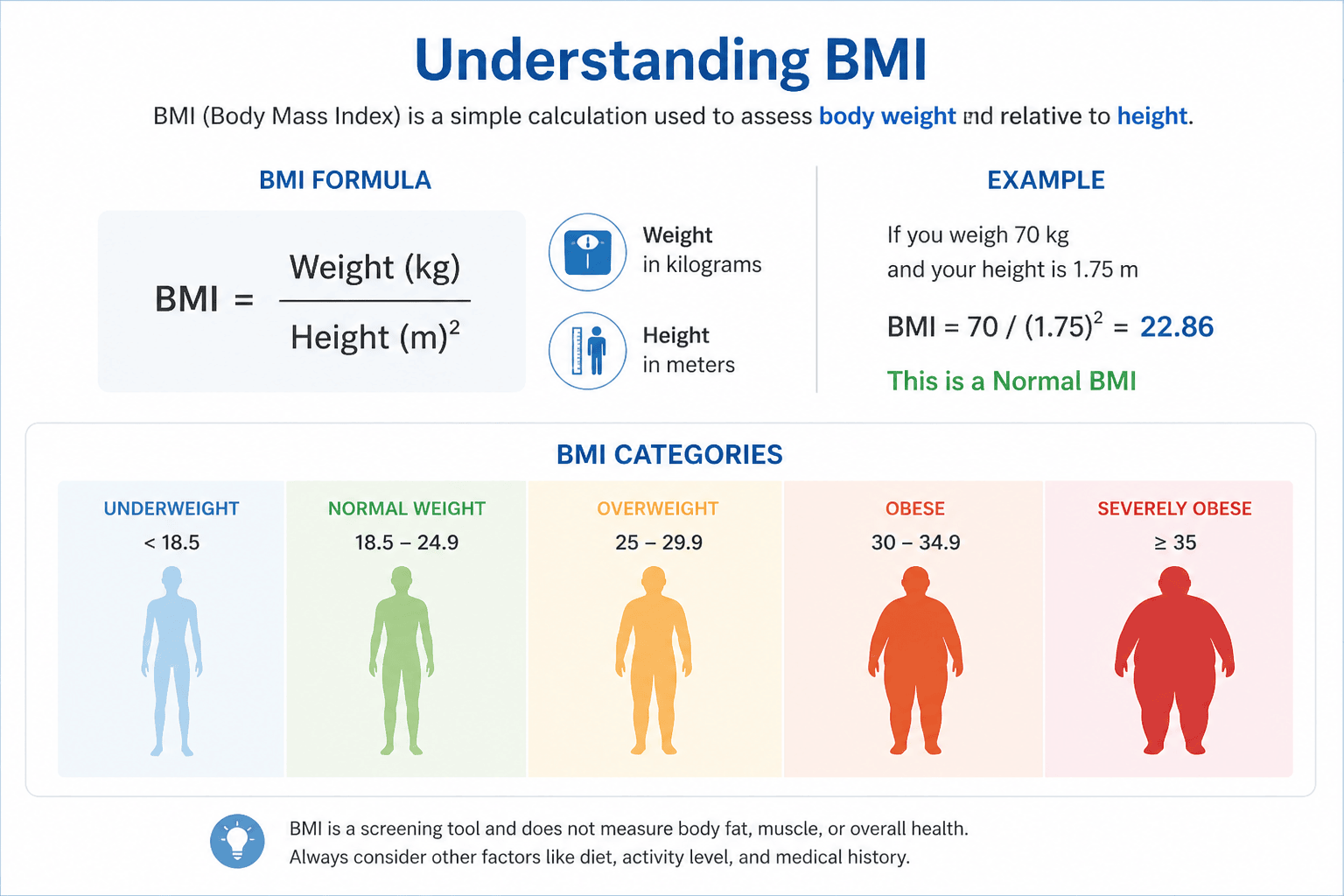
One of the most useful parts of BMI is that it turns a number into an easy-to-read category. Common adult BMI categories are:
Underweight
A BMI below 18.5 is commonly classified as underweight.
Normal Weight
A BMI from 18.5 to 24.9 is commonly considered within the normal or healthy range.
Overweight
A BMI from 25 to 29.9 is commonly classified as overweight.
Obesity Category
A BMI of 30 or above is commonly grouped under obesity. Some references break this into additional obesity classes for more detail.
These labels are meant to make the result easier to understand, but they should still be viewed with context. Two people can have the same BMI and very different body composition, activity levels, and health backgrounds.
What Is a Healthy BMI Range?
A commonly used healthy BMI range for adults is 18.5 to 24.9. This range is often used as a general reference for a typical weight relative to height.
Important Reminder
A healthy BMI range is a helpful benchmark, but it does not automatically capture body composition, fitness, lifestyle, or individual medical context.
This range can be useful as a general guide, but it should not be treated as the only sign of health. Your body composition, waist measurement, energy level, habits, and medical history can all add important context.
How to Read Your BMI Result
To make sense of your BMI result, start with the number, compare it with the category, then look at the bigger picture before making decisions.
Look at the Number
Start with the actual BMI value shown by your calculator or chart.
Match the Category
See whether the result falls into underweight, normal weight, overweight, or obesity.
Add Personal Context
Think about muscle mass, waist size, activity level, and other health indicators before drawing conclusions.
You can pair this guide with a BMI Calculator, Body Fat Calculator, Waist-to-Hip Ratio Calculator, and What Is BMR and How Does It Work? for a more complete understanding.
Real BMI Examples (So You Can Understand Your Result Better)
Many people search for specific BMI examples to understand how the number works in real life. Here are some common BMI calculations based on height and weight.
| Height | Weight | BMI | Category |
|---|---|---|---|
| 5'7" | 70 kg | ~24.2 | Normal Weight |
| 5'7" | 80 kg | ~27.6 | Overweight |
| 5'7" | 90 kg | ~31.1 | Obese |
These examples help you quickly compare your BMI and understand where your number falls.
What BMI Can Tell You
BMI can be useful because it offers a fast, low-effort snapshot of weight relative to height. It can help with:
Weight Category Awareness
It helps identify whether your result falls into a commonly used adult BMI category.
Goal Setting
It can help you think about whether weight loss, weight maintenance, or further assessment may be useful.
Basic Health Screening
It is commonly used in population health and general wellness screening because it is simple and quick.
BMI Limitations You Should Know
A big part of learning how accurate BMI is is understanding where it falls short.
It does not measure body fat directly
BMI uses only height and weight, so it cannot tell how much of your weight comes from fat or muscle.
It may misclassify muscular individuals
Someone with high lean mass may have a high BMI without having excess body fat.
It does not show fat distribution
Where body fat is stored also matters, and BMI does not account for this.
It is not a full health assessment
Blood pressure, fitness, diet, sleep, waist size, and medical history can all matter alongside BMI.
Why Your BMI Might Be High But You’re Not Fat
One of the most common questions is why someone can have a high BMI but still look lean or fit.
Muscle Mass
Muscle weighs more than fat, so athletic individuals often have a higher BMI.
Body Composition
BMI does not distinguish between fat and lean tissue.
Bone Density
Some people naturally have heavier bone structure.
Fitness Level
Active individuals may fall into “overweight” BMI categories but still be healthy.
This is why BMI should always be combined with other measurements like body fat percentage and waist size.
What Is a Healthy Weight for Your Height?
Many people want to know their ideal weight based on height, not just BMI.
| Height | Healthy Weight Range |
|---|---|
| 5'5" | 50 – 68 kg |
| 5'7" | 54 – 72 kg |
| 5'9" | 58 – 77 kg |
This range is based on a BMI between 18.5 and 24.9.
How to Lower Your BMI Safely
If your BMI is above the healthy range, gradual changes are more effective than quick fixes.
Adjust Your Calories
Focus on sustainable calorie balance instead of extreme dieting.
Increase Activity
Combine strength training and cardio for better results.
Track Progress
Use multiple indicators like weight, waist size, and energy levels.
BMI vs Other Health Measurements
BMI
Simple and fast but limited in detail.
Body Fat %
More accurate for measuring fat levels.
Waist Ratio
Better indicator of fat distribution.
Using multiple tools gives a more complete understanding of your health.
What to Do After Getting a BMI Result
Once you know your BMI, the best next step is to use the result as a starting point rather than a final judgment.
Check Waist and Body Fat Measures
These can add more context than BMI alone, especially for body composition awareness.
Review Calorie and Metabolism Tools
Learning about BMR and calorie needs can help if your goal involves weight change.
Focus on Trends, Not Panic
A single BMI result should not cause fear. It is more useful as a guide for informed next steps.
Use Multiple Indicators
Body weight, waist size, body fat, habits, and overall health all matter together.
Helpful Tools for Understanding Your BMI Result
Disclosure: This section may contain affiliate links. If you buy through these links, LifeToolSuit may earn a small commission at no extra cost to you. These tools are optional and are meant to help you track your progress more clearly.
BMI gives you a quick starting point, but it does not show the full picture. Simple tools like a scale, measuring tape, food scale, and fitness tracker can help you understand your weight, waist size, eating habits, and daily activity more clearly.
Digital Body Weight Scale
A basic digital scale can help you track weight trends over time instead of relying on one BMI result.
View on AmazonSoft Measuring Tape
Waist size can add useful context because BMI does not show where body fat is stored.
View on AmazonDigital Food Scale
A food scale can help you understand portions more accurately if your goal is weight loss or weight maintenance.
View on AmazonFitness Tracker
A fitness tracker can help monitor steps, activity, and consistency, which are useful when trying to lower BMI gradually.
View on AmazonBest simple setup
If you only want the essentials, start with a digital scale and a soft measuring tape. That gives you both weight and waist-size context, which is more helpful than BMI alone.
Simple Takeaway
- Know your BMI number.
- Match it to the correct BMI category.
- Understand that BMI is a screening tool, not a diagnosis.
- Look at body composition, waist size, and health habits for more context.
- Use your result to guide smarter next steps, not self-judgment.
Frequently Asked Questions
What do BMI results mean?
BMI results place your body mass index into a general category such as underweight, normal weight, overweight, or obesity. It is a screening tool that helps assess weight relative to height, but it does not directly measure body fat or diagnose health conditions.
What is a healthy BMI range?
A commonly used healthy BMI range for adults is 18.5 to 24.9. This range is often used as a general reference, though individual health context, body composition, and lifestyle still matter.
How accurate is BMI?
BMI is useful as a quick screening tool, but it has limitations. It does not distinguish muscle from fat, and it does not directly measure body composition, fat distribution, or fitness level.
Can BMI tell if I am healthy?
BMI alone cannot tell if someone is healthy. It is better used as one part of a broader picture that may include waist size, body fat percentage, blood pressure, blood markers, lifestyle habits, and medical history.
What should I do after getting my BMI result?
Use your BMI result as a starting point. You may want to explore related tools such as a body fat calculator, waist-to-hip ratio calculator, calorie needs calculator, or BMR guide for more context.
What is the difference between BMI and body fat percentage?
BMI uses height and weight to place you into a category, while body fat percentage tries to estimate how much of your body weight comes from fat. Learn more with our Body Fat Calculator.
Does BMI help with weight loss planning?
BMI can help with awareness, but calorie needs and metabolism matter too. For that, it also helps to read What Is BMR and How Does It Work? and use a Calorie Needs Calculator.
Is a BMI of 20 good?
A BMI of 20 is generally within the healthy range and is considered normal weight for most adults.
Is a BMI of 25 bad?
A BMI of 25 is at the start of the overweight category, but it does not automatically mean poor health.
Is a BMI of 30 dangerous?
A BMI of 30 falls into the obesity category and may increase health risks, especially over time.
Helpful Health Guides
BMI is just one part of understanding your body. These guides can help you go deeper into calories, metabolism, body fat, and overall health.
Related Calculators
Important Note
This guide is for educational purposes only and is not medical advice. BMI is a screening tool and does not diagnose body fat level, disease risk, or overall health on its own. For individual concerns, a qualified professional can provide more personalized guidance.